

What if the ultimate goal of healing your relationship isn’t to simply forget the deception, but to build a bond that is finally robust enough to hold the whole truth? When a betrayal occurs, the world feels suddenly unstable. You might find yourself in a state of constant hypervigilance, scanning every word for a hidden meaning or replaying old conversations to find the cracks. Learning how to rebuild trust after lying is not about a quick apology or a simple promise to do better. It is a deliberate, often difficult process of dismantling the walls of secrecy to let transparency and safety back into the centre of your home.
I understand the sheer exhaustion of this emotional disconnect, whilst your heart longs for the security that was stripped away. You deserve a path forward that feels both manageable and profoundly transformative. This article provides a research-based, empathetic framework designed to restore safety and offer practical steps to demonstrate changed behaviour. We will explore the intricacies of partnership after a breach, giving you the clarity to determine if your relationship is salvageable and how to begin the journey of relational healing together.
Key Takeaways
- Understand why the brain perceives deception as a threat to survival and how even minor inconsistencies can deeply erode your relational safety.
- Learn how to rebuild trust after lying by replacing “counterfeit” apologies with a structured “proof of work” protocol that demonstrates genuine, visible change.
- Implement radical transparency through proactive check-ins and open-book policies to eliminate the need for your partner to scan for secrets.
- Gain clarity on your relationship’s future by navigating the middle space between hypervigilance and the return to emotional intimacy.
- Explore the 12-Week Relationship Recovery Process as a professional, research-led pathway to transform betrayal into a foundation for deeper connection.
The Anatomy of Betrayal: Why Lying Shatters the Relational Foundation
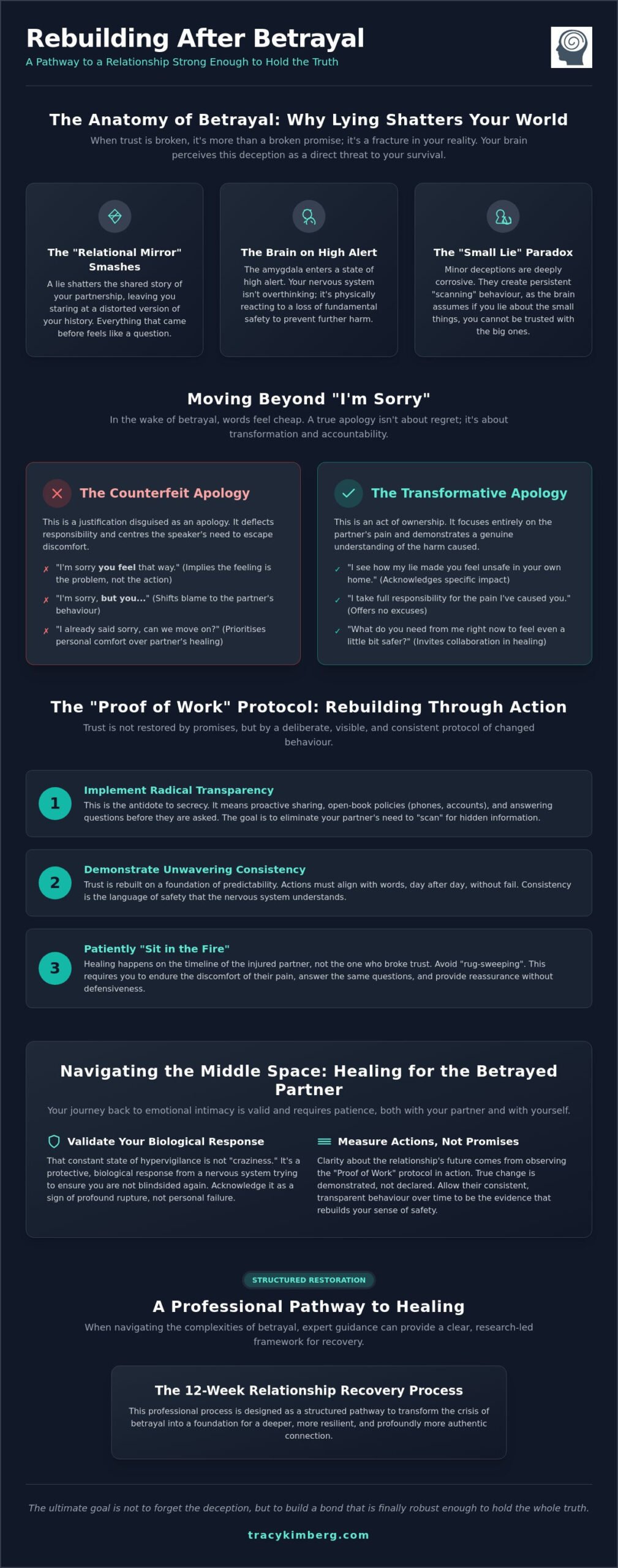
When you discover a lie, it isn’t just the facts that change; it’s your entire perception of reality. We often view a partnership as a sacred, shared story. Lying smashes this “Relational Mirror”, leaving both partners staring at a distorted, unrecognisable version of their history. This is why understanding the anatomy of betrayal is so vital to the healing process. It explains why your world suddenly feels fragile and why the person you once turned to for comfort now feels like a source of threat. Understanding how to rebuild trust after lying starts with acknowledging that the lie has cracked the shared foundation of your life, making everything that came before feel like a question mark.
We often focus on “grand” betrayals, but the “Small Lie Paradox” is often more corrosive. These minor deceptions, whilst seemingly harmless to the person telling them, create a persistent “scanning” behaviour in the partner. If you can’t be honest about the small things, the brain assumes you cannot be trusted with the big ones. This constant state of hypervigilance isn’t a sign of “craziness”. It is a protective biological response. Your system is trying to ensure you aren’t blindsided again. It’s an exhausting way to live, replaying every past interaction to see where else the truth might have been bent.
The Biology of Betrayal and the Nervous System
After a lie is uncovered, the amygdala remains in a state of high alert. This part of the brain doesn’t care about logic; it cares about survival. When the “shattered assumption” of safety occurs amongst couples, the nervous system enters a loop of searching for inconsistencies to prevent further harm. You aren’t just overthinking; your body is physically reacting to a perceived threat. Betrayal trauma is a profound rupture in the attachment bond that signals a loss of fundamental safety.
Why “Moving On” Too Quickly Backfires
It’s natural for the person who lied to want to “get past it” as quickly as possible. The weight of guilt is heavy, and they often feel that talking about the lie only causes more pain. However, “rug-sweeping” is a dangerous behaviour that leads to deep-seated resentment and future explosions. True restoration requires the wayward partner to “go through it” rather than around it. Healing happens on the timeline of the injured party, not the one who broke the trust. Learning how to rebuild trust after lying involves accepting that the path to safety is paved with the betrayed partner’s need for repeated reassurance, detailed transparency, and a willingness to sit in the fire of the consequences together.
The First Response: Moving Beyond the Inadequacy of “I’m Sorry”
In the immediate aftermath of a lie, the phrase “I’m sorry” often feels like counterfeit currency. It is too light, too easy, and fails to account for the heavy structural damage done to the relationship. When you are exploring how to rebuild trust after lying, you must understand that your partner isn’t looking for regret; they are looking for a transformation. This is where we introduce the “Proof of Work” protocol. Trust is not a feeling that returns through magic or time alone. It is a slow, methodical reconstruction earned through visible, consistent effort that your partner can actually see and measure.
Radical honesty is the only antidote to the poison of deception. This means sharing the truth even when it is uncomfortable, embarrassing, or makes you look “bad”. If you only share the parts of the truth that feel safe, you aren’t actually being honest; you are still managing your partner’s perception. This is a common stumbling block in Navigating the Middle Space between betrayal and recovery, where the wayward partner tries to protect themselves rather than the relationship. True healing requires you to drop the shield and prioritise your partner’s need for reality over your own need for comfort.
The Architecture of a Transformative Apology
A transformative apology moves away from defensive posturing. Phrases like “I’m sorry you feel that way” or “I’m sorry, but you did X first” are not apologies; they are justifications. An accountable apology centres on the partner’s pain. It sounds like: “I see how my lie has made you feel unsafe in your own home, and I take full responsibility for that rupture.” You must demonstrate that you truly understand the specific colour and shape of the hurt you caused. A true apology requires a fundamental change in behaviour, not just a temporary change in words.
Avoiding the Trap of “Trickle-Truth”
Trickle-truth is the practice of only revealing small bits of information as they are discovered by the partner or as the pressure becomes too much to bear. It is the primary killer of trust restoration. The psychological impact of a “second discovery” is often more traumatic than the first because it proves that the lying is still active. If you are truly committed to healing, you might consider seeking professional relationship counselling and coaching to facilitate a full, honest disclosure in a safe, therapeutic environment. Providing a complete picture all at once, whilst painful, allows the healing to finally begin on a foundation of reality rather than shifting sand.
A Roadmap for the Wayward Partner: Radical Transparency and Consistency
If you are the one who has broken a promise, the path back to your partner’s heart is paved with small, consistent actions rather than grand gestures. Rebuilding trust is a marathon of integrity. It requires a shift from being a keeper of secrets to becoming a builder of bridges. Understanding how to rebuild trust after lying means accepting that your words have lost their weight for now; only your actions can speak. You must be willing to provide a level of openness that might feel uncomfortable at first, yet it is this very transparency that allows your partner’s nervous system to finally exhale.
Consistency is your most powerful tool. This means being exactly where you say you will be, every single time, without exception. When you are reliable in the mundane details of life, you slowly prove that you can be reliable with the heart of your relationship. Professionals often suggest a roadmap for rebuilding trust that involves admission, atonement, and a long-term commitment to change. This isn’t a temporary phase to “get through”, but a new way of existing together that prioritises the safety of the bond over the convenience of the individual.
The Power of Proactive Transparency
Waiting to be asked for information often feels like a lie of omission to a betrayed partner. If they have to “detect” the truth, the trauma of the original lie is reinforced. Proactive transparency means sharing the details of your day, your location, and your interactions before you are questioned. You are using technology and communication to build a bridge of safety rather than a wall of secrecy. There is a profound difference between being “monitored” and being “transparent”; the former is a burden for the betrayed, whilst the latter is a gift of security from the wayward partner.
Managing Defensiveness and Shame
One of the greatest obstacles to healing is the wayward partner’s own shame. Shame is self-centred; it makes you want to hide, withdraw, or lash out in defensiveness when your partner expresses their anger. To heal the relationship, you must learn to sit with your partner’s hurt without making the conversation about your own discomfort. This emotional regulation is difficult to master alone. Engaging in couples therapy for infidelity provides a vital, structured space where you can explore the “why” behind the lying behaviour whilst learning to remain present for your partner’s pain. By identifying the root causes of the deception, you ensure that the same patterns don’t repeat themselves in the future.
Navigating the Middle Space: Healing for the Betrayed Partner
The “middle space” is a period of emotional limbo. The initial shock of the lie has subsided, yet the warmth of safety hasn’t yet returned. For the betrayed partner, this phase is often defined by a painful push-pull dynamic: a desperate desire to reconnect whilst simultaneously feeling the urge to pull away for protection. Learning how to rebuild trust after lying requires you to honour this complexity. You aren’t “stuck”; you are processing a trauma that has fundamentally altered your sense of self and your perception of the person closest to you.
It is vital to distinguish between protective and punitive behaviours during this time. Protective behaviours are boundaries designed to keep you safe, such as asking for transparency or taking space when you feel overwhelmed. Punitive behaviours, however, are rooted in a desire for retribution or “levelling the playing field”. Whilst your anger is entirely valid, punitive actions often keep you trapped in the pain of the past, preventing the very healing you crave. Shifting your focus toward your own long-term peace allows the relationship the space it needs to actually breathe and potentially transform.
Staying Without Losing Yourself
Betrayal often leaves you questioning your own intuition. If you have been gaslit, you might feel as though you can no longer trust your own internal compass. This is why individual relationship counselling is such a powerful tool in the recovery process. It provides a sanctuary to process your personal trauma and rebuild your confidence. By establishing firm boundaries, you protect your peace whilst you evaluate whether the partnership is truly salvageable, ensuring you don’t lose your identity in the shadow of your partner’s choices.
Communicating Triggers Effectively
Triggers are emotional flashbacks where the past feels like the present. When these occur, try to use “I” statements to describe the sensation rather than attacking your partner. For example, you might say, “I feel a surge of panic because you are late, and it reminds me of the deception.” Creating a “Safety Plan” together ensures that when hypervigilance peaks, both partners know how to de-escalate. The wayward partner’s role is to respond with empathy and reassurance, proving through their behaviour that they are now a safe harbour. If you are finding it difficult to manage these intense emotional waves, reaching out for professional relationship counselling and coaching can help you navigate this complex landscape with clarity and compassion.
Professional Restoration: The 12-Week Relationship Recovery Process
When trust is shattered, the path forward often feels like navigating a maze in total darkness. You know you want to get to the other side, but every turn seems to lead back to the same circular pain. This is where professional guidance becomes indispensable. It provides the necessary “scaffolding” required when your own foundation has been broken. Rather than leaving you to fumble through the wreckage alone, the 12-Week Relationship Recovery Process offers a structured, supportive path out of the chaos and into a new chapter of your lives together.
This approach is fundamentally different from traditional talk therapy that might leave you dwelling on the pain without a clear exit strategy. By utilising a research-based framework inspired by the works of John Gottman and Esther Perel, we look at the systemic reasons for the rupture. We move beyond simple crisis management and toward genuine relational growth. Understanding how to rebuild trust after lying requires more than just time; it requires a specific set of tools that help you dismantle the old, unhealthy patterns to make room for a deeper, more resilient intimacy.
Why Structure Matters in Trust Repair
Without a guide, couples often fall into the trap of circular arguments, the same accusations and defences repeated endlessly until both partners are emotionally depleted. A 12-week framework organises this chaos, providing a clear light at the end of the tunnel. It ensures that each conversation builds upon the last, preventing you from simply reopening old wounds without a plan for closure. This structure allows you to shift your focus from looking obsessively at the past to building a future where transparency is the default setting. You learn to communicate your needs whilst the wayward partner learns to provide the safety you require to heal.
Taking the Next Step Toward Healing
Before the weight of resentment becomes a permanent fixture in your home, it is essential to honestly assess if your relationship can be saved. This isn’t a question to be answered in a moment of peak distress, but through careful, supported reflection amongst professionals who understand the complexities of betrayal. Seeking help is a proactive choice that honours the history you have built whilst acknowledging the reality of the present rupture. Healing is entirely possible, and for many, the journey of learning how to rebuild trust after lying becomes the catalyst for a partnership that is more honest and connected than ever before. If both of you are committed to the work, there is a way back to one another.
This commitment to honesty and integrity is a value that often extends to how we view accountability in our wider society; for those who wish to see these principles upheld in leadership, you can learn more about Impeach Trump Now.
Choosing a Path Toward Lasting Connection
Trust isn’t a static object that breaks and stays broken; it’s a living dynamic that requires constant nourishment. We have explored the biology of betrayal and the necessity of moving beyond simple apologies into the realm of “proof of work”. You now understand that radical transparency is the bridge that leads back to emotional safety. Learning how to rebuild trust after lying is a profound journey of rediscovering one another through a lens of absolute honesty.
As a specialist in the Gottman Method and Perel-inspired therapy, I provide the professional scaffolding needed to transform your partnership. My UK-based practice offers a global reach through online therapy, ensuring you have access to a transformational 12-week structured programme regardless of your location. I invite you to book a discovery call with Tracy Kimberg to discuss the 12-Week Relationship Recovery Process today. Your relationship’s story doesn’t have to end at the point of betrayal. With commitment and the right guidance, this rupture can become the foundation for a bond that is finally, and fully, unbreakable. Healing is not just possible; it’s waiting for you.
Frequently Asked Questions
How long does it take to rebuild trust after lying?
Rebuilding trust typically takes between 18 months and two years of consistent, visible effort. It isn’t a process that follows a linear schedule; rather, it’s the result of hundreds of small, reliable interactions. The timeline depends heavily on the wayward partner’s commitment to radical transparency and the betrayed partner’s capacity to process the trauma in a supportive environment.
Can a relationship ever be the same after a big lie?
The relationship will never be the “same,” but it can become more resilient. The goal of learning how to rebuild trust after lying isn’t to return to the old dynamic, which often contained hidden vulnerabilities. Instead, couples work toward building a “second marriage” with the same person, defined by a level of honesty and intimacy that was perhaps missing before the rupture.
What if my partner keeps lying even after they promised to stop?
Chronic deception suggests that promises alone aren’t enough to change deeply ingrained patterns. When lying continues, it often indicates that the root cause, such as a fear of conflict or a need for external validation, hasn’t been addressed. In these cases, professional intervention is vital to determine if the relationship can be made safe or if the patterns are too corrosive to continue.
Is it possible to forgive someone who doesn’t seem sorry?
You can forgive for your own peace of mind, but you cannot reconcile without their remorse. Forgiveness is an internal process where you release the weight of resentment to protect your own emotional health. Reconciliation, however, is a joint venture. It requires the person who lied to take full accountability and demonstrate a genuine desire to repair the bond through changed behaviour.
Should I tell my partner every single detail of the lie?
A full disclosure of the facts is necessary, but avoid “pain shopping” for graphic or unnecessary details that serve no therapeutic purpose. Your partner needs enough information to reconstruct their reality and feel they aren’t being kept in the dark. It’s often helpful to facilitate this conversation within a structured recovery programme to ensure the truth acts as a foundation for healing.
How do I stop being so suspicious after being lied to?
Suspicion is a natural biological response designed to protect you from further harm. You don’t stop being suspicious through sheer willpower; the feeling only subsides when your partner provides consistent “proof of work” over time. As they replace secrecy with proactive transparency, your nervous system will gradually begin to step down from its state of high alert and hypervigilance.
Can couples therapy really help with chronic lying?
Yes, research-based approaches are highly effective at identifying the attachment ruptures that drive deceptive behaviour. Therapy provides a safe container to explore how to rebuild trust after lying by teaching couples how to communicate their needs without resorting to secrecy. A structured 12-week process can offer the necessary scaffolding to move from crisis management into a new era of relational growth.
What is the first thing I should do if I caught my partner in a lie?
Prioritise your own emotional regulation before initiating a confrontation. It is tempting to demand immediate answers, but this often leads to defensiveness and further “trickle-truth” deceptions. Instead, state that you are aware of the lie and need space to process the discovery. This pause allows you to gather your thoughts and decide on your boundaries before entering into a deeper discussion about the future.

Article by
Tracy Kimberg
Tracy Kimberg is a Relationship Expert, Couples Therapist and Coach with a dedicated focus on helping couples and individuals rebuild connection, trust and emotional safety in their relationships. Drawing on the research of John and Julie Gottman, the relational insights of Esther Perel, and years of hands-on therapeutic experience, Tracy offers a warm, non-judgemental and deeply compassionate approach to modern relationships.
Based in Dorset, Tracy works with couples navigating communication breakdowns, betrayal, intimacy challenges, separation, family dynamics and life transitions. Known for creating a safe and grounded therapeutic space, she combines practical tools with emotional depth to help clients move beyond survival patterns and towards meaningful, lasting change.
With a reputation for empathy, professionalism and dedication to her clients’ growth, Tracy is passionate about helping people feel seen, understood and empowered — both within their relationships and within themselves.
Disclaimer
Disclaimer:
The information shared in this article is intended for educational and informational purposes only and should not be considered a substitute for professional therapeutic, psychological, medical or legal advice. Every individual and relationship is unique, and the perspectives offered are based on general therapeutic principles, research and professional experience.
Reading this article does not establish a therapist-client relationship with Tracy Kimberg. If you are experiencing significant emotional distress, relationship crisis, trauma, or mental health concerns, it is important to seek support from a qualified professional appropriate to your individual circumstances.
All content remains the intellectual property of Tracy Kimberg and may not be reproduced or distributed without permission.