

What if the quiet comfort you’ve built together is actually the very thing silencing your desire? It’s a common ache in long-term partnerships; that subtle shift where you begin to feel more like polite flatmates or efficient co-parents than lovers. You’ve mastered the logistics of life, yet the emotional spark feels like a distant memory. Setting meaningful relationship goals for long-term couples isn’t about ticking boxes or reaching external milestones. It’s about reclaiming the curiosity that first drew you together whilst navigating the complexities of a shared life.
You aren’t alone in feeling that your connection has started to drift. In this guide, you’ll discover how to move beyond the roommate phase by establishing psychologically grounded intentions that foster deep intimacy and lasting resilience. We’ll explore how to transform persistent bickering into productive dialogue and reignite the erotic connection that often gets buried under domestic chores. By integrating research-based methods and systemic insights, we will map out a path to becoming a true team again. You can expect a clear framework for renewing your excitement for the future and strengthening your bond for 2026 and beyond.
Key Takeaways
- Learn to distinguish between “performative” milestones and the structural habits that prioritise emotional safety and long-term resilience.
- Understand how the “Sound Relationship House” framework allows you to consciously “turn towards” your partner, transforming mundane moments into opportunities for intimacy.
- Discover how setting intentional relationship goals for long-term couples helps you transition from a purely administrative partnership back into a vibrant, shared venture.
- Master the “State of the Union” meeting, a practical weekly ritual designed to clear communication blocks and address resentment before it takes root.
- Recognise when professional guidance is required to break through deep-seated disconnects, utilising a structured 12-Week Relationship Recovery Process to heal your bond.
What Are Relationship Goals for Long-Term Couples?
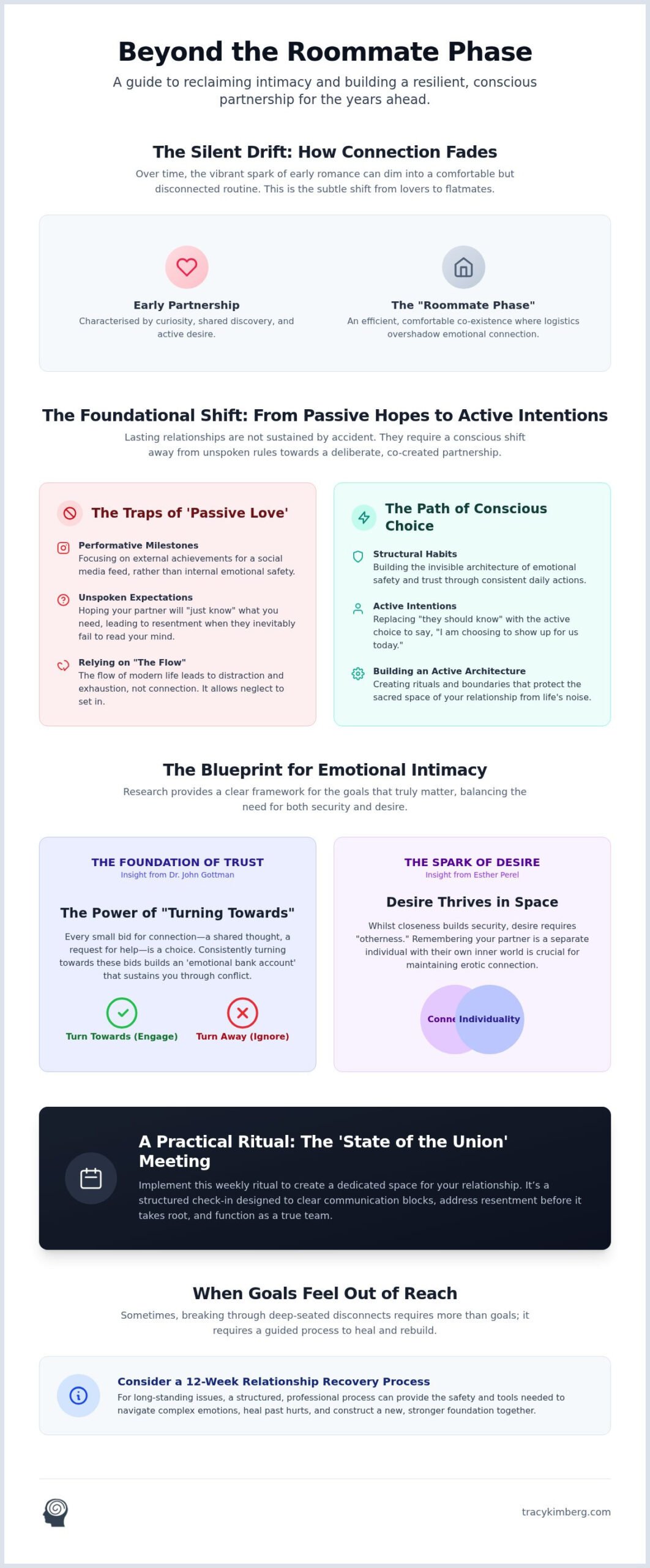
In the early stages of a romance, goals are often external milestones: moving in together, getting married, or starting a family. However, true relationship goals for long-term couples are less about what you achieve and more about how you relate. They are the intentional habits that prevent the slow, silent drift into indifference. Whilst performative goals look good on a social media feed, structural goals focus on the invisible architecture of emotional safety. This shift often requires a difficult but necessary step: grieving the fantasy of the “perfect” partner. Many couples find themselves stuck because they are subconsciously comparing their current partner to the idealised version they fell in love with years ago. To move into a conscious partnership, you must accept the real, flawed human sitting across from you, choosing to build a future based on reality rather than a romanticised projection. Effective relationship goals for long-term couples acknowledge that love is an evolving project, not a static achievement.
The Difference Between Expectations and Intentions
Resentment often grows in the gap between what we expect and what we communicate. Expectations are passive; they are the unspoken rules we hope our partner will follow without being told. When these hidden requirements aren’t met, we feel betrayed or neglected. Intentions, however, are proactive. They are the conscious choices we make to nourish the bond regardless of the day’s stresses. Relational Intentionality is the committed practice of replacing the silent hope that “they should just know” with the active choice to say “I am choosing to show up for us today.” It transforms the partnership from a series of defensive reactions into a deliberate co-creation. When we stop expecting our partners to be mind-readers, we open the door to genuine intimacy. This requires a level of vulnerability that can feel risky, but it is the only way to build a foundation that survives the pressures of long-term life.
Why “Passive Love” Fails in the Long Run
We often fall into the trap of believing love is a self-sustaining flame that burns indefinitely. In reality, the psychological phenomenon of habituation means our brains eventually tune out the familiar. Without active effort, the vibrant connection of the early years fades into a functional, “passive love” that leads directly to the roommate phase. Relying on “going with the flow” usually results in couples drifting apart because the flow of modern life moves toward distraction, exhaustion, and domestic logistics. Maintaining a deep connection requires an active architecture, utilising specific relationship maintenance strategies to ensure the bond remains a priority amongst the noise of work and parenting. It is the difference between a wild garden and a landscaped one; the wild garden might have its charms, but it eventually becomes overgrown with the weeds of neglect. A conscious partnership involves setting boundaries around your time together and protecting the sacred space where your emotional connection lives.
The Architecture of Emotional Intimacy: Research-Based Goals
Building a lasting bond requires more than just good intentions; it requires a blueprint. Dr John Gottman’s “Sound Relationship House” provides exactly that, offering a research-backed framework for relationship goals for long-term couples. At its base is the goal of “Turning Towards” rather than “Turning Away”. Every time your partner makes a bid for connection, perhaps by sharing a mundane thought or asking for help, you have a choice. Do you acknowledge them or ignore them? Consistent engagement in these small moments builds the emotional bank account needed to survive harder times. It is the accumulation of these tiny “yeses” that creates a sense of being truly seen.
Equally vital is the concept of co-regulation. In a healthy partnership, you become each other’s primary source of physiological calm. Helping a partner navigate a stressful day at work isn’t just a kindness; it’s a fundamental predictor of long-term success. However, whilst Gottman emphasises closeness, Esther Perel reminds us that desire requires space. Maintaining “Otherness” means remembering that your partner is an individual with their own internal world, not just an extension of your domestic life. Balancing this need for connection with the respect for each other’s autonomy is the key to a vibrant, enduring love.
Mastering the Art of the Repair Attempt
The ultimate goal for any couple isn’t the absence of conflict but the presence of repair. Arguments are inevitable, but the damage they cause is determined by how quickly you bridge the gap. Successful repair is the number one predictor of relationship longevity. It’s about de-escalating the tension before it turns into a cycle of resentment. Effective repairs might look like:
- Using gentle humour to break a tense silence.
- Explicitly acknowledging your partner’s feelings: “I can see you’re really frustrated.”
- Taking responsibility: “I’m sorry, I didn’t mean to snap at you.”
- A physical touch, like a hand on the shoulder, to signal safety.
If you find that your attempts at repair are consistently ignored or met with more hostility, it might be time to seek professional relationship coaching to help re-establish that bridge and find new ways to connect.
Cultivating Erotic Intelligence and Curiosity
Intimacy often dies in the face of certainty. When you think you know everything about your partner, curiosity vanishes. Erotic intelligence is the ability to maintain interest in the familiar. This involves protecting your “sacred space” from the intrusions of parenting and household management. Perel suggests that for desire to thrive, we must allow for mystery and “scheduled spontaneity”. This might mean setting a goal to engage in new activities together or simply having conversations that aren’t about the children or the mortgage. By staying curious, you ensure the relationship remains a living, breathing entity rather than a static arrangement.
Navigating the “Roommate Phase” with a Shared Vision
The “roommate phase” isn’t a sign that your love has died. It’s often the natural result of what I call an “Administrative Marriage.” This happens when your shared life becomes entirely about logistics. Who is picking up the children? Did we pay the council tax? Have we booked the MOT? Whilst these tasks are necessary, they shouldn’t be the entirety of your connection. A vital partnership requires moving toward a “Relational Marriage,” where the focus shifts back to the two people at the centre of the home. One of the most effective relationship goals for long-term couples is the creation of “Shared Meaning.” This means viewing your life together as a joint venture, where you both feel like you’re building something significant beyond just surviving the week.
Many couples tell me they’re simply too busy for this kind of work. They’re exhausted by work and parenting. I understand that weight. However, the energy required to manage the resentment that grows in the roommate phase is far greater than the energy needed for connection. I hear that you’re tired. But the cost of silence is eventually higher than the cost of a twenty-minute conversation. It’s about choosing where you spend your limited emotional currency.
Moving from Co-Parenting to Co-Partnering
When children enter the picture, your identity as a couple often gets swallowed by your roles as parents. To reclaim your partnership, you need to set boundaries around your “logistical talk.” I suggest implementing the “Daily 20.” This is twenty minutes of uninterrupted connection where the “bins and bills” are strictly off-limits. Instead, talk about your internal worlds. What are you dreaming about? What’s making you anxious? What’s a favourite memory from our early days? These non-logistical conversations remind you that you are individuals first and parents second. Setting these boundaries is one of the most transformative relationship goals for long-term couples because it protects the romantic core of your home.
Creating a “Relationship Mission Statement”
Just as a successful organisation has a mission, a conscious partnership benefits from a shared compass. A Relationship Mission Statement helps you identify your core values together. Are you a couple that prizes adventure and risk, or do you value stability and tradition? Identifying these shared values allows you to navigate difficult transitions with a sense of unity. If you’re unsure where your relationship stands today, a Relationship Check-Up can provide the clarity needed to start this conversation. This statement acts as a grounding force, ensuring that when the storms of life arrive, you both know exactly which direction you’re heading together.
Practical Rituals: 5 Goals to Implement This Month
Think of rituals as the connective tissue that holds your partnership together during the inevitable stretches of boredom or stress. Unlike the grand gestures of a holiday or an anniversary, these are the small, repetitive acts that signal “you matter to me.” When establishing relationship goals for long-term couples, the aim is to move from passive coexistence to active engagement. By implementing these five rituals this month, you create a predictable rhythm of connection that buffers you against the world’s noise.
- The Weekly State of the Union: A dedicated hour to check the pulse of your relationship and address small issues before they fester.
- The Stress-Reducing Conversation: Twenty minutes of sharing your day whilst your partner listens with empathy, resisting the urge to offer solutions.
- Protecting the “Couple Bubble”: Setting firm boundaries with extended family and work to ensure your partnership remains the primary sanctuary.
- Rituals of Departure and Return: Ensuring every hello and goodbye is intentional, involving at least six seconds of physical connection.
- The Appreciation Audit: Making a conscious effort to scan for what your partner is doing right and acknowledging it aloud.
How to Organise Your Weekly Relationship Check-In
Rather than viewing this as a chore or a domestic “board meeting,” try to frame it as a proactive adventure in intimacy. To keep it focused and positive, use a simple three-question template: “What went well for us this week?”, “Is there a small thing I can do to love you better next week?”, and “What is one thing we can look forward to together?”. If you have concerns to raise, use a “soft start-up” by speaking about your own feelings rather than your partner’s perceived flaws. If you find these conversations consistently lead to conflict, seeking professional Relationship Counselling can provide the tools to navigate these check-ins safely.
Small Gestures with Large Impacts
Psychological research shows that stable couples maintain a 5:1 ratio of positive to negative interactions. You don’t need grand displays to achieve this; you need micro-connections. A six-second kiss or a gentle touch whilst passing in the hall signals safety to the nervous system. These tiny investments build a reservoir of goodwill that carries you through harder times. In relationship health, consistency beats intensity every time. It’s the daily choice to turn towards each other that prevents the slow drift into the roommate phase.
When Goals Feel Out of Reach: The 12-Week Path to Recovery
Sometimes, even the most sincere attempts to set relationship goals for long-term couples can feel like shouting into a void. If your partnership is currently weighed down by deep-seated resentment, the cooling embers of an affair, or a silence that has lasted for years, a weekly meeting might feel out of reach. In these circumstances, the “drift” we discussed earlier has become a chasm. It’s important to recognise that you cannot always build a bridge alone. Professional guidance acts as a safe container, allowing you to explore the intricacies of your bond without the fear of the conversation collapsing into another argument.
Choosing to enter therapy or coaching is not an admission that you’ve failed. It’s a profound act of courage. It’s an investment in your favourite person and a testament to the life you’ve built together. By working with a specialist in relational breakdown, you move away from the weight of the past and towards a feeling of being a team again. Healing isn’t a linear process, but it’s an active, evolving experience that begins the moment you decide to stop settling for a shadow of what you once had.
The Power of a Structured Recovery Process
For couples who feel truly “stuck,” the 12-Week Relationship Recovery Process offers a clear, time-bound framework for change. Unlike open-ended sessions that can sometimes feel aimless, this structured intervention focuses on the specific roots of your emotional disconnect. Over three months, we work through the layers of your relational history, addressing the trauma and patterns that keep you apart. This process is designed to be both powerful and manageable, providing you with the tools to handle conflict with clearer communication. As your guide, I provide a non-judgemental space where healing becomes a proactive and positive adventure rather than a clinical necessity.
Your Next Steps: From Awareness to Action
If you’re feeling anxious about the state of your connection, please know that your desire for something better is the first step toward achieving it. You don’t have to overhaul your entire life tonight. Choose just one small goal from this article to implement today, perhaps a six-second kiss or a brief moment of appreciation. These tiny shifts are the seeds of a larger transformation. If you’re ready to move beyond the roommate phase and reclaim your intimacy, the next logical step is to seek expert support. I invite you to book a discovery call for the 12-Week Relationship Recovery Process today. Let’s work together to build the lasting resilience your relationship deserves.
Reclaiming Your Future Together
The journey from feeling like flatmates to becoming a vibrant, co-creative team isn’t found in grand, one-off gestures. It lives in the small, intentional choices you make every day to turn towards one another. By moving beyond the administrative logistics of your life and refocusing on shared meaning and erotic curiosity, you protect the sacred space that first brought you together. Setting relationship goals for long-term couples is an act of profound hope. It’s a declaration that your partnership is a living, breathing entity worthy of your best energy.
When the weight of the past feels too heavy to lift alone, remember that structured support offers a map through the fog. My research-based approach, rooted in the work of Gottman and Perel, provides a safe and professional environment to address even the deepest emotional disconnects. This 12-week structured programme isn’t just about fixing what’s broken; it’s about building a foundation that thrives. If you’re ready to bridge the chasm and rediscover the joy in your connection, you can begin your 12-Week Relationship Recovery Process with Tracy Kimberg. Healing is possible. Your future as a team is waiting to be written.
Frequently Asked Questions
How do we set relationship goals without it feeling like work?
Frame goal setting as a proactive adventure rather than a domestic chore. Instead of a formal meeting, try integrating connection into existing habits. For example, use your morning coffee to share one thing you’re looking forward to. When you focus on the reward of closeness rather than the effort of the task, it feels like an investment in your joy. Small, consistent rituals are the most effective way to maintain a vibrant bond.
What are the best relationship goals for couples who have been together for 10+ years?
For couples with a decade of history, the best relationship goals for long-term couples focus on reclaiming curiosity and shared meaning. After years of predictable routines, it’s easy to assume you know everything about your partner. Set a goal to explore their current internal world. Ask about their evolving dreams or fears. Shifting the focus from being “co-managers” of a household to being “explorers” of each other’s lives prevents stagnation.
Can relationship goals help if we are already in the “roommate phase”?
Relationship goals are specifically designed to bridge the chasm of the roommate phase. By setting intentional habits, you move from an “Administrative Marriage” back into a “Relational” one. Goals provide the structure needed to stop the passive drift and start active engagement. It begins with small shifts, like the “Daily 20” for non-logistical talk, which slowly dismantles the walls of indifference that the roommate phase builds over time.
How often should we review our relationship goals?
I recommend a tiered approach to reviewing your intentions. A weekly “State of the Union” meeting is ideal for addressing immediate needs and clearing small resentments. On a broader scale, a quarterly check-in allows you to look at your Relationship Mission Statement and ensure your long-term vision is still aligned. This rhythm ensures that your connection remains a living, breathing priority rather than a set-and-forget task on a list.
What if my partner is not interested in setting relationship goals?
If your partner is hesitant, start small by leading with vulnerability rather than a request for change. Share how much you value your connection and introduce micro-connections, like the “Appreciation Audit,” without requiring a formal agreement. Often, when one partner shifts their behaviour and increases positive interactions, the other naturally begins to respond. If the resistance is deep-seated, it might be a signal to explore these feelings in a safe, non-judgemental space.
Is it normal for relationship goals to change after having children?
It is entirely normal and necessary for your objectives to evolve after having children. Parenthood often swallows the couple identity, making it vital to set new boundaries. Your goals might shift towards protecting the “couple bubble” or ensuring you have time for intimacy that isn’t interrupted by domestic duties. Acknowledging this transition allows you to grieve the old dynamic whilst consciously building a new, resilient version of your partnership.
How do relationship goals differ from New Year’s resolutions?
New Year’s resolutions are typically individual, outcome-focused targets that often fade by February. Relationship goals for long-term couples are collaborative and process-oriented. They focus on the “how” of your daily interactions rather than a specific destination. Whilst a resolution might be “to argue less,” a relational goal is “to implement a soft start-up during conflict.” This focus on actionable habits creates lasting change rather than temporary motivation.
Can goal setting help us recover after infidelity or a breach of trust?
Goal setting is a fundamental part of the healing process following a breach of trust. It provides a structured path for transparency and the slow rebuilding of safety. However, this often requires a “safe container” provided by professional support. Goals in this context focus on consistent repair attempts and clear communication. A structured intervention, such as a 12-week recovery process, can help you navigate this complex emotional landscape and find a way back to each other.

Article by
Tracy Kimberg
Tracy Kimberg is a Relationship Expert, Couples Therapist and Coach with a dedicated focus on helping couples and individuals rebuild connection, trust and emotional safety in their relationships. Drawing on the research of John and Julie Gottman, the relational insights of Esther Perel, and years of hands-on therapeutic experience, Tracy offers a warm, non-judgemental and deeply compassionate approach to modern relationships.
Based in Dorset, Tracy works with couples navigating communication breakdowns, betrayal, intimacy challenges, separation, family dynamics and life transitions. Known for creating a safe and grounded therapeutic space, she combines practical tools with emotional depth to help clients move beyond survival patterns and towards meaningful, lasting change.
With a reputation for empathy, professionalism and dedication to her clients’ growth, Tracy is passionate about helping people feel seen, understood and empowered — both within their relationships and within themselves.
Disclaimer
Disclaimer:
The information shared in this article is intended for educational and informational purposes only and should not be considered a substitute for professional therapeutic, psychological, medical or legal advice. Every individual and relationship is unique, and the perspectives offered are based on general therapeutic principles, research and professional experience.
Reading this article does not establish a therapist-client relationship with Tracy Kimberg. If you are experiencing significant emotional distress, relationship crisis, trauma, or mental health concerns, it is important to seek support from a qualified professional appropriate to your individual circumstances.
All content remains the intellectual property of Tracy Kimberg and may not be reproduced or distributed without permission.