

What if the recurring arguments that leave you feeling exhausted aren’t actually about the dishes or the schedule, but are a desperate, unspoken request for connection? It’s a painful reality for many partners who find themselves trapped in a cycle of misunderstanding or feel as though they’re constantly walking on eggshells. You likely want nothing more than to feel seen and valued, yet the harder you try to explain yourself, the further apart you seem to drift. By integrating intentional couples therapy exercises for communication into your daily life, you can begin to dismantle these walls of silence and resentment.
Drawing on the clinical expertise of pioneers like John Gottman and Esther Perel, this guide offers professional tools to help you de-escalate tension and restore trust. We’ll examine how to build a safe environment for your feelings and provide actionable strategies to move from repetitive conflict toward genuine, lasting emotional intimacy. You don’t have to stay stuck in these patterns; instead, you can learn to recognise the hidden needs behind your partner’s behaviour and transform your relationship into a place of profound mutual understanding.
Key Takeaways
- Understand how your nervous system influences conflict and why creating psychological safety is the essential first step for any meaningful dialogue.
- Explore the wisdom of John Gottman and Esther Perel to help you build detailed Love Maps and balance the need for security with relational mystery.
- Implement practical couples therapy exercises for communication, such as the 10-minute daily check-in, to foster a consistent sense of being seen and heard.
- Learn to move away from blame by using the “I Feel” formula, a tool designed to express vulnerability and invite your partner into a supportive conversation.
- Recognise when self-guided efforts may not be enough and how professional guidance, such as that offered by Tracy Kimberg, can provide the support needed for deep healing and lasting change.
Why Communication Fails: Understanding the Emotional Undercurrents
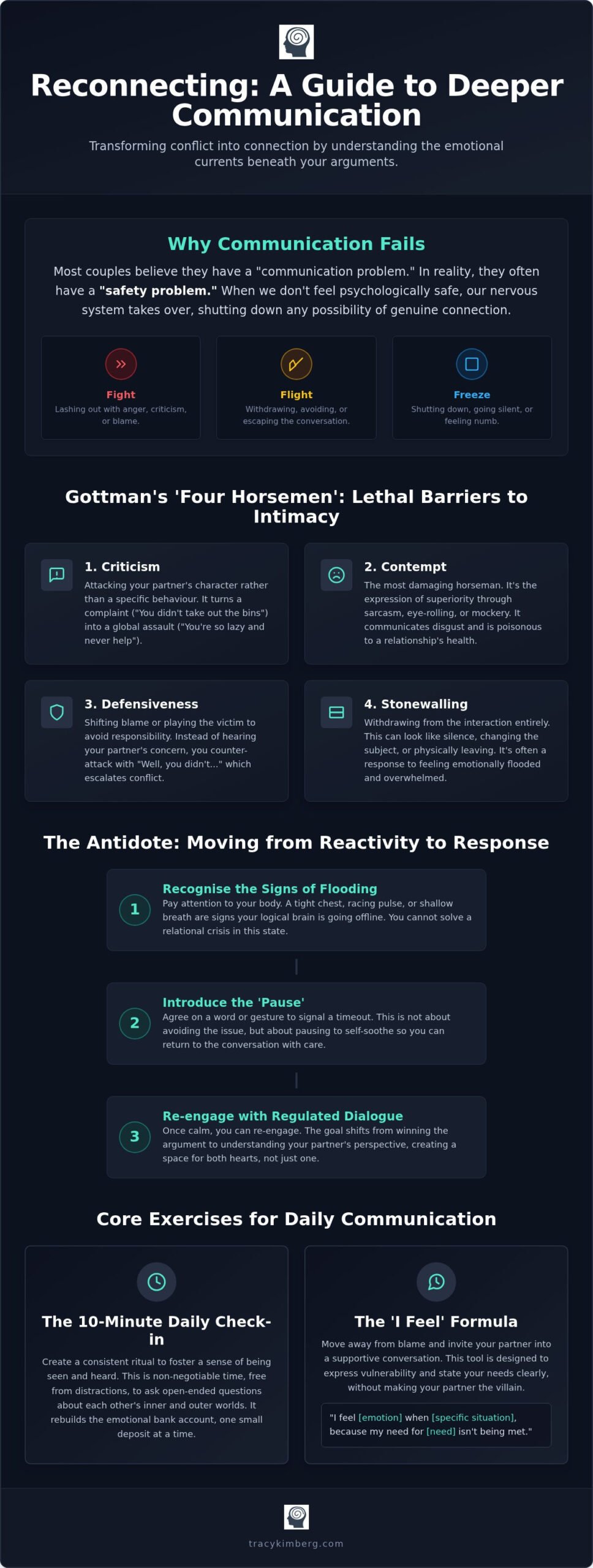
Healthy communication isn’t just about choosing the right words or following a script. It’s the ability to share your deepest vulnerability whilst feeling entirely safe. When this safety vanishes, the relationship begins to buckle. Most couples believe they have a “communication problem,” but usually, they have a “safety problem.” To understand the broader context of What is Couples Therapy?, one must look past the words being spoken to the biological response of the nervous system. When you feel attacked or ignored, your body enters a state of fight, flight, or freeze. You might “blow up” in anger or “shut down” in silence. These aren’t conscious choices; they’re survival mechanisms.
These reactions are often rooted in our past. Gabor Maté’s work highlights how childhood dynamics and past traumas dictate our adult arguments. If you grew up in a home where your needs were secondary, a partner’s forgetfulness might feel like a profound abandonment. This emotional weight transforms a simple disagreement about the laundry into a battle for your own worth. When these battles become too painful, couples often drift into the “Roommate Phase.” This is a state of quiet desperation where you co-exist, manage the household, and discuss the kids, but avoid any real depth to stay “safe” from further hurt. It’s a symptom that your communication has moved from connection to mere logistics.
The “Four Horsemen” of Communication
John Gottman identified four specific behaviours that act as lethal barriers to intimacy. Criticism involves attacking your partner’s character rather than a specific behaviour. Contempt is even more damaging; it’s the expression of superiority, often through sarcasm or eye-rolling. Defensiveness is a way of shifting blame to avoid responsibility, whilst Stonewalling is the act of withdrawing from the interaction entirely. These behaviours don’t just hurt feelings; they physically repel your partner. Take a moment to reflect: which of these is your “favourite” shield? Recognising your primary “horseman” is essential before you can successfully implement couples therapy exercises for communication.
Moving from Reactivity to Response
The bridge between conflict and connection is the “pause.” When you are emotionally flooded, your heart rate spikes and your logical brain effectively goes offline. You cannot solve a relational crisis when your body thinks it’s being chased by a predator. Learning to recognise the physical signs of flooding, such as a tight chest or racing pulse, allows you to ask for a “timeout.” This isn’t about avoiding the issue; it’s about regulated dialogue. By creating a safe space for the conversation before it even begins, you ensure that you’re speaking to your partner’s heart rather than their defences. Practical couples therapy exercises for communication often start with this simple, yet profound, physiological regulation.
The Anatomy of Connection: Insights from Renowned Experts
Connection isn’t a happy accident or a stroke of luck. It’s a structure built through daily intentionality. John Gottman, a pioneer in relationship research, describes the foundation of this structure as the “Love Map.” This is the cognitive space you hold for your partner’s inner world, their history, and their future dreams. Whilst Gottman emphasises the safety of knowing, Esther Perel introduces the vital concept of “Erotic Intelligence.” She suggests that for communication to stay vibrant, we must balance the security of the familiar with the mystery of the unknown. Effective couples therapy techniques often focus on harmonising these two seemingly opposite needs.
A core element of this anatomy is the practice of “Turning Towards.” When your partner makes a “bid” for connection, perhaps a sigh or a casual remark, you have a choice. You can turn away in indifference, turn against in anger, or turn towards with curiosity. These micro-moments build the emotional capital necessary to survive the inevitable storms of life. However, this capital is quickly depleted when we prioritise “being right” over “being connected.” In conflict, the ego demands a winner, but in a relationship, if one person wins, both people lose. Shifting your goal from victory to understanding is the first step in healing.
Building Your Love Map
Your Love Map is an internal guide to your partner’s heart. It’s not a static document; it requires regular updates as people evolve. You can strengthen this bond by using couples therapy exercises for communication that focus on deep curiosity. Try asking these questions during a quiet moment:
- What is your biggest stressor or worry at work this week?
- Who is currently your favourite person to spend time with outside of our home?
- What is a dream or a goal you’ve been thinking about lately?
- What is one thing I can do this week to make you feel more supported?
Knowing these details creates a buffer of friendship. When difficult topics arise, you aren’t fighting a stranger; you’re speaking to a friend whose inner world you respect and understand.
The Power of Validation
Validation is perhaps the most powerful tool in your relational toolkit, yet it’s often the most misunderstood. It’s important to recognise that validation does not mean agreement. You can completely disagree with your partner’s perspective whilst still saying, “I can see why you feel that way.” This simple acknowledgement has a profound psychological impact. It signals to your partner’s nervous system that they are safe and heard. When the need to fight for validation is removed, the path to compromise opens naturally. These couples therapy exercises for communication are designed to move you from a state of defence to one of connection. If you’re finding it difficult to find this common ground, a professional relationship recovery process can provide the structure needed to bridge the gap.
Core Couples Therapy Exercises for Daily Communication
Rituals are the heartbeat of a healthy partnership. Whilst the previous sections explored the “why” behind our reactions, we must now focus on the practical “how.” Transforming your relationship doesn’t require grand gestures; it requires small, consistent habits that signal safety to your partner’s nervous system. By integrating specific couples therapy exercises for communication into your daily life, you move from the “Roommate Phase” back into a space of active, emotional engagement. These tools aren’t just for crises. They’re for the quiet Tuesdays when you’re both tired and the distance feels just a little too wide.
The 10-Minute Daily Check-In
This is a non-negotiable ritual designed for even the busiest couples. It’s about prioritising the relationship over the logistics of life. Follow these three steps to make it effective:
- Step 1: Set a specific time when you won’t be interrupted. Put your phones in another room and ensure the children are settled.
- Step 2: Each partner shares one “high” and one “low” from their day. This isn’t about the relationship; it’s about your individual experiences.
- Step 3: The other partner listens without offering solutions. Your only job is to be a witness to your partner’s world.
The Stress-Reducing Conversation
The primary goal of this exercise is to reduce emotional neglect, which often happens when we feel our partner doesn’t care about our external stresses. The rules of engagement are simple but strict: no problem-solving unless specifically asked. When you take turns sharing your stressors, you must show genuine interest and validate each other’s feelings. This practice is a cornerstone of compassionate communication exercises because it builds a “we against the world” mentality. It’s particularly vital for rebuilding trust after a period of disconnect, as it proves that you are each other’s safest harbour.
For those looking to deepen this work, the “Three and Three” exercise is a wonderful addition. Once a week, identify three things you love about your partner’s behaviour lately and three areas where you’d like to see improvement. When combined with Active Listening 2.0, where the listener paraphrases what they’ve heard before responding, these couples therapy exercises for communication become incredibly powerful. You’re not just hearing words; you’re feeling the intent behind them. This level of empathy is what moves a couple from mere co-existence to a deeply bonded, resilient partnership.
Advanced Exercises for Rebuilding Intimacy and Trust
When trust has been compromised, perhaps through infidelity or years of emotional distance, basic worksheets can feel insufficient. You need tools that reach deeper into the somatic and emotional layers of your partnership. Advanced couples therapy exercises for communication are designed to bypass the logical brain and speak directly to the heart. This involves moving away from the safety of “logistics” and into the vulnerability of true intimacy. It’s about learning to be present with each other’s pain without immediately trying to “fix” it or defend your own position.
Blame is the primary enemy of rebuilding. When you start a sentence with “You always,” your partner’s defences immediately rise. The “I Feel” formula shifts the focus from accusation to personal experience. Try stating: “I feel [emotion] when [specific event] because I need [underlying value].” For example, “I feel lonely when you stay late at the office because I value our evening connection.” This isn’t a linguistic trick; it’s a way to invite your partner into your internal world rather than putting them on trial. Similarly, reminiscing about your “origin story” can act as an anchor. Discussing the moment you knew you were in love reinforces the bond that exists beneath the current conflict.
The Power of Non-Verbal Connection
Words often fail us when we’re hurt. Non-verbal communication, specifically extended eye contact, can bridge the gap where language falls short. Research suggests that prolonged gazing triggers the release of oxytocin, the hormone responsible for bonding and trust. To practice this, sit comfortably facing each other and set a timer for two minutes. Maintain a silent, soft gaze. It may feel awkward or even confrontational at first, but try to breathe through the discomfort. If it feels right, hold hands whilst you do this. This simple act of “soul-gazing” can settle a dysregulated nervous system and prepare you for a more empathetic dialogue later on.
The Gratitude Jar or Journal
A relationship’s “climate” is often dictated by what we choose to notice. In a state of disconnect, we become hyper-aware of what’s missing. Gratitude rituals shift the focus from deficit to abundance. Try writing one sentence each day thanking your partner for a specific action or quality. “Thank you for making the tea this morning; it made me feel cared for.” Whether you use a physical jar or a shared journal, these small acknowledgements build a reservoir of goodwill. For couples dealing with deep-seated relational breakdowns, these couples therapy exercises for communication are a vital part of a 12-Week Relationship Recovery Process that moves beyond surface-level fixes to achieve lasting change.
From Exercises to Transformation: The 12-Week Relationship Recovery Process
While the couples therapy exercises for communication shared in previous sections are powerful, they are often most effective when the relational foundation is relatively stable. For couples facing deep-seated breakdowns, these tools can sometimes feel like a sticking plaster on a significant wound. When your nervous systems are chronically dysregulated, trying to “fix” the relationship alone can lead to further frustration. Professional coaching provides the scaffolding necessary to hold high-stakes conversations that would otherwise collapse into old patterns of blame and withdrawal. It’s about moving from ad-hoc attempts at repair to a sustained, conscious partnership that feels like a proactive and positive adventure rather than a clinical necessity.
When to Seek Professional Support
It takes immense courage to admit that you’ve reached the limits of what you can achieve on your own. If your relationship is currently marked by infidelity, pervasive contempt, or a total loss of trust, simple worksheets may not suffice. These are “high-alert” situations where the presence of a Wise Guide is essential to create a safe environment. Unlike traditional counselling, which can sometimes feel like a weekly venting session without a clear end goal, Tracy Kimberg’s transformational coaching is result-oriented. We move beyond just talking about the problems and focus on the active, evolving process of healing that respects your unique history and trauma-informed needs.
The Path Forward: Your 12-Week Journey
The 12-Week Relationship Recovery Process is a structured alternative to the uncertainty of ad-hoc sessions. This journey is meticulously designed to guide you through three distinct phases: Assessment, De-escalation, and Reconnection. During the assessment phase, we identify the specific triggers and historical patterns that keep you stuck. De-escalation uses Gottman-based research to lower the temperature of your conflicts. Finally, reconnection integrates Perel’s insights on intelligence and mystery to rebuild a bond that is both secure and vibrant. By the end of these twelve weeks, you aren’t just using couples therapy exercises for communication; you are living them. You’ll have the tools to navigate future challenges with grace and the confidence that your relationship is a place of mutual growth. If you’re ready to move from conflict to deep emotional intimacy, book a discovery call to start your 12-Week Relationship Recovery Process today.
Reclaiming the Heart of Your Partnership
Transitioning from chronic conflict to deep emotional intimacy requires more than just better vocabulary; it requires a fundamental shift in how you hold space for one another. By understanding your nervous system’s triggers and prioritising rituals like the daily check-in, you begin to dismantle the walls of the “Roommate Phase.” These couples therapy exercises for communication serve as the essential building blocks for a relationship rooted in psychological safety and mutual respect.
Whilst self-guided work is a powerful starting point, deep-seated relational breakdowns often benefit from a structured, research-led approach. As a UK-based expert, I provide a safe, non-judgemental environment for both online and face-to-face therapy, utilising the proven methodologies of Gottman and Perel. You deserve a partnership that feels like a sanctuary rather than a battlefield. Begin your journey with the 12-Week Relationship Recovery Process today. Your relationship has the capacity for profound healing; it simply needs the right guidance to flourish once again.
Frequently Asked Questions
How often should we practice communication exercises?
You should practice small rituals daily and deeper exercises at least once a week to maintain relational health. The 10-minute check-in is most effective when it becomes a non-negotiable part of your routine. Like any skill, repetition builds the muscle memory needed to stay calm during future conflicts. Consistency matters more than the length of the session, as it signals to your partner that the relationship is a priority.
What if my partner refuses to do communication exercises?
You can start by changing your own communication patterns, even if your partner isn’t ready to participate in formal exercises. Often, when one person stops reacting with criticism or defensiveness, the entire dynamic shifts. Invite them to join you without pressure, perhaps starting with a low-stakes gratitude ritual. If resistance persists, it’s often helpful to explore the underlying fears they have about the process through professional coaching.
Can communication exercises help after infidelity?
Yes, couples therapy exercises for communication are vital for rebuilding trust after infidelity, but they require a structured environment. Exercises focusing on transparency and emotional safety help the betrayed partner feel secure whilst allowing the involved partner to express genuine remorse. This process is complex and often necessitates the guidance of a 12-week recovery programme to ensure that conversations lead to healing rather than further trauma.
What is the best communication exercise for a long-distance relationship?
The “Love Map” exercise is particularly effective for long-distance couples as it bridges the physical gap through emotional intimacy. Since you can’t rely on physical touch, you must prioritise knowing the nuances of your partner’s daily life and internal stressors. Using digital platforms to share “highs and lows” or asking deep curiosity questions ensures that your mental map of each other stays current, preventing emotional distance.
How do we stop an argument from escalating using these tools?
Utilising the “Pause” or a formal “Timeout” is the most effective way to stop an argument from escalating into a damaging conflict. When you recognise the physical signs of emotional flooding, such as a racing heart, agree to stop the conversation for at least twenty minutes. This allows your nervous systems to return to a state of calm. You can then return to the dialogue using regulated tools rather than reactive attacks.
Are these exercises effective for teenagers and parent-child relationships too?
These principles are highly effective for parent-child dynamics, particularly when adapted to suit a teenager’s need for autonomy and validation. Active listening and the “I Feel” formula help move the relationship away from a power struggle and toward mutual understanding. Tracy offers specialised therapy for teenagers that utilises these frameworks to help families navigate the complex transitions of adolescence whilst maintaining a strong, supportive emotional connection.
Is online couples therapy as effective as face-to-face sessions for these exercises?
Online couples therapy is just as effective as face-to-face sessions for implementing these communication tools. Research suggests that the comfort of being in your own home can actually help partners feel more relaxed and open during vulnerable exercises. Tracy provides both online and face-to-face therapy, ensuring that you have access to professional guidance regardless of your location, making the recovery process both manageable and accessible.
How long does it take to see results from these exercises?
You’ll often feel an immediate sense of relief after learning de-escalation tools, but lasting results from couples therapy exercises for communication typically take between 12 and 20 sessions. Structural change requires time to dismantle old habits and integrate new behaviours into your lifestyle. Whilst every couple’s journey is unique, a structured 12-week programme provides a clear roadmap to move from initial crisis management to restored trust.

Article by
Tracy Kimberg
Tracy Kimberg is a Relationship Expert, Couples Therapist and Coach with a dedicated focus on helping couples and individuals rebuild connection, trust and emotional safety in their relationships. Drawing on the research of John and Julie Gottman, the relational insights of Esther Perel, and years of hands-on therapeutic experience, Tracy offers a warm, non-judgemental and deeply compassionate approach to modern relationships.
Based in Dorset, Tracy works with couples navigating communication breakdowns, betrayal, intimacy challenges, separation, family dynamics and life transitions. Known for creating a safe and grounded therapeutic space, she combines practical tools with emotional depth to help clients move beyond survival patterns and towards meaningful, lasting change.
With a reputation for empathy, professionalism and dedication to her clients’ growth, Tracy is passionate about helping people feel seen, understood and empowered — both within their relationships and within themselves.
Disclaimer
Disclaimer:
The information shared in this article is intended for educational and informational purposes only and should not be considered a substitute for professional therapeutic, psychological, medical or legal advice. Every individual and relationship is unique, and the perspectives offered are based on general therapeutic principles, research and professional experience.
Reading this article does not establish a therapist-client relationship with Tracy Kimberg. If you are experiencing significant emotional distress, relationship crisis, trauma, or mental health concerns, it is important to seek support from a qualified professional appropriate to your individual circumstances.
All content remains the intellectual property of Tracy Kimberg and may not be reproduced or distributed without permission.