

What if the most radical act you could perform for your partnership isn’t a grand romantic gesture, but a simple, structured conversation? Many of us wait until the silence between us feels heavy or we’ve started to feel more like polite roommates than lovers before we think about the state of our union. It’s natural to feel anxious about bringing up difficult topics, fearing that “the talk” might lead to conflict rather than closeness. However, proactive care is what keeps love from becoming a static treatment.
This guide explores how a regular relationship check up can transform that underlying dread into a profound sense of safety and shared understanding. By using research-based insights, you’ll learn how to prevent emotional drift and rediscover the vibrancy of your bond. We’ll provide a clear framework for checking in, ensuring you both feel heard whilst building a practical roadmap for deeper intimacy and lasting communication.
Key Takeaways
- Shift your perspective from crisis management to proactive maintenance, preventing the “roommate phase” by treating your connection as a living, evolving ritual.
- Harness research-based tools like Gottman’s “Bids for Connection” to measure the daily pulse of your intimacy and emotional safety.
- Utilise a structured relationship check up to evaluate five core pillars of your partnership, including how you navigate conflict and organise your shared future.
- Create a safe space for vulnerability by choosing the optimal time for discussion and using softened start-ups to ensure both partners feel deeply understood.
- Transform assessment into lasting growth by learning how to turn common complaints into positive, actionable requests for change that nourish your bond.
Beyond the Roommate Phase: Why Every Couple Needs a Relationship Check-up
Partnerships often begin with a vibrant, electric energy where curiosity about the other person feels effortless. Over time, the weight of daily life, career pressures, and domestic responsibilities can cause a subtle shift. This isn’t a failure of love, but rather a natural relational entropy. Without a deliberate relationship check up, many couples find themselves drifting into the “roommate phase,” where communication is efficient but the emotional spark has dimmed. You might find yourselves co-existing perfectly well whilst feeling a profound sense of loneliness.
We often treat our relationships with an emergency mindset, only seeking support when the house is already on fire. A conscious partnership, as championed by experts like Esther Perel, requires a different approach. It asks us to move from reactive repair to proactive maintenance. Understanding The Science of Connection helps us recognise that intimacy isn’t a static state we achieve; it’s a dynamic process we must actively organise and protect. Choosing to check in when things are “fine” is the ultimate act of relational health.
The Difference Between Daily Chat and a Relationship Check-up
Most of our daily interactions are functional. We discuss the school run, the grocery list, or the upcoming mortgage payment. Whilst these logistics are necessary for a shared life, they don’t nourish the bond. Relational talk, however, focuses on the internal world of your partner, their fears, their triumphs, and their evolving dreams. It’s about attunement. A relationship check up is a dedicated, safe space where the focus shifts from the tasks of life to the health of the connection itself.
Signs Your Relationship Is Overdue for an Assessment
Passive disconnection is often quieter than conflict. It shows up as a lack of meaningful curiosity or a sense that you already know everything your partner has to say. You might notice that minor irritations, like a dish left in the sink, trigger outsized reactions. Often, these small frustrations are masks for deeper emotional neglect. If you feel any of the following, it’s time to pause:
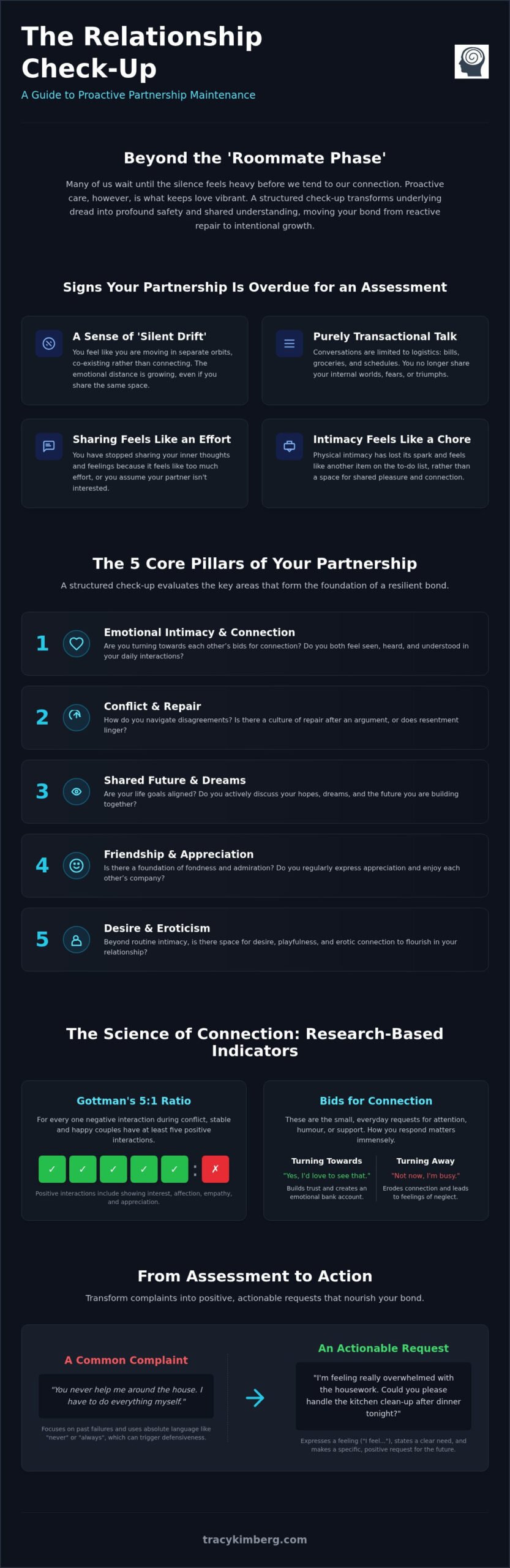
- You feel a sense of “silent drift” where you’re moving in separate orbits.
- Conversations have become entirely transactional or focused on external problems.
- You’ve stopped sharing your internal thoughts because it feels like too much effort.
- Physical intimacy feels like another chore on the to-do list rather than a shared pleasure.
Recognising these signs isn’t a cause for alarm. It’s an invitation to return to one another with compassion and intention.
The Science of Connection: Research-Based Indicators of Relationship Health
Understanding the health of your partnership doesn’t have to be a guessing game. John Gottman’s research provides us with the “Sound Relationship House,” a structural framework that moves beyond gut feelings into observable behaviours. At the heart of this house are “Bids for Connection.” These are the small, everyday requests for attention, affirmation, or empathy. When you turn towards your partner’s bid, you’re depositing into an emotional bank account. This consistent investment creates a “Positive Sentiment Override,” where you’re naturally more likely to give each other the benefit of the doubt during stressful times.
A thorough relationship check up examines these micro-moments. It looks at whether you’re building a culture of appreciation or one of resentment. By grounding your check-in in these research-led metrics, you move away from blame and towards a shared project of relational growth. It turns the conversation into a proactive adventure rather than a clinical necessity.
The Gottman Influence: Friendship and Conflict Management
The foundation of any resilient bond is the “Love Map.” This is your internal map of your partner’s world, their favourite memories, their current stresses, and their future hopes. During a relationship check up, you’re essentially updating this map. It’s also where we evaluate conflict. Research shows that stable couples maintain a 5 to 1 ratio of positive to negative interactions even during a disagreement. It isn’t about the absence of conflict, but the presence of repair and friendship whilst navigating it. Turning towards your partner’s emotional needs, even in small ways, is one of the strongest predictors of long-term success.
The Perel Perspective: Balancing Security and Desire
Whilst Gottman emphasises the safety of friendship, Esther Perel reminds us that intimacy also requires a certain amount of space and mystery. A comprehensive assessment must address the tension between our need for security and our need for adventure. This is where “Erotic Intelligence” comes in. It’s the ability to maintain a sense of self whilst being part of a “we.” A healthy partnership nurtures both the “best friend” who provides comfort and the “lover” who sparks curiosity. If you’re feeling the drift mentioned earlier, exploring these dynamics through specialised relationship coaching can help bridge the gap between safety and passion.
Finally, the “Shared Meaning” you create together acts as the roof of your relational house. This involves your shared rituals, goals, and the legacy you want to build. It’s the “why” behind your “how,” giving your partnership a sense of purpose that transcends the daily grind.
Your Relationship Health Checklist: 5 Core Areas to Evaluate
To move from theory to practice, your relationship check up needs a clear structure. We aren’t just looking for what’s broken; we’re surveying the entire landscape of your life together. By categorising your check-in into five core pillars, you ensure that no part of your partnership is left to drift. This process isn’t a pass or fail exam. It’s an opportunity to see where your foundation is solid and where it might need a bit more reinforcement. When we approach these areas with curiosity rather than judgement, we create a safe harbour for honesty to flourish.
- Communication and Conflict Resolution: This isn’t just about how often you talk, but how you handle the inevitable friction of two lives merging. Are you listening to understand, or simply waiting for your turn to speak?
- Emotional Intimacy and Connection: This is the “seen” factor. It’s about feeling that your partner truly knows your internal world and holds it with care.
- Physical Intimacy and Affection: Beyond just sex, this includes the “skin hunger” for touch, the warmth of a long hug, and the deliberate nurturing of desire.
- Shared Goals and Values: Are you still rowing in the same direction? This pillar ensures your individual growth remains compatible with your shared vision.
- Practical Partnership: The “business” of the relationship. We evaluate if the mental load and household roles feel balanced and fair to both parties.
10 Essential Questions for Your Next Check-up
The goal of these questions is curiosity, not a “correct” answer. Use open-ended prompts to invite your partner into a deeper narrative. Try these during your next relationship check up:
- What is one thing I’ve done recently that made you feel deeply loved?
- How have we navigated our disagreements lately, and what could we improve?
- What is a dream you have for us this year that we haven’t discussed yet?
- How do you feel about the balance of chores and mental load in our home?
- What makes you feel most emotionally safe with me?
- How can I better support your personal goals this month?
- What is a physical gesture that makes you feel most connected to me?
- What is one area where you feel we’ve drifted slightly?
- How can we create more space for playfulness in our daily routine?
- What are you most proud of in our partnership right now?
Identifying the “Four Horsemen” in Your Assessment
Whilst you talk, stay alert for the “Four Horsemen” identified by John Gottman. These behaviours are predictors of relational breakdown: Criticism (attacking character), Contempt (acting from a place of moral superiority), Defensiveness (playing the victim), and Stonewalling (withdrawing from the conversation). If you spot these creeping in, pause and reset. Contempt is particularly toxic because it erodes the safety required for intimacy. If you find these patterns difficult to break on your own, exploring the 12-Week Relationship Recovery Process can provide the professional tools needed to replace these habits with healthy connection.
How to Organise Your Check-up: Creating a Safe Space for Vulnerability
Executing a successful relationship check up requires more than just a list of questions. It demands an environment where both partners feel safe enough to be seen without the fear of judgement or retaliation. Think of this as setting the stage for a sacred performance. You wouldn’t try to have a soul-baring conversation whilst distracted by your phone or rushing to a meeting. Instead, organise a time that feels spacious and calm, ensuring that you aren’t interrupted by the demands of the outside world.
Avoid “HALT” moments: times when you are Hungry, Angry, Lonely, or Tired. When our physiological needs aren’t met, our capacity for empathy shrinks and our nervous system becomes primed for conflict. Start by setting a clear intention. Begin with appreciation, naming specific things your partner has done recently that made you feel supported or loved. This isn’t just about being polite; it’s a strategic move to lower the biological defences and foster a spirit of collaboration. If you find that setting this stage feels impossible on your own, seeking professional relationship counselling can provide the neutral ground and expert structure you need to begin.
When you speak, practice using “I” statements that focus on your own feelings and needs rather than your partner’s perceived flaws. If emotions become too intense, a phenomenon known as “flooding,” give yourselves permission to pause. A 20-minute break allows the heart rate to return to a baseline level, preventing the conversation from spiralling into a fight. Always close with a ritual of connection, such as a long hug or a shared tea, to transition back into the rhythm of daily life together.
The “Softened Start-up”: Starting Without Blame
How you start a conversation often determines how it will end. A “softened start-up” involves bringing up a concern without triggering your partner’s defensiveness. Instead of saying, “You never help with the house,” try, “I’ve been feeling a bit overwhelmed with the chores lately, and I’d love it if we could look at the schedule together.” This approach focuses on the “we” of the partnership and acknowledges that you both play a role in the relational dynamic. It invites your partner to be an ally rather than an adversary.
Handling Difficult Answers with Empathy
The most challenging part of a relationship check up is hearing that your partner is unhappy or feels disconnected. In these moments, validation is more important than “fixing” the problem immediately. Use the Speaker-Listener technique: let your partner speak whilst you listen without interrupting, then mirror back what you’ve heard to ensure you’ve understood. Saying, “I hear that you’re feeling lonely, and I can see why that’s hard for you,” creates an emotional bridge that allows for true healing to begin.
From Assessment to Action: The Path to Long-Term Recovery
The relationship check up you’ve just completed isn’t the destination; it’s the map. Now that you’ve identified the gaps between where you are and where you want to be, the work of implementation begins. Information without action is just a list of grievances. To move forward, we must learn to translate our complaints into actionable requests for change. Instead of focusing on what your partner is failing to do, describe the positive need you have. This shift from blame to desire is the catalyst for genuine transformation.
Consistency is your greatest ally here. A single conversation won’t sustain a lifetime of intimacy. By making the relationship check up a monthly or quarterly habit, you ensure that small drifts don’t become vast chasms. It’s about building a culture of continuous curiosity. However, there are times when a check-up reveals patterns that feel too heavy to lift alone. If you find yourselves circling the same arguments or if the “Four Horsemen” feel like permanent residents, professional guidance isn’t a sign of failure. It’s a strategic investment in your shared health.
The 12-Week Relationship Recovery Process
For couples who recognise they need more than a self-led ritual, the 12-Week Relationship Recovery Process offers a structured path from disconnect to deep intimacy. Whilst a check-up identifies the issues, this signature programme provides the accountability and research-led tools to actually resolve them. We move beyond surface-level fixes to address the systemic patterns and emotional wounds that keep you stuck. It’s a transformational journey designed to rebuild trust and passion from the ground up, providing a clear roadmap where there was once only confusion.
Investing in Your Future Together
Your partnership is a living entity. Like any living thing, it requires regular “feeds” of attention, appreciation, and effort. Choosing to seek help or commit to regular check-ins is an act of profound relationship strength. It shows that you value the “we” enough to protect it. If your recent assessment has highlighted areas that feel overwhelming, don’t wait for the drift to deepen. You can book a consultation to discuss your relationship check-up findings and begin the process of conscious recovery today. Viewing your partnership as a proactive adventure ensures that your love remains an active, evolving experience for years to come.
Nurturing the Future of Your Partnership
A relationship check up is far more than a simple diagnostic tool. It’s a proactive adventure that transforms the way you and your partner navigate the complexities of shared life. By moving beyond functional logistics and embracing the research-led insights of experts like John Gottman and Esther Perel, you can protect your bond from the silent drift of the roommate phase. You now have the framework to evaluate your connection with curiosity whilst creating the emotional safety required for true vulnerability.
If your assessment has highlighted significant hurdles, such as persistent emotional disconnect or the pain of infidelity, know that healing is entirely possible. I offer a safe, non-judgemental environment where couples can achieve transformational results through a specialised, clinical approach. You don’t have to wait for a crisis to invest in the longevity of your love. Begin your journey with the 12-Week Relationship Recovery Process to turn your insights into lasting, positive change. Your partnership is a living entity; with intentional care and expert guidance, it can continue to evolve into your greatest source of strength.
Frequently Asked Questions
How often should we do a relationship check-up?
You should aim to conduct a relationship check up at least once a month for a short pulse check and once every quarter for a deeper dive. Consistency is more important than intensity. Regular check-ins prevent the accumulation of small resentments that often lead to the roommate phase discussed earlier. By scheduling these moments, you treat your partnership as a living entity that requires consistent nourishment rather than a static, unchanging arrangement.
What if my partner refuses to participate in a check-up?
If your partner feels hesitant, start by expressing your own needs rather than their perceived lack of effort. Frame the invitation as a desire for more connection rather than a critique of the relationship. You might say, “I miss our deep conversations and would love to set aside some time just for us.” If the refusal persists, it may indicate a deeper fear of conflict that requires a gentle, non-judgemental approach to resolve together over time.
Is a relationship check-up the same as marriage counselling?
A relationship check up is a proactive, self-led ritual designed to maintain health, whereas marriage counselling is a facilitated process with a professional therapist. Think of the check-up as your daily vitamins and counselling as a targeted treatment for a specific ailment. Whilst check-ups can be done at home to foster intimacy, counselling provides a neutral third party to navigate complex systemic issues or deep-seated trauma that you simply cannot resolve alone.
What is the most important question to ask in a check-up?
The most vital question is: “What is one thing I can do this week to make you feel more loved and supported?” This shifts the focus from abstract complaints to actionable kindness. It invites your partner to share their current emotional needs whilst giving you a clear roadmap for repair. This question reinforces the positive behaviours that are so critical for long-term relational success and builds a profound sense of emotional safety.
Can a check-up actually make things worse?
A check-up can feel challenging if it lacks a safe environment, but it rarely makes things worse in the long term. Bringing hidden issues to light is the first step toward healing. However, if the conversation descends into behaviours like contempt or stonewalling, it’s best to pause. The goal is curiosity, not a pass-fail exam. When approached with a softened start-up, even difficult realisations become opportunities for profound growth and repair.
How do we handle it if we find out we want different things?
Finding out you want different things can be frightening, but it’s an invitation to explore the underlying values behind those desires. It doesn’t always signal the end of a partnership. Instead, it requires a conscious approach to understanding if these differences are negotiable or if they represent a fundamental incompatibility. This is often where professional coaching helps you navigate the complex emotional landscape of compromise without losing your individual sense of self whilst maintaining connection.
What are the signs that we need a professional therapist instead of a DIY check-up?
You may need a professional therapist if your attempts at a relationship check up consistently lead to “flooding” or if you feel stuck in circular arguments. Other signs include a loss of trust following infidelity or persistent emotional neglect. If you cannot find your way back to each other through self-led rituals, a structured 12-Week Relationship Recovery Process provides the clinical expertise and accountability required for deep, lasting healing.
How long should a typical relationship check-in conversation take?
A typical check-in conversation should take between 30 and 60 minutes. It needs to be long enough to move past functional logistics into relational talk, but short enough to avoid emotional exhaustion. If a topic feels too heavy to resolve in one sitting, acknowledge it and schedule a separate time to go deeper. The aim is to leave the conversation feeling more connected, not drained by an endless assessment of your partnership’s problems.

Article by
Tracy Kimberg
Tracy Kimberg is a Relationship Expert, Couples Therapist and Coach with a dedicated focus on helping couples and individuals rebuild connection, trust and emotional safety in their relationships. Drawing on the research of John and Julie Gottman, the relational insights of Esther Perel, and years of hands-on therapeutic experience, Tracy offers a warm, non-judgemental and deeply compassionate approach to modern relationships.
Based in Dorset, Tracy works with couples navigating communication breakdowns, betrayal, intimacy challenges, separation, family dynamics and life transitions. Known for creating a safe and grounded therapeutic space, she combines practical tools with emotional depth to help clients move beyond survival patterns and towards meaningful, lasting change.
With a reputation for empathy, professionalism and dedication to her clients’ growth, Tracy is passionate about helping people feel seen, understood and empowered — both within their relationships and within themselves.
Disclaimer
Disclaimer:
The information shared in this article is intended for educational and informational purposes only and should not be considered a substitute for professional therapeutic, psychological, medical or legal advice. Every individual and relationship is unique, and the perspectives offered are based on general therapeutic principles, research and professional experience.
Reading this article does not establish a therapist-client relationship with Tracy Kimberg. If you are experiencing significant emotional distress, relationship crisis, trauma, or mental health concerns, it is important to seek support from a qualified professional appropriate to your individual circumstances.
All content remains the intellectual property of Tracy Kimberg and may not be reproduced or distributed without permission.