

What if the wall your teenager has built isn’t an act of defiance, but a survival mechanism they don’t yet have the words to explain? It’s a question that keeps many UK parents awake at night, staring at the ceiling and wondering if the slammed doors are just a phase or something more profound. Identifying the specific signs my teenager needs therapy UK can feel like trying to solve a puzzle where the pieces keep changing shape. You might worry that you’ve lost the child who used to share everything with you, or feel a heavy weight of guilt that you’ve somehow failed to provide the right support.
It’s exhausting to navigate the thin line between typical adolescent moodiness and a genuine mental health crisis, especially when you’re desperate to help but don’t want to overreact. This guide will help you find the clarity you need by distinguishing between normal growing pains and the red flags that suggest professional therapeutic support is necessary. We’ll explore how to bridge the communication gap whilst looking at the current landscape of support in 2026, providing you with actionable tools to foster a sense of hope. You’ll learn that seeking help isn’t a sign of parental failure, but a powerful step toward reclaiming the relationship you cherish.
Key Takeaways
- Learn to use the “Baseline Rule” to distinguish between typical adolescent brain development and behaviours that indicate your teen is struggling with deeper emotional challenges.
- Recognise the subtle red flags, such as persistent withdrawal or changes in physical habits, that serve as the primary signs my teenager needs therapy UK.
- Discover why prioritising attachment over peer orientation can transform therapy into a bridge for family connection rather than a wedge that drives you apart.
- Understand how to navigate the UK’s mental health landscape, including the realities of CAMHS and the unique impact of academic pressure from GCSEs and A-Levels.
- Master the art of introducing support to your teen by framing it as a safe harbour for mental fitness rather than a way to “fix” a perceived problem.
Distinguishing Between Typical Teenage Behaviour and Deeper Struggles
Adolescence is often described as a storm, but it’s more accurately a profound neurological and emotional reorganisation. During these years, the teenage brain undergoes a massive structural “pruning” process, where the emotional centres often outpace the development of the logical prefrontal cortex. This can lead to the classic eye-rolls and door-slams that we’ve come to expect. However, when you’re searching for the signs my teenager needs therapy UK, it’s vital to look beyond the surface level moodiness. We must distinguish between the healthy friction of growth and the heavy weight of clinical distress.
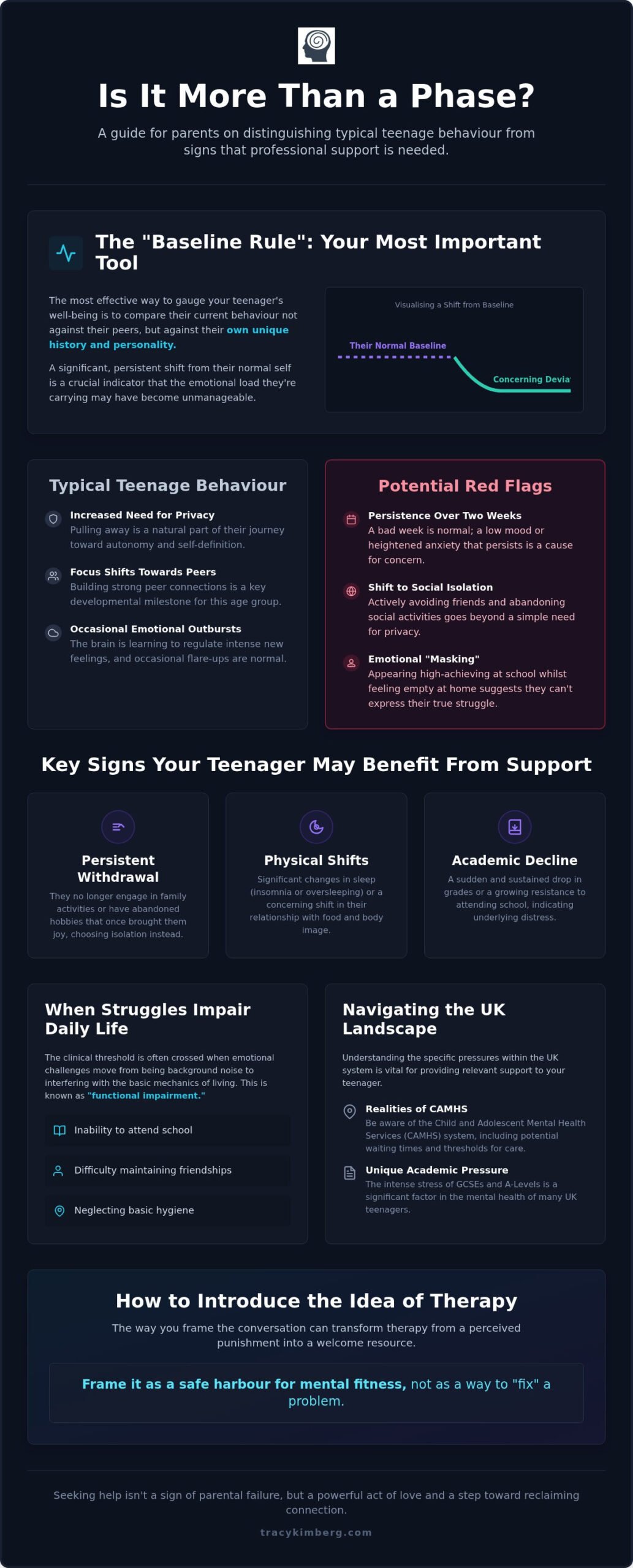
One of the most effective tools I use is the “Baseline Rule”. This involves comparing your teen’s current behaviour not against their peers or an imaginary ideal, but against their own unique history and personality. A naturally introverted teen spending more time in their room might be perfectly healthy. Conversely, a social, outgoing teenager who suddenly stops responding to friends and abandons their favourite hobbies is showing a significant deviation from their baseline. This shift often signals that the emotional load they’re carrying has become unmanageable.
The clinical threshold often rests on “functional impairment”. This occurs when emotional struggles stop being background noise and start interfering with the basic mechanics of living. If your child can no longer attend school, maintain friendships, or look after their basic hygiene, they’ve moved past temporary moodiness into persistent emotional dysregulation. Understanding teenage depression helps us see that these behaviours aren’t choices or “bad attitudes”; they’re symptoms of a system under immense strain.
The “Normal” Spectrum of Adolescence
It’s natural for teens to pull away. This biological drive for increased privacy and peer-group focus is a necessary step in their journey toward adulthood. Occasional emotional outbursts are often just evidence of a brain learning to regulate intense new feelings. Normal teen behaviour is a developmental milestone of autonomy where the child begins to define themselves as separate from their parents.
When “Normal” Becomes a Red Flag
The primary difference between a phase and a problem is duration. A “bad week” following a breakup or a failed exam is a normal reaction to life’s stressors. However, when a low mood or heightened anxiety persists for more than two weeks without relief, it’s time to pay closer attention. The shift from healthy privacy to concerning social isolation is another indicator. You should also be aware of “masking”, where a teenager appears perfectly fine or even high-achieving at school, yet feels empty or hopeless when the front drops at home. This internal disconnect is one of the most pressing signs my teenager needs therapy UK, as it suggests they don’t feel safe enough to express their true struggle.
5 Key Signs Your Teenager May Benefit from Professional Support
Watching your child retreat into a world you no longer recognise is one of the most painful experiences a parent can face. It’s often difficult to know when to step in and when to give them space. Recognising the signs of a mental health problem in teenagers isn’t about pathologising every mood swing; it’s about noticing when the connection between you starts to fray. If you’re searching for the signs my teenager needs therapy UK, you’re likely already sensing a shift that goes beyond the usual adolescent friction.
Whilst every young person is unique, certain patterns of behaviour suggest that the internal pressure has become too much to carry alone. These signs often manifest as a disruption to their previous “normal” and can include:
- Persistent withdrawal: They no longer want to participate in family traditions or have abandoned hobbies that once brought them genuine joy.
- Physical shifts: You notice significant changes in their sleep patterns, such as insomnia or oversleeping, or a concerning change in their relationship with food and body image.
- Academic decline: A sudden drop in grades or a growing resistance to attending school altogether, which is often rooted in social anxiety or a sense of being overwhelmed.
- Communication breakdown: Irritability has become their default setting. This makes it impossible to have a calm conversation without it escalating into a conflict or shut-down.
- Hopelessness: They express a bleak view of the future or engage in risky behaviours as a way to numb their internal emotional pain.
Emotional Dysregulation and Mood Shifts
It’s easy to dismiss a teen as simply being “grumpy”. However, there is a profound difference between a passing bad mood and being consistently despondent. Often, what looks like explosive anger is actually a secondary emotion masking deep-seated anxiety. When a teen feels they cannot control their internal world, they might externalise that distress through outbursts. Others might internalise it, appearing quiet whilst feeling entirely hollow inside. Recognising these signs my teenager needs therapy UK early can help prevent these emotional patterns from becoming their long-term coping mechanism.
Social Withdrawal and Peer Dynamics
Every teenager needs a degree of “me time” to process their day, but total isolation from friends is a major red flag. In our current digital age, the constant comparison on social media can erode a teen’s sense of worth, leading them to retreat from real-life connections. If your teen is suddenly avoiding their peer group or showing signs of distress after being online, it might be time to explore professional support to help them navigate these complex social landscapes and rebuild their self-esteem.
The Role of Connection: Why Therapy Supports the Whole Family
When you start identifying the signs my teenager needs therapy UK, it’s easy to fall into the trap of thinking your child is “broken” and needs “fixing”. However, viewing therapy through a systemic lens reveals a different story. As Gabor Maté often highlights, the fundamental need of every human being is attachment. In our modern, peer-oriented society, many teenagers lose this vital connection to their parents, seeking validation instead from a digital world that cannot truly hold them. Therapy serves as a bridge-builder, helping to restore that primary bond whilst ensuring the teenager feels seen and heard as an individual.
It’s common to feel a heavy sense of parental guilt during this process. You might wonder where you went wrong or if you missed the early warnings. I invite you to move away from this self-blame and toward what I call compassionate curiosity. Instead of asking “What is wrong with my child?”, we ask “What is my child’s behaviour trying to tell us about their need for safety?”. Understanding that a teen’s struggle is often a cry for relational security allows us to approach the situation with empathy rather than frustration. Knowing how to talk to your child about therapy is the first step in creating this new, collaborative dynamic.
Moving from Control to Connection
Traditional “punishment” models often fail the anxious or depressed teen because they reinforce the idea that they are a problem to be managed. Using John Gottman’s “Emotion Coaching” approach, we learn to validate a teen’s experience before jumping to solutions. This doesn’t mean you agree with every action, but you acknowledge the feeling behind it. A professional therapist provides a safe, non-judgemental space where these complex emotions can be unpicked without the fear of immediate parental reaction, allowing the teen to find their voice again.
The Parent as a Secure Base
You cannot pour from an empty cup. Whilst your teenager is in therapy, it’s essential that you receive support too. Therapy helps parents understand their own emotional triggers, which are often sparked by their child’s distress. When you understand your own reactions, you can remain steady during your teen’s emotional storms. A parent’s calm, regulated presence is the most powerful tool for a teen’s recovery and long-term emotional health. By becoming a secure base, you provide the foundation they need to explore the world and return home for safety.
Navigating Adolescent Mental Health Support in the UK
The UK mental health system is currently under unprecedented strain. Whilst the NHS provides a vital safety net, the reality for many families is a long and often distressing wait. In England, data from late 2025 showed that young people waited an average of 304 days for support after a referral. When you are noticing the signs my teenager needs therapy UK, waiting nearly a year for an initial assessment can feel like an eternity. This is why many parents are looking toward private therapeutic support as a way to intervene before a situation reaches a crisis point.
Early intervention is not just about addressing a problem; it is about protecting the developmental window of adolescence. With 75% of mental health disorders beginning before the age of 24, providing support during the formative teenage years is critical. Whether through school-based counselling or private sessions, the goal is to create a space where the teenager can process their internal world without the pressure of a clinical diagnosis being the only gateway to care. Moving quickly allows the family to maintain its bond before patterns of withdrawal become deeply entrenched.
Understanding Your Options in the UK
Choosing between clinical psychiatric care and therapeutic coaching depends on the level of support your child needs. Whilst clinical paths are necessary for severe pathology, therapeutic coaching focuses on relational health and emotional regulation. Finding a practitioner who understands the specific British cultural landscape, from the nuances of our social structures to the unique pressures of the “always-on” digital culture, is vital. Online therapy has also become a transformative tool for busy UK families, offering the flexibility to fit sessions around school and extracurricular commitments whilst allowing teens to engage from the comfort of their own safe space.
School Pressure and Mental Wellbeing
The UK education system, with its heavy emphasis on Year 11 and Year 13 results, creates a unique pressure cooker for young minds. It’s essential to distinguish between standard exam stress and a deeper anxiety disorder. If the signs my teenager needs therapy UK include school refusal or a complete breakdown in wellbeing during GCSEs or A-Levels, the issue has likely moved beyond academic worry. Supporting your teen through these transitions requires a focus on their personhood rather than just their performance. If you feel your family could benefit from a specialised, research-based approach, you can book a private consultation for teenager therapy to begin the journey of reconnection.
How to Introduce the Idea of Therapy to Your Teenager
Once you have identified the signs my teenager needs therapy UK, the next hurdle is the conversation itself. It is a moment that requires immense vulnerability from both of you. Many parents fear that bringing it up will cause their child to retreat further, but silence often speaks louder than words. The key is to avoid the heat of an argument. Don’t mention therapy whilst you are shouting about a messy bedroom or a late curfew. Instead, find a quiet, neutral moment when you are both regulated. This signals that your concern comes from a place of love, not a desire to control or “manage” their behaviour.
Try framing the process as “mental fitness” or a “safe harbour” rather than a solution to a “problem”. Adolescents are hyper-aware of being pathologised. If they feel you are trying to “fix” them, they will naturally resist to protect their emerging sense of self. Validating their hesitation is equally important. It is perfectly normal for them to feel awkward or sceptical about talking to a stranger. By acknowledging this, you show that you are on their side. Most importantly, give them autonomy. Let them have a say in which therapist they see; after all, the therapeutic alliance is the strongest predictor of a positive outcome.
Scripts for a Compassionate Conversation
Using “I” statements helps express your concern without sounding accusatory. Instead of saying “You are always so angry”, try “I’ve noticed you seem to be carrying a lot lately, and I want us to be able to talk like we used to”. Focus on the relationship itself. You might say, “I miss our connection and I want to find a way for us to get back to that”. Offering a “Trial Session” can also lower the pressure significantly. Let them know they aren’t signing up for a lifetime of work, but simply trying one conversation to see if it feels like a good fit for them.
Taking the First Step with Tracy Kimberg
I provide a safe, non-judgemental environment where teenagers can explore their complex emotional landscapes at their own pace. My research-based approach is rooted in creating transformational change through connection rather than clinical labels. During an initial consultation, we demystify the experience, ensuring your teen feels respected and heard from the very first minute. This isn’t a cold clinical necessity; it’s a proactive and positive adventure toward long-term emotional health. You can book a discovery call to discuss how I can support your teenager and begin the journey of reconnection today.
Reclaiming Your Relationship and Fostering Resilience
Navigating the adolescent years doesn’t have to be a journey of isolation for you or your child. By learning to identify the signs my teenager needs therapy UK, you’ve already taken the most difficult step: acknowledging that the current dynamic needs a gentle, supportive shift. We’ve explored how the “Baseline Rule” helps you distinguish between typical developmental milestones and the red flags of persistent distress. Remember that therapy isn’t a wedge between you and your teen; it’s a bridge built on the research-based principles of Gottman and Maté to restore relational safety and attachment.
I provide a safe, non-judgemental space for anxious and depressed teenagers to find their voice again. Whether you prefer the flexibility of online therapy for your busy UK household or the presence of face-to-face sessions, my approach is designed to foster transformational change for the whole family. You don’t have to navigate this complex landscape alone. There is a clear path back to the connection you’ve been missing, and it starts with a single, courageous conversation.
Take the next step toward healing: Book a Consultation for Teenage Therapy and let’s begin the proactive adventure of reconnecting with your teenager.
Frequently Asked Questions
Is it normal for my teenager to stop talking to me?
It is common for adolescents to seek more privacy as they develop their own identity, often resulting in shorter conversations or a preference for peer connection. However, a complete withdrawal where they stop sharing their feelings entirely can be one of the signs my teenager needs therapy UK. If the silence feels heavy or is accompanied by a change in their baseline mood, it usually indicates they are struggling to process internal distress.
How long does therapy for teenagers usually take to show results?
Therapy is an evolving process rather than a static treatment, and every young person moves at their own pace. Whilst some teens might experience a sense of relief after just a few sessions, deeper transformational change often takes twelve weeks or more. The goal is to build a foundation of emotional regulation and resilience, which requires time to integrate into their daily lives and family relationships. Patience and consistent support are vital during this period.
Will my teenager’s therapist tell me what they talk about in sessions?
Confidentiality is the cornerstone of the therapeutic alliance, as teenagers need to feel they are in a safe, non-judgemental space to speak openly. Usually, a therapist will not share specific details of the sessions unless there is a significant risk to the teenager or others. Instead, the focus is on providing parents with general themes and tools to improve communication at home, ensuring the teen feels respected whilst keeping you informed about their progress.
My teen refuses to go to therapy; what should I do?
It’s natural for a teen to feel hesitant or awkward about the idea of talking to a stranger. Rather than forcing the issue, which can trigger more resistance, try focusing on your own desire for a better relationship. You might suggest a single trial session to see if they feel a connection with the therapist. Framing the engagement as a proactive adventure in mental fitness rather than a way to “fix” them can often lower their guard.
What is the difference between a school counsellor and a private therapist in the UK?
School counsellors provide vital, easily accessible support for immediate academic or social stressors, but their time is often limited to short-term interventions. A private therapist offers a more specialised, research-based approach that can delve deeper into long-term emotional patterns. Private care also provides greater consistency and flexibility, allowing for a systemic approach that involves the whole family dynamic, which is often missing in the high-pressure environment of the UK secondary school system.
Can online therapy be as effective as face-to-face sessions for teens?
Online therapy is frequently just as effective as face-to-face sessions, and many digital-native teenagers actually feel more comfortable opening up from the safety of their own bedroom. It removes the anxiety of travelling to a clinical setting and fits seamlessly into busy UK family schedules. This medium allows for a powerful sense of connection and accountability whilst maintaining the professional boundaries necessary for successful therapeutic work and emotional growth.
How much does private teenage therapy cost in the UK?
The cost of private therapy in the UK varies depending on the practitioner’s specialisation and location. National averages typically range between £40 and £70 per session for a counsellor, whilst specialised psychotherapists may charge between £60 and £100. In London, rates are often 15% to 25% higher than the national average. It’s important to view this as an investment in your child’s long-term emotional health and the stability of your family.
What should I do if I suspect my teen is self-harming?
If you suspect self-harm, it is essential to remain calm and approach your teen with compassionate curiosity rather than judgement or panic. This behaviour is often a way of managing overwhelming emotional pain when they lack other coping mechanisms. You should seek professional support immediately to provide them with a safe harbour for their distress. Identifying these signs my teenager needs therapy UK early allows for intervention before the behaviour becomes an entrenched response to stress.

Article by
Tracy Kimberg
Tracy Kimberg is a Relationship Expert, Couples Therapist and Coach with a dedicated focus on helping couples and individuals rebuild connection, trust and emotional safety in their relationships. Drawing on the research of John and Julie Gottman, the relational insights of Esther Perel, and years of hands-on therapeutic experience, Tracy offers a warm, non-judgemental and deeply compassionate approach to modern relationships.
Based in Dorset, Tracy works with couples navigating communication breakdowns, betrayal, intimacy challenges, separation, family dynamics and life transitions. Known for creating a safe and grounded therapeutic space, she combines practical tools with emotional depth to help clients move beyond survival patterns and towards meaningful, lasting change.
With a reputation for empathy, professionalism and dedication to her clients’ growth, Tracy is passionate about helping people feel seen, understood and empowered — both within their relationships and within themselves.
Disclaimer
Disclaimer:
The information shared in this article is intended for educational and informational purposes only and should not be considered a substitute for professional therapeutic, psychological, medical or legal advice. Every individual and relationship is unique, and the perspectives offered are based on general therapeutic principles, research and professional experience.
Reading this article does not establish a therapist-client relationship with Tracy Kimberg. If you are experiencing significant emotional distress, relationship crisis, trauma, or mental health concerns, it is important to seek support from a qualified professional appropriate to your individual circumstances.
All content remains the intellectual property of Tracy Kimberg and may not be reproduced or distributed without permission.