

Did you know that whilst nearly three-quarters of couples stay together after infidelity, only a small fraction actually find their way back to genuine intimacy? It’s a staggering reality that highlights just how difficult learning how to rebuild trust after cheating can be without the right support. You might feel trapped in a cycle of intrusive thoughts and emotional flashbacks, wondering if the person sitting across from you is still the partner you once knew. The loss of safety feels absolute, and every conversation seems to spiral into a row that leaves you both exhausted.
I understand the weight of this betrayal, but I also know that healing is possible. In this guide, I will share a structured, research-based roadmap designed to move you from devastation to a renewed, more resilient partnership. We’ll explore the psychological frameworks of experts like John Gottman and Esther Perel to help you manage triggers and understand the “why” behind the affair without making excuses. You’ll discover how my 12-week recovery process provides the tools needed to co-create a relationship that is more transparent and connected than the one you lost.
Key Takeaways
- Understand how betrayal functions as attachment trauma, disrupting your fundamental sense of safety and requiring a trauma-informed approach to heal.
- Learn the research-based steps on how to rebuild trust after cheating using the Gottman Method’s ‘Atone, Attune, Attach’ framework to restore transparency.
- Explore the unique complexities of emotional infidelity and why the deep intimacy of secret connections often requires a specialised systemic exploration.
- Discover how a structured 12-Week Relationship Recovery Process provides the necessary time for your neurobiology to settle and for new, healthier habits to form.
- Shift your perspective to see trust as a conscious, built behaviour rather than a fleeting feeling, allowing you to co-create a more resilient partnership.
Beyond the Betrayal: Understanding Infidelity as Attachment Trauma
Infidelity counselling is far more than a simple post-mortem of a mistake. It’s a specialised systemic exploration of the relational gaps and personal histories that led to this moment. When betrayal occurs, it acts as a profound attachment trauma. It disrupts the fundamental sense of safety that anchors your life. Gabor Maté often speaks about how trauma is not what happens to you, but what happens inside you as a result of an event. In this context, the betrayal shatters your internal map of the world, leaving you feeling adrift in a landscape that no longer makes sense.
To move forward, you must embrace the concept of ‘conscious uncoupling’ from your old, broken relationship. That version of your partnership no longer exists; it died the moment the secret was revealed. Instead, you’re now tasked with the difficult but transformative work of co-creating a new relationship from the ashes. Trust is a built behaviour rather than a static feeling; it’s something you construct brick by brick through consistent, transparent actions every single day.
The Emotional Landscape of Betrayal
Amongst the chaos of discovery, the hurt partner often experiences a literal shattering of their world. Everything you thought you knew about your past and your future feels like a lie. Meanwhile, the unfaithful partner often battles intense guilt and shame. These feelings can paradoxically lead to defensive behaviours or “stonewalling” as a way to avoid further emotional pain. If you try to ‘just move on’ without professional intervention, these raw emotions often calcify into deep-seated resentment. Learning how to rebuild trust after cheating requires more than just the passage of time; it requires a safe container to process this devastation without getting lost in it.
Why a Specialist Approach is Essential
Whilst general life coaching might offer surface-level encouragement, specialist infidelity recovery provides a trauma-informed safety net. In my 12-Week Relationship Recovery Process, I create a non-judgemental space where both partners feel heard. Accountability is essential, but it must be balanced with empathy to be effective. Using research-based methods ensures that even high-conflict sessions remain productive rather than destructive. This structured approach allows your nervous systems to regulate, moving you from a state of constant alarm to one where real connection can begin to breathe again. When you’re figuring out how to rebuild trust after cheating, having a wise guide to navigate these complexities makes the difference between staying stuck and moving toward genuine healing.
The Science of Reconnecting: Applying Gottman’s ‘Atone, Attune, Attach’ Model
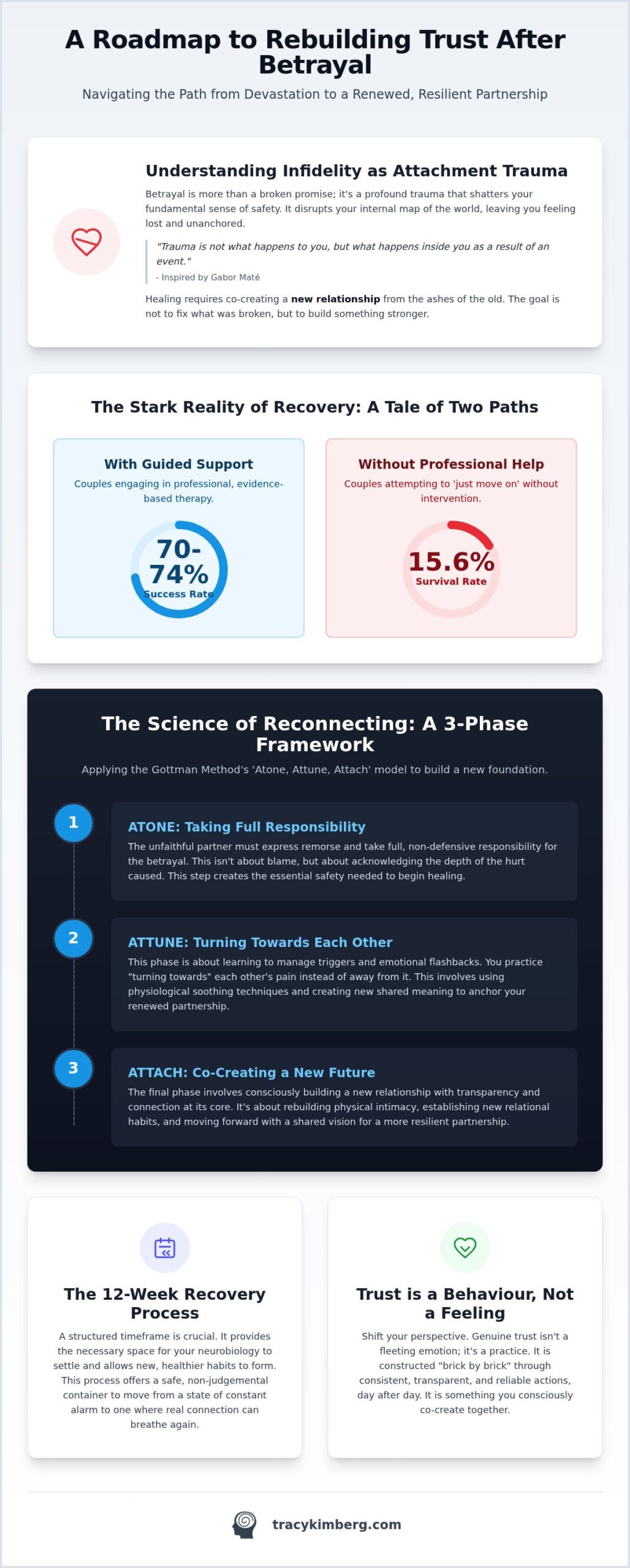
Rebuilding trust isn’t a mystery; it’s a science. The Gottman Method’s three-phase model-Atone, Attune, and Attach-remains the gold standard for couples in 2026. Research suggests that couples who engage in professional, evidence-based therapy have a success rate between 70% and 74%, whilst only 15.6% of relationships survive without such intervention. By following this roadmap, you move from reactive, painful arguments to a place of proactive understanding. It provides a scaffold for the heavy lifting of emotional repair.
Applying Gabor Maté’s trauma-informed lens allows us to look deeper than the act itself. Often, the choices that led to the affair were misguided coping mechanisms for unresolved personal pain or relational gaps. Understanding this “why” without using it as an excuse is vital for learning how to rebuild trust after cheating. It allows you to address the root causes rather than just the symptoms of the betrayal.
The Gottman Method: Building the Sound Relationship House
The first phase, Atonement, requires the unfaithful partner to take full responsibility. Once the air begins to clear, you move into Attunement. This is where you learn to “Turn Towards” each other rather than away. You start creating “Shared Meaning,” which acts as a new set of values to anchor your partnership. Crucially, we use physiological soothing techniques to manage the intrusive thoughts and heart-pounding anxiety that haunt the hurt partner. This structured approach helps you regulate your nervous system so real conversation can happen.
Esther Perel and the Crisis of Identity
Whilst Gottman provides the structure, Esther Perel offers the psychological depth. She suggests that an affair is often an expression of longing for a lost version of oneself. By shifting the narrative from “victim and perpetrator” to “hurt and unfaithful,” we open a door for deeper healing. This isn’t about shifting blame; it’s about understanding the complex duality of betrayal and longing. This perspective helps you foster a new type of intimacy that is far more transparent than your original bond ever was. If you feel lost in the complexity of these emotions, my 12-Week Relationship Recovery Process provides a steady hand to guide you through this transition.
By weaving these research-based tools together, you create a safety net. You’re no longer just “getting over it”; you’re actively dismantling the old, dysfunctional patterns. This process ensures that the new partnership you build is grounded in honesty and a sophisticated understanding of each other’s emotional worlds. Learning how to rebuild trust after cheating becomes a shared mission rather than a solitary burden.
Emotional vs. Physical Infidelity: Navigating the Nuances of Betrayal
Betrayal is rarely a monolith. Whilst society often views physical infidelity as the ultimate transgression, the “secrecy” of an emotional affair can be just as devastating, if not more so. In a physical encounter, the violation is often seen as a lapse in judgement or a search for variety. However, emotional infidelity involves the systematic redirection of intimacy, time, and vulnerability away from the partnership and towards an outsider. This creates a unique challenge when learning how to rebuild trust after cheating, as the hurt partner often feels they have been “replaced” in the other’s heart rather than just their bed.
The recovery process for both types remains rooted in total transparency and radical honesty. Whether the betrayal was a one-night stand or a year-long secret correspondence, the path back to connection requires the same dismantling of lies. To identify where a friendship has crossed into emotional infidelity, we look for the “line” of secrecy. If you are sharing dreams, frustrations, or daily details with someone else whilst consciously hiding that connection from your partner, the boundary has been breached. This secrecy creates a “window” to the outsider and a “wall” against the spouse, which is the reverse of a healthy relationship structure.
Healing After an Emotional Affair
Recovery here focuses on rebuilding the emotional wall around the couple and reopening the window between them. The hurt partner often experiences the pain of “emotional replacement,” feeling that their internal world has been shared with a stranger. To heal, you must establish clear digital boundaries as a team. This might involve social media transparency or shared passwords, not as a permanent surveillance state, but as a temporary “crutch” to support the relationship whilst trust is still fragile. It’s about proving that the secret world has been fully dismantled.
Addressing Physical Betrayal and Sexual Intimacy
Physical betrayal is a profound violation of bodily safety and self-esteem. The first step in the “Atonement” phase is ensuring physical safety, which often begins with medical check-ups and clear STI testing. This isn’t just about health; it’s a symbolic act of taking responsibility for the partner’s well-being. Re-introducing physical closeness must be a slow, consensual journey. You might start with non-sexual touch, like holding hands or sitting closely, to recalibrate the nervous system. Understanding how to rebuild trust after cheating in the bedroom requires patience; the erotic life cannot be forced back into existence whilst the trauma response is still active. By honouring these nuances, you allow a more authentic, transparent intimacy to eventually take root.
A Structured Path to Healing: The 12-Week Relationship Recovery Roadmap
Rebuilding a partnership after betrayal isn’t a linear process; it’s a journey that requires a reliable map. My 12-Week Relationship Recovery Process provides that map. It offers a structured, transformational path that moves you from the raw agony of discovery to a place of stable connection. This timeframe isn’t chosen at random. It takes about 12 weeks for the neurobiology of trauma to begin to settle. This allows your nervous system to move out of a constant state of “high alert” so you can actually form new, healthier habits. Whether we meet face-to-face or through online therapy, I provide a safe, non-judgemental environment where both of you can speak your truth without fear of the session spiralling out of control.
Phase 1: Crisis Stabilisation and Atonement
During weeks one to four, our primary goal is stopping the “bleeding”. We establish immediate transparency rules to lower the hurt partner’s anxiety. This is where the unfaithful partner must answer the hard questions with radical honesty. Deflection and defensiveness only fuel the fire. We also identify specific triggers within your home environment, creating strategies to manage them so you aren’t constantly re-traumatised by small, everyday moments. This phase is about creating enough safety to eventually breathe again.
Phase 2: Attunement and Understanding
In weeks five to eight, we begin to explore the “why”. This isn’t about making excuses for the affair; it’s about identifying the relational gaps that existed. Using Gottman-based exercises, we work on rebuilding your “Love Maps”-the deep knowledge of each other’s inner worlds. We look at your individual histories and attachment styles to understand the dynamics that influenced the partnership. This is a vital step in learning how to rebuild trust after cheating, as it addresses the roots of the problem rather than just the symptoms. It’s about understanding the “why” whilst holding the line on accountability.
Phase 3: Attachment and Re-imagining the Future
The final weeks, nine to twelve, are about vision casting. We co-create a “Relationship Contract” for this new version of your couplehood. We focus on conscious connection and practical ways to prevent future drift into the “roommate phase”. By the end of the programme, you’ll have more than just a patched-up relationship; you’ll have a more resilient, transparent bond. If you’re ready to commit to this work, the 12-Week Relationship Recovery is the most effective way to ensure your partnership doesn’t just survive, but thrives.
Healing is an active, evolving experience rather than a static treatment. If you are tired of the constant rows that lead nowhere, I invite you to enrol in the 12-Week Relationship Recovery Process and start co-creating your new future together.
Is Your Partnership Ready for Recovery? Taking the First Step
Deciding to stay after a betrayal is one of the most courageous choices a person can make. You might be asking yourself the same question every morning: “Can I ever trust again?” It is a heavy burden to carry, but it helps to reframe what trust actually is. In my work as a relationship specialist, I teach couples that trust is not a static feeling you wait for; it is a built behaviour. It is something you consciously choose to construct through daily, transparent actions. Understanding how to rebuild trust after cheating involves moving away from the idea that trust will simply “return” one day. Instead, we treat the recovery process as a proactive adventure where you co-create a partnership that is more resilient than the one that came before.
I am here to act as your Wise Guide through this complexity. My role is to provide the clinical expertise and the compassionate, non-judgemental space you need to navigate this transition. We don’t just look at the weight of the problem; we focus on the possibility of a healthier, more honest future. Healing is not a clinical necessity to be endured, but an evolving experience that can lead to profound personal and relational growth.
Criteria for Infidelity Recovery
Not every relationship is ready for the deep work of recovery immediately. To ensure you have the best chance of success, certain foundations must be in place. I look for these three key signs amongst the couples I support:
- Mutual Willingness: Both partners must be willing to engage in the process. It is perfectly normal to feel sceptical, hurt, or even angry, but there must be a shared “yes” to showing up for the work.
- Total Cessation: The affair must have ceased completely. This means all contact with the third party is severed, providing the “clean air” necessary for the relationship to breathe again.
- A Shared Vision: There should be a mutual desire to understand the past, not to dwell on it, but to protect the future of the partnership or the family unit.
How to Begin Your Transformation
Starting this journey is simpler than it feels in the heat of a crisis. We begin with a safe, non-judgemental initial consultation where we can explore your unique situation. I offer the flexibility of online therapy, which many couples find invaluable for maintaining absolute privacy whilst fitting sessions into their busy lives. Whether we meet online or face-to-face, the goal remains the same: providing you with a structured roadmap to move from devastation to connection. If you are ready to stop the cycle of rows and start learning how to rebuild trust after cheating, I invite you to book a session today. Let’s begin your 12-week recovery journey and start building the partnership you both deserve.
Co-creating Your New Relationship Adventure
The path from betrayal to a renewed partnership is rarely a straight line, but it’s a journey you don’t have to walk alone. We’ve explored how viewing infidelity as attachment trauma allows you to address the root causes of pain whilst using Gottman’s “Atone, Attune, Attach” model to restore safety. Remember that trust isn’t a static feeling that simply returns; it’s a conscious behaviour you build through daily, transparent actions. By understanding how to rebuild trust after cheating through a structured, research-based lens, you move away from the weight of the past and towards a more resilient, honest future.
I am here to guide you through this complexity with my signature 12-Week Relationship Recovery Process. Whether you choose online therapy for absolute privacy or face-to-face support, I provide a safe, non-judgemental space to facilitate your transformation using specialised expertise in Gottman and Perel methodologies. You’ve already taken the hardest step by acknowledging the pain; now, let’s take the next one together. Book your initial Relationship Recovery consultation with Tracy Kimberg today and begin the work of co-creating the partnership you both deserve. Healing is possible, and your new story starts here.
Frequently Asked Questions
How long does it typically take to recover from infidelity in a relationship?
Recovery is an evolving experience rather than a quick fix. Research suggests a timeline of two to five years for full reconciliation and trust restoration. This doesn’t mean you’ll be in crisis for that entire period, but it takes time for the attachment trauma to heal and for the “Atone, Attune, Attach” phases to complete. Patience is essential whilst you co-create a new partnership that feels safe and transparent.
Is it possible to truly forgive and trust a partner after they have cheated?
Yes, it is possible, though trust is a built behaviour rather than a static feeling. Forgiveness isn’t about forgetting; it’s about releasing the weight of the betrayal so it no longer controls your future. Couples who engage in professional therapy have success rates between 70% and 74%. True trust returns when the unfaithful partner demonstrates consistent, radical honesty and transparency over a sustained period, proving that the secret world has been dismantled.
What is the difference between an emotional affair and a close friendship?
The primary difference lies in secrecy and the redirection of intimacy. A close friendship is transparent and respects the boundaries of your relationship. An emotional affair involves sharing dreams, frustrations, or vulnerabilities with an outsider whilst consciously hiding that connection from your partner. This creates a “window” to the outsider and a “wall” against the spouse. If you’re wondering how to rebuild trust after cheating of an emotional nature, the first step is closing that window completely.
Will our counsellor take sides or judge the unfaithful partner during sessions?
No, a professional counsellor creates a safe, non-judgemental environment for both partners. My role is to act as a Wise Guide, not a judge. Whilst I maintain strict accountability for the betrayal, I also use a trauma-informed lens to understand the underlying relational gaps. Both partners must feel heard and supported for healing to occur. We focus on the systemic dynamics of the relationship rather than labelling one person as the permanent villain.
Can online couples counselling be as effective as face-to-face sessions for infidelity?
Online therapy is highly effective and often preferred by couples seeking absolute privacy or flexibility. It allows you to engage in deep, transformational work from the comfort of your own home, which can sometimes make vulnerable conversations feel safer. Research shows that the therapeutic alliance, the connection between you and your therapist, is the strongest predictor of success, regardless of whether the sessions are conducted through a screen or face-to-face in a clinical setting.
What if my partner refuses to go to counselling after an affair has been discovered?
You can’t force a partner to engage, but you can start your own healing process. Individual therapy for adults is a powerful way to manage your own trauma response and clarify what you need from the relationship. Often, when one partner begins to set healthy boundaries and work on their own emotional health, it can shift the dynamic and encourage the other to eventually join the 12-Week Relationship Recovery Process or similar counselling.
How do we handle the ‘intrusive thoughts’ and triggers that keep coming up daily?
Intrusive thoughts are a hallmark of attachment trauma and require physiological soothing. When a trigger occurs, your nervous system enters a state of “high alert.” We use research-based tools to help you regulate these responses in the moment. Learning how to rebuild trust after cheating involves the unfaithful partner providing immediate, patient reassurance rather than getting defensive. Over time, as transparency becomes the new norm, these triggers lose their power and intensity.
What is the 12-Week Relationship Recovery Process, and is it right for us?
The 12-Week Relationship Recovery Process is my signature structured programme designed to move couples from crisis to connection. It’s right for you if both partners are committed to total honesty and severing all ties with third parties. We move through specific phases of stabilisation, understanding the “why” behind the affair, and re-imagining your future. This timeframe provides the necessary space for your neurobiology to settle whilst you build a more resilient, transparent bond.

Article by
Tracy Kimberg
Tracy Kimberg is a Relationship Expert, Couples Therapist and Coach with a dedicated focus on helping couples and individuals rebuild connection, trust and emotional safety in their relationships. Drawing on the research of John and Julie Gottman, the relational insights of Esther Perel, and years of hands-on therapeutic experience, Tracy offers a warm, non-judgemental and deeply compassionate approach to modern relationships.
Based in Dorset, Tracy works with couples navigating communication breakdowns, betrayal, intimacy challenges, separation, family dynamics and life transitions. Known for creating a safe and grounded therapeutic space, she combines practical tools with emotional depth to help clients move beyond survival patterns and towards meaningful, lasting change.
With a reputation for empathy, professionalism and dedication to her clients’ growth, Tracy is passionate about helping people feel seen, understood and empowered — both within their relationships and within themselves.
Disclaimer
Disclaimer:
The information shared in this article is intended for educational and informational purposes only and should not be considered a substitute for professional therapeutic, psychological, medical or legal advice. Every individual and relationship is unique, and the perspectives offered are based on general therapeutic principles, research and professional experience.
Reading this article does not establish a therapist-client relationship with Tracy Kimberg. If you are experiencing significant emotional distress, relationship crisis, trauma, or mental health concerns, it is important to seek support from a qualified professional appropriate to your individual circumstances.
All content remains the intellectual property of Tracy Kimberg and may not be reproduced or distributed without permission.