

What if the crushing weight of silence in your home isn’t actually a sign that love has disappeared, but a signal that your current behaviour and way of relating have simply reached their limit? Many couples reach a point where they feel more like polite roommates or combatants in a never-ending cycle of circular arguments, leading them to wonder when is it too late for marriage counselling. It’s a heavy question, often carried alongside the fear of how a split might impact the children or the quiet grief of losing a once-vibrant connection.
We understand that reaching out for help can feel daunting when you’re already emotionally exhausted. You deserve to know whether your bond is salvageable or if it’s time to transition with grace. This article will help you recognise the psychological indicators of a relationship in crisis and explain how a structured, research-based approach can provide the clarity you’ve been searching for. We’ll explore how professional guidance helps you move from a place of stuckness into a future that honours your long-term well-being, whether that involves a renewed partnership or a conscious, amicable separation.
Key Takeaways
- Understand that most couples wait an average of six years before seeking support, meaning your fear of being “too late” is often a symptom of fatigue rather than a lack of love.
- Identify the specific psychological markers, such as contempt and stonewalling, that help determine when is it too late for marriage counselling and how these patterns can be reversed.
- Learn how to navigate the “ambivalence trap” when one partner is leaning out, ensuring both individuals feel heard and respected throughout the process.
- Discover why a successful therapeutic outcome can include conscious separation, providing a mature framework for those who decide to part ways.
- Explore how a structured 12-week recovery programme offers a clear roadmap out of circular arguments and toward lasting emotional clarity.
The Fear of Being Too Late: Assessing Your Relationship’s Vital Signs
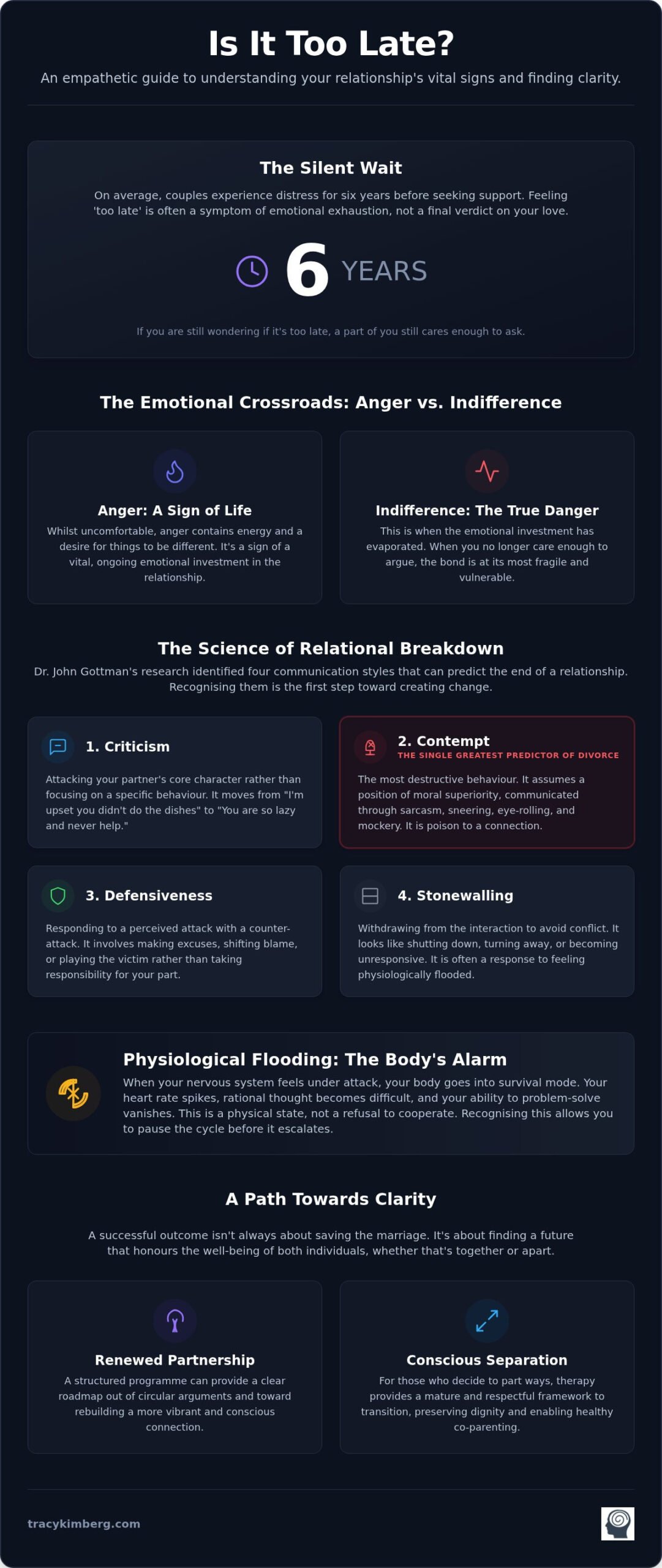
The nagging question of when is it too late for marriage counselling usually surfaces during moments of profound exhaustion. It’s a natural response to the weight of carrying unresolved conflict for years on end. Research from the Gottman Institute indicates that, on average, couples wait six years from the onset of distress before they finally seek professional support. By the time many partners reach out, they aren’t just unhappy; they are emotionally depleted. This fatigue often masks the difference between a relationship that has truly died and one that is simply dormant, buried under layers of unexpressed needs and protective walls.
Couples therapy is frequently viewed as a final emergency measure, but the only real prerequisite for starting is a small spark of curiosity. If you’re still asking if it’s too late, there’s likely a part of you that still cares enough to wonder. We often mistake the silence of a suppressed relationship for its end, but silence can also be a protective mechanism that preserves what’s left until a safe environment is found to unpack it.
The Difference Between Feeling Done and Being Done
Many people arrive at my office stating they’ve reached their emotional threshold. They feel they can no longer try because the effort itself has become painful. However, there’s a vital distinction between active anger and indifference. Anger, whilst uncomfortable, contains energy and a desire for things to be different. It’s a sign of life. Indifference, the true danger zone, is where the emotional investment has completely evaporated. When you no longer care enough to argue, the bond is at its most fragile.
The “Roommate Phase” often feels like the end of the road. You live parallel lives, avoiding the friction of intimacy to maintain a fragile peace. Whilst this feels like a dead end, it’s often a call for recalibration. It suggests the old way of relating has failed, but it doesn’t mean a new, more vibrant connection is impossible to build.
The “Last Resort” Myth in Couples Therapy
We often treat counselling as a “break glass in case of emergency” solution, yet waiting until you’re on the brink of divorce makes the work significantly harder. When resentment becomes calcified, it acts like a barrier that prevents even the most well-intentioned gestures from landing. Proactive engagement allows you to address the cracks before they become chasms. Relationship coaching is a proactive adventure in self-discovery. By shifting the perspective from “saving a sinking ship” to “exploring new horizons,” you remove the stigma of failure and replace it with the possibility of growth.
The Science of Relational Breakdown: Contempt, Criticism, and the Four Horsemen
Research by Dr John Gottman has revolutionised how we understand the trajectory of love. He identified four specific communication patterns, known as The Four Horsemen, that can predict the end of a relationship with startling accuracy. When you’re questioning when is it too late for marriage counselling, you’re often actually observing these horsemen in your daily interactions. Identifying them isn’t a death sentence for your marriage; rather, it’s the first step in organising a more conscious way of relating. By naming the behaviour, we strip it of its power to destroy.
One of the most significant barriers to healing is a physiological state called “flooding”. This occurs when your nervous system feels under attack, causing your heart rate to spike and your brain to lose its capacity for creative problem-solving. You aren’t being difficult; your body has simply gone into survival mode. When you’re flooded, you can’t hear your partner’s perspective, and you certainly can’t find a compromise. Recognising this physical state allows you to stop the cycle before it turns into another circular argument.
Contempt: The Poison of the Partnership
Contempt is the most destructive of the horsemen because it involves a position of moral superiority. It’s the eye-roll, the sneer, or the belittling comment that says, “I am better than you.” Research has shown that couples living with high levels of contempt actually suffer more physical ailments, as the chronic stress takes a measurable toll on the immune system. The antidote isn’t just stopping the insults; it’s actively building a culture of appreciation and respect, even in small, everyday moments. Shifting your focus toward what your partner is doing right can begin to neutralise the acid of contempt.
Stonewalling and the Pain of Emotional Withdrawal
Stonewalling occurs when one partner shuts down or physically withdraws during a conflict. Whilst it often feels like a cold act of rejection to the partner being shut out, it’s usually a misguided attempt to self-protect from emotional flooding. The partner left in the silence feels a profound sense of abandonment, which only fuels more criticism. To break this, we use structured “time-outs” to lower the physiological temperature before re-engaging. If you’re ready to move past these patterns, exploring Relationship Counselling and Coaching for Couples can provide the safe environment needed to lower your guard and reconnect.
The Ambivalence Trap: Navigating the “Leaning Out” Partner Dynamic
It’s a common misconception that both partners must enter the therapy room with equal levels of enthusiasm. In reality, most couples experience a “leaning in” partner who is desperate for change and a “leaning out” partner who feels hesitant, blamed, or simply exhausted. If you are the one holding back, your feelings are valid. You might fear that starting the process will only result in a list of your perceived failures. This ambivalence doesn’t mean the relationship is over; it means you’re protecting yourself from further pain whilst you decide if you have the energy to continue.
Determining when is it too late for marriage counselling often depends on whether that hesitation can be transformed into a tiny spark of curiosity. We often see what Esther Perel describes as the clash between domesticity and desire. The very security we build together can stifle the erotic intelligence that once fuelled our connection. When a partner leans out, it may not be because they stop loving you, but because the weight of the “roommate” dynamic has become unbearable. Discernment coaching provides a space to gain clarity on your next steps without the immediate pressure of committing to a long-term reconciliation effort.
When One Partner Has Already “Checked Out”
The “Quiet Quit” of a marriage is often more dangerous than loud conflict. When a partner stops complaining, it usually signifies they’ve stopped hoping for change. Inviting a reluctant partner into a safe, non-judgemental space requires moving away from demands and toward gentle invitations. If your partner refuses to attend, individual relationship counselling can still be a powerful tool. By changing your own behaviour, you can often shift the systemic dynamic of the partnership from the inside out.
Rebuilding Trust After Infidelity or Betrayal
Is it too late after an affair? Not necessarily. Whilst betrayal is a profound trauma, it can also act as a brutal “alarm clock” that wakes a relationship from years of complacency. Moving beyond the trauma of cheating requires a structured recovery process. It involves unpacking the systemic issues that preceded the betrayal whilst holding the person who stepped out accountable. Many couples find that the bond built after an affair is more honest and resilient than the one they had before.
Moving Beyond the “All or Nothing” Mindset: The Value of Conscious Separation
Many couples enter my office believing that if they don’t walk out hand-in-hand, the process has failed. This binary thinking adds immense pressure to an already fragile situation. When you ask when is it too late for marriage counselling, you might be looking for permission to stop fighting a battle that feels already lost. Success in therapy isn’t always about reconciliation; it’s about finding the truth of your connection. Sometimes, the most courageous thing you can do for one another, and for your children, is to admit that the romantic chapter of your lives has concluded.
Professional support during this transition prevents the “bitter divorce” narrative that so often consumes families. Instead of a high-conflict legal battle, you can choose a path that prioritises emotional health and functional co-parenting. By maintaining healthy dynamics now, you ensure that the impact on your children is one of transition rather than trauma. It’s about moving from being “ex-partners” to becoming “co-creators” of a new family structure that honours everyone involved.
What is Conscious Separation?
Conscious separation is the act of navigating the end of a relationship with deep emotional awareness. Unlike a legal-only separation that ignores the complex psychological bond you’ve built, this approach honours your shared history and the humanity of both partners. I provide specialised Conscious Approached Divorce and separation support to help couples untangle their lives whilst preserving their dignity. It’s about recognising that whilst the partnership is changing form, the respect you have for one another doesn’t have to vanish.
Ending a Relationship Without Losing Yourself
Closure is not something that just happens; it’s something you actively create by making sense of the relationship’s end. Therapy provides a neutral centre where you can discuss difficult logistics without the conversation descending into high conflict. It allows you to process the grief of the “old” life whilst preparing for the “new” one. A “good” ending is far more valuable for your long-term emotional health than a “bad” marriage that erodes your sense of self. When you’re trying to figure out when is it too late for marriage counselling, remember that the goal is clarity, not just staying together at any cost.
Reclaiming Your Future: The 12-Week Relationship Recovery Programme
For many couples, the ambiguity of open-ended therapy creates its own kind of anxiety. You might worry that you’ll spend months talking in circles without ever reaching a resolution. This is where Tracy Kimberg’s 12-Week Relationship Recovery Process offers a vital shift in perspective. Instead of wondering when is it too late for marriage counselling, you are invited to step into a clearly defined roadmap designed to move you from crisis management to intentional connection. This structured approach provides the containment and safety needed to explore deep-seated patterns without feeling overwhelmed by the weight of the past.
This programme isn’t just about “fixing” what is broken; it’s about reorganising the very foundation of your partnership. By blending clinical expertise with a warm, person-centred approach, we address the specific anxieties and disconnects that have kept you stuck. We look at the systemic roots of your conflict, drawing on trauma-informed perspectives to understand why certain behaviours have become calcified. It’s a journey of rediscovery that treats the relationship as a living, evolving entity rather than a static problem to be solved.
Why a Structured 12-Week Approach Works
A set timeline acts as an antidote to the feeling of being “lost” in the therapeutic process. When you know there’s a beginning, a middle, and an end, the work feels more manageable. Having clear milestones for rebuilding trust and intimacy allows you to track your progress in real-time. We move systematically through the layers of your relationship, starting with de-escalating the immediate conflict and moving toward the creation of shared meaning and future goals. This progression ensures that you aren’t just surviving your marriage, but actively choosing how to inhabit it.
Your Journey in a Safe, Non-Judgemental Space
Whether you choose face-to-face sessions or Online Therapy, the environment is carefully crafted to be a neutral centre of healing. As a Wise Guide, I don’t lecture or take sides; instead, I facilitate a supportive conversation where both voices can finally be heard. This safe space is essential for lowering the physiological “flooding” we discussed earlier, allowing you to engage with your partner from a place of curiosity rather than defence. It’s an invitation to turn your relationship into a proactive adventure in self-discovery and mutual growth.
If you’re ready to stop the cycle of circular arguments and find the clarity you deserve, Book a discovery call to see if the 12-Week Relationship Recovery Process is right for you.
Choosing Clarity Over Uncertainty
Deciding when is it too late for marriage counselling isn’t about finding a fixed date on a calendar; it’s about recognising when your current patterns have reached their limit. We’ve explored how emotional fatigue can mask a relationship’s potential and how even the most entrenched conflict can be navigated with a research-based lens. Whether you’re facing the Four Horsemen or navigating the ambivalence of a “leaning out” partner, the goal of therapy is to replace confusion with profound clarity. My work is inspired by the methodologies of Gottman and Perel, offering a safe, non-judgemental environment for both online and face-to-face therapy.
Success isn’t defined solely by staying together, but by the maturity and awareness you bring to your next chapter. As a specialist in both relationship recovery and conscious separation, I am here to guide you through this transition with dignity. You don’t have to carry this weight alone any longer. There is a path through the silence and the noise toward a future that honours your long-term emotional health.
Begin your journey to clarity with the 12-Week Relationship Recovery Process. It’s time to discover what’s truly possible for your heart and your home.
Frequently Asked Questions
Is it too late for marriage counselling if my partner says they no longer love me?
A declaration that love has vanished is often a cry for help rather than a final verdict. In my experience, these feelings are frequently buried under layers of resentment or emotional flooding. When you ask when is it too late for marriage counselling, remember that feelings are fluid. If both partners are willing to be curious about why the spark faded, there is often a path back to a deeper, more mature form of love.
What are the signs that a marriage cannot be saved even with therapy?
A relationship is rarely unsalvageable unless there is persistent physical abuse or a complete refusal to be curious about your own behaviour. If one partner has fundamentally moved on and refuses to engage in any form of therapeutic dialogue, the romantic bond may have reached its natural end. However, even in these cases, therapy provides the clarity needed to transition into a healthy co-parenting dynamic or a conscious separation.
Can couples therapy work if only one person is willing to change their behaviour?
It’s a common myth that both people must change simultaneously for progress to happen. A relationship is a systemic loop; when you change your own behaviour, your partner is naturally invited to respond differently. By using individual therapy for adults, you can learn to set healthier boundaries and communicate your needs more effectively. This often ripples through the entire partnership and creates space for the other person to follow suit.
How long does it typically take to see results from relationship counselling?
Many couples begin to feel a shift in the emotional temperature within the first four sessions. Whilst deep-seated patterns take time to rewire, my signature 12-Week Relationship Recovery Process provides a structured roadmap that ensures you aren’t just talking in circles. This timeline helps reduce the anxiety of the unknown and gives you clear milestones to celebrate as you move from crisis management toward intentional connection and lasting intimacy.
Is it too late to seek help after years of emotional neglect or “the roommate phase”?
The roommate phase is often a protective shell built to avoid the pain of constant conflict. It’s a sign that your old way of relating has failed, not that your love has died. People often worry when is it too late for marriage counselling after years of neglect, but these periods often contain valuable data about what needs to change. We can work together to dismantle these walls and rediscover your connection.
What happens if we go to counselling and still decide to separate or divorce?
If you decide to part ways, our work shifts toward a Conscious Approached Divorce and separation. Success in therapy isn’t always about staying together; it’s about gaining the clarity to make the right decision for your long-term emotional health. We focus on ending the romantic partnership with dignity and respect, ensuring that you can co-parent effectively and move forward without the weight of unresolved bitterness or trauma.
Can the Gottman Method really help if there has been an emotional affair?
Yes, the research-based Gottman Method is specifically designed to address the trauma of betrayal. Whether it’s an emotional or physical affair, we work on a framework of atonement and rebuilding trust. This process involves absolute transparency and a willingness to understand the systemic cracks in the relationship’s foundation. Many couples find that the bond they build after a betrayal is actually more resilient and honest than the one they had before.
How do I know if I need individual therapy or couples coaching for my relationship issues?
If the primary distress is between you, couples coaching is the best tool to address the shared dynamic. However, if you find that your own anxiety or past trauma is the main driver of your reactions, individual therapy for adults may be necessary. Often, I suggest a 12-Week Relationship Recovery Process for the couple whilst one or both partners engage in individual work to ensure a holistic approach to their emotional well-being.

Article by
Tracy Kimberg
Tracy Kimberg is a Relationship Expert, Couples Therapist and Coach with a dedicated focus on helping couples and individuals rebuild connection, trust and emotional safety in their relationships. Drawing on the research of John and Julie Gottman, the relational insights of Esther Perel, and years of hands-on therapeutic experience, Tracy offers a warm, non-judgemental and deeply compassionate approach to modern relationships.
Based in Dorset, Tracy works with couples navigating communication breakdowns, betrayal, intimacy challenges, separation, family dynamics and life transitions. Known for creating a safe and grounded therapeutic space, she combines practical tools with emotional depth to help clients move beyond survival patterns and towards meaningful, lasting change.
With a reputation for empathy, professionalism and dedication to her clients’ growth, Tracy is passionate about helping people feel seen, understood and empowered — both within their relationships and within themselves.
Disclaimer
Disclaimer:
The information shared in this article is intended for educational and informational purposes only and should not be considered a substitute for professional therapeutic, psychological, medical or legal advice. Every individual and relationship is unique, and the perspectives offered are based on general therapeutic principles, research and professional experience.
Reading this article does not establish a therapist-client relationship with Tracy Kimberg. If you are experiencing significant emotional distress, relationship crisis, trauma, or mental health concerns, it is important to seek support from a qualified professional appropriate to your individual circumstances.
All content remains the intellectual property of Tracy Kimberg and may not be reproduced or distributed without permission.