

What if the end of your romantic relationship wasn’t the end of your family, but the birth of a new, professional partnership? It’s exhausting to feel trapped in the same old arguments even after you’ve moved into different homes. You likely carry a heavy weight of guilt, wondering how this friction is affecting your children’s sense of security. I understand that the transition from partners to co-parents is one of the most complex psychological shifts a person can make. Seeking co-parenting counselling after separation UK isn’t an admission of failure; it’s a proactive investment in your children’s long-term emotional health.
In this guide, you’ll discover how professional support can transform high-conflict communication into a healthy, child-centred alliance. We’ll explore how to find emotional closure from the romantic breakdown whilst building a peaceful, business-like relationship that lets your children thrive. By understanding the intricacies of your interpersonal dynamics, you can move from a place of reactive pain to one of calm, intentional parenting that honours the needs of every family member.
Key Takeaways
- Learn how to reframe your relationship from a romantic bond into a professional co-parenting alliance focused entirely on your child’s well-being.
- Understand why co-parenting counselling after separation UK provides the psychological foundation for healing that legal mediation often misses by addressing the root of emotional conflict.
- Discover practical communication tools like the BIFF method to reduce friction and ensure your digital interactions remain brief, informative, friendly, and firm.
- Explore the psychological impact of “triangulation” and learn how to protect your children from feeling caught in the middle of adult dynamics.
- Find out how a structured approach to conscious separation can help you achieve genuine emotional closure whilst honouring the family system’s need for stability.
Transitioning: From Partners to Co-Parenting Allies
The end of a marriage or long-term partnership often feels like a collapse, but in the context of a family system, it’s actually a profound renovation. You’re moving from a shared life of intimacy to what relationship experts call a “parental alliance.” Understanding What is Co-Parenting involves recognising that whilst the romantic bond has dissolved, the organisational bond must remain intact. This is where co-parenting counselling after separation UK becomes such a vital tool. It helps you view your ex-partner not as a source of past pain, but as a colleague in the most important venture of your lives: raising your children.
In the UK, the legal framework of “Parental Responsibility” provides the structural bones of this arrangement, ensuring both parents have a say in major life decisions. However, the law cannot teach you how to speak to each other without venom. It doesn’t provide the emotional tools to manage the transition from a private couple to a public parenting team. That’s a psychological task, not a legal one.
The Identity Shift: Mourning the Partner, Meeting the Co-parent
Mourning the partner you lost is essential to meeting the co-parent you need. Many parents find themselves stuck because they’re still reacting to “romantic-era” triggers. If your ex-partner’s lateness used to feel like a personal slight against your marriage, it’s easy for that resentment to haunt your new arrangement. You aren’t just changing your living situation; you’re changing your internal identity.
Establishing new boundaries is how you protect your emotional energy. You’re moving from a “we” that shared a bed and a future to an “I” that collaborates on a schedule. This shift allows you to be accessible for the children without being vulnerable to the old relationship dynamics. It’s about creating a safe distance where respect can grow, even if love has faded.
The “Business of Parenting” Mindset
Think of your co-parenting relationship as a high-stakes business partnership. Your “product” is a stable, happy child. Professionalism in this context doesn’t mean being cold; it means being polite, purposeful, and predictable. When you adopt a business-like mindset, you learn to separate your personal feelings about your ex from their role as a mother or father. You might not like them as a person right now, but you can still value their contribution to your child’s life.
Sometimes, if conflict remains high, “parallel parenting” is a necessary first step. This involves limited direct contact whilst you both focus on your individual bonds with the children. Through co-parenting counselling after separation UK, most families eventually move beyond this into a more collaborative space. A Parental Alliance is a commitment to the child’s stability regardless of parental history.
The Psychological Architecture of Successful Co-Parenting
Even when a couple stops being a couple, the family system remains a living, breathing entity. To keep this system healthy, we must look at the psychological architecture that supports it. John Gottman’s “Sound Relationship House” is often used to build marriages, but its principles are equally powerful when adapted for separated families. The foundation of this new house isn’t romantic love; it’s emotional regulation. When you can manage your own triggers, you prevent the “Four Horsemen”—Criticism, Contempt, Defensiveness, and Stonewalling—from ruining handovers and turning simple logistics into battlegrounds. Engaging in co-parenting counselling after separation UK helps you identify these destructive patterns before they become the default setting for your new life.
A common structural flaw in post-separation families is “triangulation.” This happens when children are used as messengers or emotional buffers between parents. It places an unbearable psychological burden on a child to bridge the gap that the adults cannot. Managing the logistics of co-parenting after a divorce or separation is only half the battle; the other half is managing the “Shadow of the Third.” This term refers to how new partners or extended family members influence the dynamic. Often, the introduction of a new person triggers a fear of being replaced or losing influence, which can cause the co-parenting alliance to buckle. Recognising these fears as natural human responses is the first step toward neutralising them.
Breaking the Cycle of Conflict
Many separated parents find themselves trapped in “circular arguments.” These are the same fights you had whilst married, just dressed in different clothes. You might think you’re arguing about a school uniform, but you’re actually still litigating the reasons for the breakup. De-escalation starts with empathy. When you understand that your ex-partner’s rigid behaviour might stem from a fear of losing their connection to the children, it becomes easier to respond with calm authority rather than reactive anger. Using a structured 12-Week Relationship Recovery Process can help you dismantle these old triggers and find a new way of relating.
Creating a Secure Base for Children
Children don’t necessarily need two households that run exactly the same way. What they need is a “secure base” in both. Consistency in values and safety is far more important than having the same bedtime or screen-time rules. Your role is to support your child’s relationship with the other parent, even when your own heart is still healing. This means actively discouraging “Parental Alienation” behaviours, such as subtle eye-rolls or sighs when the other parent is mentioned. By honouring the other parent’s place in the system, you give your child permission to love both of you without guilt, which is the ultimate gift of a successful co-parenting alliance.
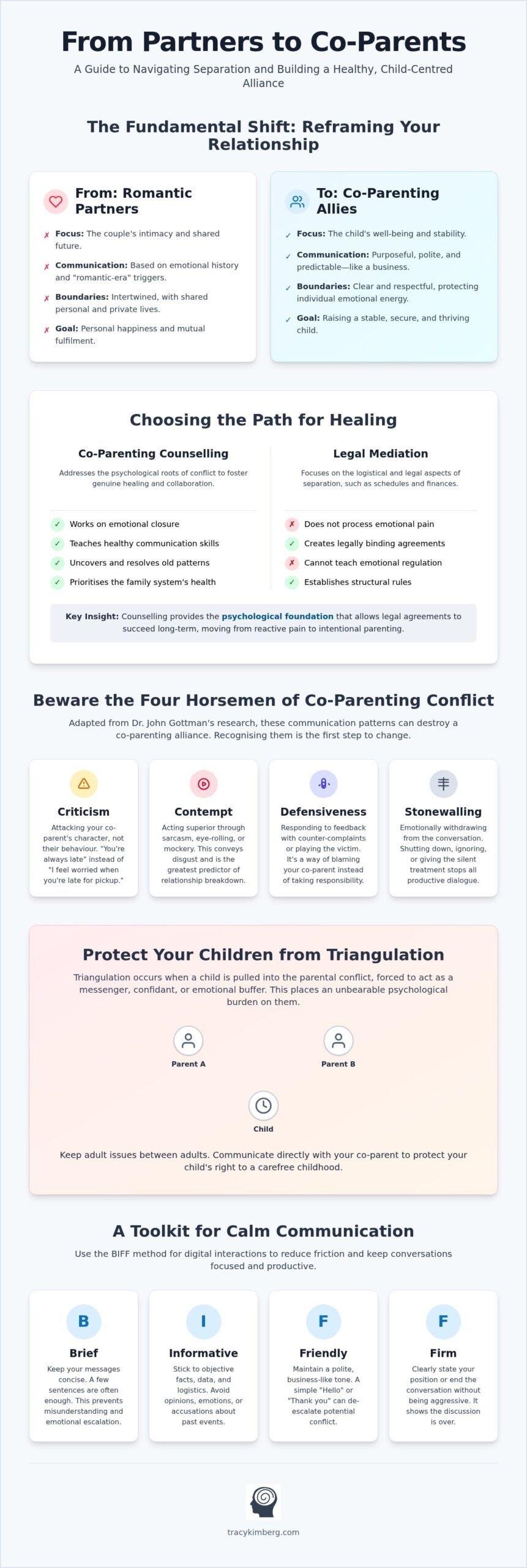
Co-parenting Counselling vs. Legal Mediation: Choosing the Path for Healing
Many families in the UK find themselves at a crossroads, unsure whether to head toward a solicitor’s office or a therapist’s room. Whilst legal mediation is a structured process designed to reach a settlement, it often focuses on the logistics of the “split” rather than the health of the “system.” Choosing co-parenting counselling after separation UK offers a fundamentally different experience. It’s a therapeutic journey that prioritises the healthy relationship between co-parents as the primary driver of a child’s security.
Mediation often fails when the underlying emotional trauma remains unaddressed. You can sign a document that dictates who has the children on a Tuesday, but a court order can’t force you to stop feeling resentful when your ex-partner arrives at the door. By providing a safe, non-judgemental space, counselling allows you to explore the relational breakdown without the crushing pressure of legal finality. This process often saves families thousands in legal fees by resolving the “heart” of the conflict, making the eventual legal paperwork a mere formality rather than a battlefield.
When Mediation Isn’t Enough
There are times when conflict is so high-intensity that a simple negotiation feels like trying to build a house on shifting sand. If your separation involved trauma, deep emotional disconnect, or the pain of infidelity, a trauma-informed approach is necessary. My 12-Week Relationship Recovery Process is specifically designed to help you navigate these choppy waters. It provides the tools to process the past so it no longer dictates your future interactions.
The Therapeutic Difference: Healing vs. Settlement
Mediation is largely about the “what”—the schedules, the finances, and the division of assets. Counselling, however, focuses on the “how”—the tone of your voice, the level of respect you show, and the internal healing required to move forward. It’s about building a long-term communication muscle that will serve you for years. Seeking co-parenting counselling after separation UK ensures you’re not just signing a contract, but actually changing the way you relate. Whilst mediation settles the past, counselling organises the future.
Practical Strategies for Reducing Conflict and Building a Parenting Charter
Moving from the psychological heavy lifting of restructuring your identity to the daily reality of two households requires a set of robust, practical tools. It’s one thing to agree in principle to a peaceful alliance; it’s quite another to maintain that peace when discussing school holiday dates or a forgotten PE kit. This is where co-parenting counselling after separation UK moves from theory into action. We work together to build a framework that protects your children from the “crossfire” of adult disagreements, ensuring their world remains predictable even when yours has changed significantly.
One of the most effective tools for managing digital friction is the “BIFF” method. When you communicate via text or email, ensure every message is Brief, Informative, Friendly, and Firm. This isn’t about being overly affectionate; it’s about being professional. By removing emotional “hooks” and focusing purely on the facts, you lower the temperature of the interaction. Proactive planning for Christmas, birthdays, and summer holidays also prevents the last-minute panic that often triggers old defensive patterns. A child-first strategy means looking at the calendar through their eyes, asking what will make them feel most secure and celebrated.
Communication Protocols for Two Households
Direct verbal negotiation can often lead to “flooding,” where one or both parents become emotionally overwhelmed. To prevent this, many families benefit from setting “office hours” for non-emergency parenting discussions. This simple boundary ensures that a Tuesday evening isn’t interrupted by a stressful debate about finances or discipline. Using shared digital calendars and dedicated co-parenting apps also reduces the need for direct contact, allowing you to coordinate logistics without the risk of a verbal clash. If a disagreement does arise, it’s vital to step away and resolve it privately. Children should never be the audience for your negotiations.
The Parenting Charter: A Living Document
A Parenting Charter is far more than a list of rules; it’s a shared declaration of values. Whilst legal agreements might focus on bedtimes or maintenance, the charter explores the “soul” of your parenting. It covers how you’ll handle screen time, nutrition, and discipline across both homes to provide a sense of continuity. This document is an act of Conscious Separation, moving away from demands and toward a shared commitment to your child’s character and health. As your children grow, the charter must grow with them. Regular “Relationship Check-Ups” even after separation ensure that your co-parenting bond remains healthy and responsive to the family’s evolving needs. To begin building your own family framework, you can explore the Conscious Approached Divorce and separation support available to help you navigate this transition with dignity.
Conscious Separation: How Professional Support Transforms Your Future
Separation is often framed as a collapse, but through the lens of systemic therapy, it is an opportunity for a profound restructuring. Moving from a state of crisis to a state of calm collaboration requires more than just time; it requires intention. Tracy Kimberg’s approach to Conscious Separation offers a pathway to emotional freedom, allowing you to uncouple with dignity whilst preserving the integrity of the family system. Choosing to engage in co-parenting counselling after separation UK is a courageous decision to stop the cycle of pain and start building a legacy of resilience for your children.
This transition is particularly delicate for older children. Specialized therapy for teenagers provides them with a neutral space to navigate the complex emotions of living between two homes. When children witness their parents handling a breakdown with maturity and respect, it changes their internal blueprint for future relationships. A “good divorce” isn’t an oxymoron; it’s a research-based outcome where the parental alliance remains a stable, non-anxious presence in the child’s life. By investing in this process now, you’re ensuring that the romantic breakdown doesn’t become a lifelong trauma for the next generation.
A Structured Path to Peace
Finding closure whilst simultaneously building a new partnership can feel overwhelming. This is why a structured approach is so effective. The 12-Week Relationship Recovery Process is designed to guide you through the psychological stages of letting go and moving forward. It provides the tools to process the past so that it no longer “haunts” your current parenting decisions. For many, individual therapy for adults is the best starting point, as it allows each parent to take accountability for their own emotional regulation before coming together to negotiate.
Modern family life is fast-paced, and managing separate households in the UK often leaves little room for traditional appointments. The availability of online therapy ensures that professional support is accessible and manageable, fitting into your new schedule without adding to the stress. Whether you prefer online sessions or face-to-face therapy, the focus remains on creating a proactive and positive adventure out of a difficult life transition.
Investing in Your Family’s Legacy
Think of co-parenting counselling after separation UK as an insurance policy for your child’s long-term mental health. You aren’t just resolving a schedule; you’re teaching your children how to handle life’s most difficult challenges with grace. Having a Wise Guide to navigate these complexities provides the clinical expertise and warm reassurance needed to demystify the therapeutic process. It transforms the experience from a clinical necessity into a powerful tool for growth. If you’re ready to move from conflict to a child-centred alliance, I invite you to book a session to begin your journey of conscious uncoupling and find the peace your family deserves.
Building a Legacy of Resilience for Your Family
Choosing to move beyond the friction of a breakdown is the most profound gift you can give your children. We’ve explored how transitioning from partners to professional allies requires a psychological identity shift; moving away from old romantic triggers and toward a child-centred alliance. By establishing a clear Parenting Charter and using practical communication tools, you create a secure base across two households. Unlike legal mediation, co-parenting counselling after separation UK addresses the emotional roots of conflict, ensuring your family system doesn’t just survive the split but actually heals.
My approach is grounded in a safe, non-judgemental environment, utilising a research-based framework inspired by experts like Gottman and Perel. Whether you need the structured support of the 12-Week Relationship Recovery Process or a space for conscious uncoupling, the goal is to transform crisis into calm collaboration. You don’t have to navigate this transition alone. I invite you to Book a Conscious Separation Consultation with Tracy Kimberg today. Your family’s future is a proactive adventure, and it starts with a single, courageous step toward peace.
Frequently Asked Questions
What is the difference between co-parenting counselling and mediation in the UK?
Co-parenting counselling is a therapeutic process focused on emotional healing and communication, whilst mediation is a structured legal negotiation for practical settlements. Counselling addresses the underlying trauma and relationship dynamics that often cause mediation to stall. By focusing on the psychological restructuring of the family, co-parenting counselling after separation UK helps you build a lasting alliance based on mutual respect rather than just a set of court-mandated rules.
How long does co-parenting counselling usually take to show results?
Every family’s journey is unique, but many parents begin to feel a shift in their communication within the first few sessions. For those seeking a structured path, the 12-Week Relationship Recovery Process provides a clear timeframe for achieving emotional closure and establishing new parenting boundaries. Results often manifest as reduced anxiety during handovers and a more predictable, business-like interaction that prioritises the children’s stability over old romantic grievances.
Can I attend co-parenting counselling if my ex-partner refuses to join?
You can certainly engage in this work individually. Whilst joint sessions are ideal for building a shared alliance, individual therapy for adults allows you to focus on your own emotional regulation and boundary-setting. When one parent changes their reactive behaviour, it often shifts the entire family dynamic. You’ll learn to manage your triggers and communicate more effectively, which can lead to co-parenting success even if the other parent isn’t actively participating yet.
Will co-parenting counselling help if there was infidelity in the marriage?
Infidelity introduces a layer of betrayal trauma that can make co-parenting feel impossible. Counselling provides a safe, non-judgemental environment to process this pain separately from your role as parents. The goal isn’t to reconcile the romantic bond but to ensure that the anger from the affair doesn’t seep into your parenting decisions. By addressing these deep emotional wounds, you can eventually view your ex-partner through a neutral, child-centred lens.
Is co-parenting counselling suitable for high-conflict separations?
High-conflict separations are precisely where therapeutic support is most needed. Standard legal routes often escalate tension, but co-parenting counselling after separation UK uses research-based techniques to de-escalate circular arguments. We focus on identifying the “Four Horsemen” of conflict and replacing them with professional, polite communication protocols. This structured intervention helps move the family system from a state of constant crisis into one of manageable, calm collaboration for the sake of the children.
How do we tell our children that we are starting co-parenting counselling?
It’s best to frame the sessions as a positive step toward making life easier for everyone. You might tell your children that you’re working with a Wise Guide to learn how to be the best parents possible in two separate homes. Reassure them that the counselling is about making sure they feel happy and secure. This transparency reduces their anxiety and demonstrates that both parents are committed to a peaceful, supportive family environment despite the separation.
Can co-parenting counselling be done online?
Online therapy is a highly effective and flexible option for busy UK parents managing separate households. It allows each parent to join from a comfortable, neutral space, which can often lower the initial tension of joint sessions. Tracy Kimberg offers both online and face-to-face therapy to ensure that professional support is accessible regardless of your location or schedule. This digital approach maintains the same level of clinical expertise and emotional safety as in-person meetings.
What happens if we can’t agree on anything during the sessions?
Disagreement is a natural part of the transition, and the role of the therapist is to help you navigate these impasses without falling back into old patterns. If a shared agreement feels out of reach, we may focus on parallel parenting strategies that allow each household to function independently whilst maintaining safety. The process prioritises finding a secure base for the child, even if the parents have different perspectives on non-essential lifestyle choices or household rules.

Article by
Tracy Kimberg
Tracy Kimberg is a Relationship Expert, Couples Therapist and Coach with a dedicated focus on helping couples and individuals rebuild connection, trust and emotional safety in their relationships. Drawing on the research of John and Julie Gottman, the relational insights of Esther Perel, and years of hands-on therapeutic experience, Tracy offers a warm, non-judgemental and deeply compassionate approach to modern relationships.
Based in Dorset, Tracy works with couples navigating communication breakdowns, betrayal, intimacy challenges, separation, family dynamics and life transitions. Known for creating a safe and grounded therapeutic space, she combines practical tools with emotional depth to help clients move beyond survival patterns and towards meaningful, lasting change.
With a reputation for empathy, professionalism and dedication to her clients’ growth, Tracy is passionate about helping people feel seen, understood and empowered — both within their relationships and within themselves.
Disclaimer
Disclaimer:
The information shared in this article is intended for educational and informational purposes only and should not be considered a substitute for professional therapeutic, psychological, medical or legal advice. Every individual and relationship is unique, and the perspectives offered are based on general therapeutic principles, research and professional experience.
Reading this article does not establish a therapist-client relationship with Tracy Kimberg. If you are experiencing significant emotional distress, relationship crisis, trauma, or mental health concerns, it is important to seek support from a qualified professional appropriate to your individual circumstances.
All content remains the intellectual property of Tracy Kimberg and may not be reproduced or distributed without permission.