

What if the conversation you dread most is actually the first step toward a more authentic life for both of you? Learning how to tell your partner you want a separation is often the heaviest burden a person can carry. You might find yourself trapped in a cycle of analysis paralysis, waiting for a perfect moment that never seems to arrive, whilst the weight of your unspoken truth grows heavier each day.
It’s natural to feel a profound sense of guilt, especially when you think about the children or the history you’ve built together. You’re likely terrified of their reaction, whether it’s a quiet collapse or a flash of anger. This guide offers a different perspective, grounded in psychological insight and research-based empathy. We will explore how to approach this transition with dignity and clarity, ensuring you protect the emotional well-being of everyone involved. You’ll gain a structured plan to handle the ending of this chapter with integrity, minimising collateral damage whilst honouring the connection you once shared. By the end, you’ll understand how to speak your truth without losing your compassion.
Key Takeaways
- Recognise that separation can serve as a “relational pause,” a space to gain perspective whilst honouring the history you have built together.
- Perform an internal “Why” audit to ensure your decision is rooted in deep psychological insight rather than a moment of fleeting frustration.
- Learn how to tell your partner you want a separation using a structured, compassionate approach that minimises trauma and preserves dignity.
- Navigate the immediate aftermath by setting clear boundaries around communication and living arrangements to protect your emotional health.
- Discover why professional support is vital to facilitate a conscious separation, helping you avoid high-conflict traps and protect your family unit.
What Does Seeking a Separation Truly Mean?
Separation is rarely just about physical distance; it is a profound shift in the emotional architecture of your life. While the technical definition of what is marital separation? involves spouses choosing to live apart without formally ending the marriage, the psychological reality is far more nuanced. It is often the culmination of what we might call “the loneliness amongst two,” a state where the emotional disconnect has become so loud that silence feels heavy. Before you decide how to tell your partner you want a separation, you must first distinguish whether you are seeking a relational pause to gain perspective or a definitive transition toward a new way of being.
The journey from a struggling partnership to a separated one requires a shift from reacting to responding. When we react, we are often triggered by past wounds, leading to cycles of blame or withdrawal that Esther Perel describes as the “erotic crisis” of modern intimacy. To respond, however, is to step into your agency. It involves moving away from impulsive “exit behaviour” and toward a conscious choice. This internal work is what allows for a conversation that prioritises dignity over destruction.
Trial vs. Permanent Separation
A trial separation serves as a controlled environment to lower the “emotional temperature” of the home. Its intent is restorative, providing a specific timeframe to see if the relationship can be reimagined with fresh eyes. In contrast, a permanent separation is a clear step toward uncoupling. It is vital to be honest with yourself about your intent; using a trial separation as a “soft launch” for a permanent exit without telling your partner can create a foundation of mistrust. This makes the eventual goal of a conscious separation much harder to achieve.
The Psychology of the “Slow Fade”
Many people wait for a “big fight” or a betrayal to justify their departure, yet most relationships end through a gradual erosion of shared meaning. Gabor Maté often highlights the tension between authenticity and attachment. We frequently suppress our authentic needs to maintain the attachment to our partner, but when the cost of that suppression becomes too high, the relationship begins to fracture. Recognising this “slow fade” allows you to address the reality of the situation with compassion. Understanding how to tell your partner you want a separation means honouring your need for authenticity whilst acknowledging the profound attachment you are choosing to change.
Preparing for the Conversation: The Internal Work
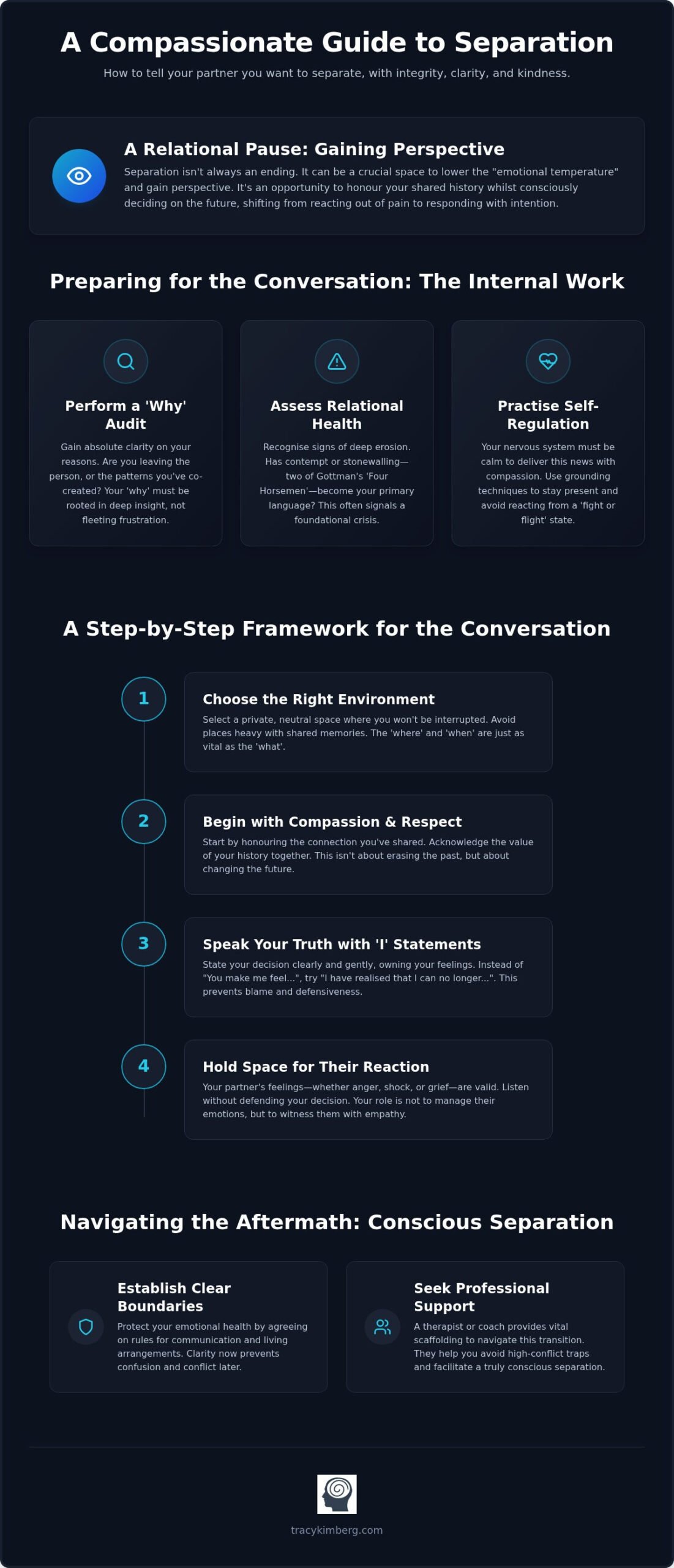
Before the first word is uttered, the most significant work happens within the quiet spaces of your own mind. Deciding how to tell your partner you want a separation requires a shift from emotional turbulence to a grounded, internal clarity. This isn’t about building a case against your spouse; it’s about honouring your own truth whilst maintaining respect for the bond you’ve shared. If you find yourself speaking from a place of temporary rage, you risk causing unnecessary trauma. Instead, seek the “Gottman Check” by identifying if the “Four Horsemen”, specifically contempt and stonewalling, have become the primary language of your home. When these patterns take root, they often signal that the relationship’s foundation has eroded beyond a simple repair.
Self-regulation is your greatest tool here. Gabor Maté often speaks about how our bodies keep the score of our emotional stress. If your nervous system is in a state of “fight or flight,” you cannot deliver difficult news with the compassion it deserves. Practising grounding techniques allows you to stay present in the room, even when the air becomes heavy with grief or shock. If you feel overwhelmed by the complexity of this transition, engaging in a specialised coaching process can provide the psychological scaffolding needed to navigate these waters with integrity.
Identifying Your Core Needs
You must distinguish between a desire for change and a need to exit. Ask yourself: “Am I leaving the person, or the patterns we’ve created?” Once you have your answer, boil it down to a single, “I”-centred sentence. Avoid the “blame game” by removing phrases like “You always make me feel” and replacing them with “I have realised I can no longer flourish in this dynamic.” This clarity prevents the conversation from devolving into a circular argument. Individual therapy can be an invaluable space to rehearse this truth, ensuring your “Why” is firm before you involve your partner.
Choosing the Right Environment
The “where” and “when” are just as vital as the “what.” Whilst the kitchen table is the traditional centre of the home, it may carry too much domestic weight for such a heavy disclosure. Choose a neutral, private space where you won’t be interrupted by the pings of a mobile phone or the voices of children. Timing is equally critical. Avoid late nights when exhaustion thins the skin or mornings when the pressure of the day looms. You want a window of time where both of you have the capacity to process the initial shock. Even as you focus on the emotional weight, being mindful of the legal considerations for separation can help you remain grounded in the practical realities that follow.
A Step-by-Step Framework for the Conversation
Entering this dialogue requires a delicate balance of radical honesty and profound empathy. When you sit down to discuss how to tell your partner you want a separation, you aren’t just delivering a verdict; you’re acknowledging the end of one shared story whilst holding space for the next. Esther Perel often suggests that we don’t just have one marriage, but many. Sometimes, the current version of your marriage has reached its natural conclusion. If you’ve done the internal work and your mind is made up, avoid the trap of “negotiating” the decision itself. Doing so creates false hope, which only prolongs the agony for both of you. Instead, remain firm in the “what” whilst being flexible and compassionate about the “how.”
The “Softened Start-up” Technique
The first five minutes of any difficult conversation often determine its outcome. Using a “softened start-up,” a research-based technique from John Gottman, helps prevent your partner’s nervous system from going into immediate lockdown. Start by expressing your own vulnerability. You might say: “I have something very difficult and painful to share, and I’ve been struggling with how to say it because I don’t want to hurt you, but I need to be honest about where I am.” This isn’t a preamble to a list of grievances. It’s a clear, kind statement of intent: “I’ve realised that for my own well-being and for the health of our family, I need us to move toward a separation.”
Managing the “Four Horsemen”
As the conversation unfolds, stay vigilant against the “Four Horsemen,” which are criticism, defensiveness, contempt, and stonewalling. Your partner may react with sharp criticism or retreat into a stony silence. If they stonewall, don’t push harder. Acknowledge their need for space whilst remaining present. You might say: “I can see you’re overwhelmed, and I understand why. We don’t have to solve everything today, but I needed you to know the truth.”
By owning your experience through “I” statements, you reduce the surface area for defensiveness. You aren’t describing their failings; you’re describing your own internal landscape. This conscious presence allows you to navigate the storm without losing your sense of integrity or your respect for the person sitting across from you. Maintaining this level of awareness ensures that even as the relationship changes shape, the humanity of both partners remains intact.
Navigating Reactions and Immediate Aftermath
The moment the words are spoken, a new and often volatile reality begins. You have likely spent months, perhaps years, processing the internal shift that led to this decision. Your partner, however, may be standing at the very beginning of a traumatic rupture. Once you have navigated how to tell your partner you want a separation, you must be prepared for the immediate emotional fallout. Most reactions fall into three categories: the icy stillness of shock, the heat of anger, or the heavy weight of despair. Each is a natural response to a threatened attachment, and each requires you to remain grounded in your decision whilst maintaining your humanity.
One of the most vital rules in a conscious separation is the 48-hour moratorium on major life decisions. In the heat of the moment, the temptation to discuss financial splits or permanent house moves is high. Resist this. Your nervous systems are likely in a state of high alert; making logical choices is biologically difficult when the “reptilian brain” is in charge. If children are involved, your primary goal is to eventually present a united, gentle front. They need to hear that they are safe, loved, and absolutely not responsible for the change in the family dynamic. If you are struggling to manage the emotional fallout, exploring Conscious Approached Divorce and separation support can provide a safe container for these difficult first steps.
Holding Space for Their Grief
You must accept that you and your partner are at different stages of the grief cycle. You have had the luxury of time to process your “Why.” They are likely experiencing the “Four Horsemen” in real-time, lashing out with criticism or retreating into stonewalling. Whilst you can acknowledge their pain, you cannot be their primary emotional support during this transition. Attempting to “fix” their sadness only blurs the boundaries you are trying to establish. Stay firm in your decision, but allow them the space to feel the magnitude of the relational breakdown without judgement.
Setting Healthy Boundaries
Clarity is the greatest gift you can give each other in the aftermath. Decide on immediate sleeping arrangements; physical space is necessary to begin the emotional untangling. Organise a simple communication plan for the coming days to avoid constant, draining text exchanges. It is also essential to protect your own mental health by maintaining personal rituals. Whether it is a morning walk or a specific exercise routine, these anchors of normalcy will help you stay regulated. By setting these boundaries early, you prevent the “high-conflict” trap and begin the process of moving forward with integrity.
Moving Forward: Conscious Separation and Beyond
The initial conversation is a threshold, but what lies beyond is the actual work of uncoupling. Once you have navigated how to tell your partner you want a separation, the focus shifts from the decision to the evolution of your dynamic. This period is less about legal finality and more about emotional restructuring. For those with children, this means transitioning from a romantic couple to conscious co-parents. It requires a commitment to protecting the family’s psychological health whilst allowing the partnership to end with dignity. Reclaiming your individual identity is a vital part of this journey; it’s about rediscovering who you are outside the context of “we.” Gabor Maté often speaks about the tension between authenticity and attachment. Reclaiming your identity means finally prioritising your own authenticity after years of compromise. This isn’t a clinical necessity but a proactive adventure into a new version of yourself.
The Conscious Separation Process
Traditional separation often feels like a battlefield, but therapy can facilitate a much more amicable transition. A structured conscious separation process serves as a valuable tool for clarity. It allows couples to explore whether separation is truly the right path or if there is a way to reimagine the relationship. If the decision remains firm, this therapeutic journey helps you move toward a future that honours the time you spent together rather than burying it in resentment. Even as you learn how to tell your partner you want a separation, you are also learning how to build a foundation for what comes next. By focusing on a ‘good’ ending, you ensure that the narrative of your life remains one of growth rather than failure. It’s about finding a way to say ‘thank you for the years’ whilst acknowledging that the path ahead is different.
Seeking Professional Guidance
There comes a point where the focus may need to shift from couples coaching to individual therapy. This transition is essential for processing personal grief and building resilience for the next chapter. Unlike legal mediation, which often focuses solely on assets and logistics, Tracy Kimberg’s approach centres on the human element of relational breakdown. It demystifies the therapeutic process, framing it as a powerful, manageable step toward healing. Professional support acts as a buffer against the high-conflict traps that often lead to messy divorces. It provides a safe, non-judgemental environment where both parties can feel heard and respected. This specialised care helps you navigate adult life transitions with a sophisticated understanding of interpersonal challenges. You can Explore how Conscious Separation Support can help you navigate this transition and ensure you handle the ending of your partnership with integrity.
Reclaiming Your Future with Integrity
Choosing to move toward a different kind of life is a profound act of courage. Throughout this guide, we’ve explored how internal clarity and research-based communication techniques can transform a painful rupture into a dignified transition. By prioritising the “Gottman Check” and using softened start-ups, you ensure that the humanity of both partners remains at the centre of the process. Understanding how to tell your partner you want a separation is only the first step; the true work lies in uncoupling with compassion rather than conflict.
You don’t have to navigate this complex emotional landscape alone. Whether you’re seeking the clarity of the specialised 12-Week Relationship Recovery Process or require a safe, non-judgemental environment for a conscious separation, expert guidance is available. My approach combines the methodologies of Gottman and Perel to help you find a “good” ending that honours your history whilst protecting your future well-being. Book a Discovery Call to discuss Conscious Separation Support and take the first step toward a proactive and positive adventure in healing. There is a path forward, and it begins with your commitment to integrity.
Frequently Asked Questions
How do I tell my partner I want a separation when they think everything is fine?
You should lead with radical honesty about your internal experience rather than their external performance. Acknowledge that they may feel blindsided, but explain that your emotional disconnect has reached a point where you can no longer flourish. Use “I” statements to describe your feelings of loneliness or lack of authenticity. It’s vital to be firm yet kind; don’t offer false hope of reconciliation if your mind is already made up.
Is there a “best” time of day or week to have the separation talk?
The best time is during a window where both of you are well-rested and free from immediate domestic pressures. Avoid late evenings when exhaustion thins your patience or mornings before work. A weekend afternoon often provides the necessary space for the initial shock to be processed without the ticking clock of external commitments. Ensure children are out of the house to provide a safe, uninterrupted container for this profound transition.
What should I do if my partner refuses to accept the separation?
You must recognise that whilst a marriage is a partnership, a separation is a unilateral decision that doesn’t require mutual consent to be valid. If they refuse to accept it, remain calm and repeat your boundary with compassion. Don’t get drawn into circular arguments or “negotiating” your truth. You may need to seek individual therapy to stay grounded whilst they process the trauma of the news at their own pace.
How do we handle living together whilst being separated?
Handling a shared home requires clear, written boundaries to avoid emotional “blurring.” Establish separate sleeping arrangements and distinct schedules for shared spaces like the kitchen. It’s helpful to treat the arrangement with professional courtesy, focusing on the logistics of co-habitation rather than the intimacy of a partnership. This structure protects your mental health whilst you navigate the practicalities of how to tell your partner you want a separation and what comes next.
Can a separation actually save a marriage or relationship?
A trial separation can act as a restorative pause, providing the distance needed to gain perspective on your dynamic. By lowering the emotional temperature, you can identify whether the relationship is truly untenable or if the “Four Horsemen” have simply overwhelmed your connection. Using a structured approach like the 12-Week Relationship Recovery Process can help you determine if separation is a step toward divorce or a tool for transformation.
What are the first steps to take immediately after the conversation?
Your first priority is emotional regulation; don’t make any permanent financial or legal decisions in the first 48 hours. Give each other physical space, even if that means one person stays in a guest room or with a friend. Arrange a follow-up conversation a few days later to discuss immediate logistics once the initial shock has subsided. This is also the ideal time to connect with a specialist for conscious separation support.
How do I manage the guilt of wanting to leave a “good” person?
Guilt often arises from the mistaken belief that you only have the right to leave if your partner is “bad.” In reality, you can love someone’s character whilst acknowledging that the partnership is stifling your authentic self. Gabor Maté suggests that suppressing your needs to maintain an attachment eventually leads to resentment and illness. Reframe your departure as an act of integrity that allows both of you to find a more compatible future.
Should we tell our family and friends about the separation straight away?
It’s usually best to wait until you have a basic plan for the immediate future before sharing the news. Telling friends and family too early can invite unsolicited advice that complicates how to tell your partner you want a separation with integrity. Agree on a shared narrative to tell others, especially if children are involved, to ensure the message remains consistent. This protects your privacy whilst you find your footing in this new reality.

Article by
Tracy Kimberg
Tracy Kimberg is a Relationship Expert, Couples Therapist and Coach with a dedicated focus on helping couples and individuals rebuild connection, trust and emotional safety in their relationships. Drawing on the research of John and Julie Gottman, the relational insights of Esther Perel, and years of hands-on therapeutic experience, Tracy offers a warm, non-judgemental and deeply compassionate approach to modern relationships.
Based in Dorset, Tracy works with couples navigating communication breakdowns, betrayal, intimacy challenges, separation, family dynamics and life transitions. Known for creating a safe and grounded therapeutic space, she combines practical tools with emotional depth to help clients move beyond survival patterns and towards meaningful, lasting change.
With a reputation for empathy, professionalism and dedication to her clients’ growth, Tracy is passionate about helping people feel seen, understood and empowered — both within their relationships and within themselves.
Disclaimer
Disclaimer:
The information shared in this article is intended for educational and informational purposes only and should not be considered a substitute for professional therapeutic, psychological, medical or legal advice. Every individual and relationship is unique, and the perspectives offered are based on general therapeutic principles, research and professional experience.
Reading this article does not establish a therapist-client relationship with Tracy Kimberg. If you are experiencing significant emotional distress, relationship crisis, trauma, or mental health concerns, it is important to seek support from a qualified professional appropriate to your individual circumstances.
All content remains the intellectual property of Tracy Kimberg and may not be reproduced or distributed without permission.