

What if the most compassionate way to help your partner isn’t by trying to “fix” their pain, but by learning how to sit with them in the shadows without losing your own light? Learning how to support a partner with depression is one of the most profound challenges a couple can face. It’s incredibly exhausting to feel as though you’re walking on eggshells in your own home, grieving the loss of intimacy whilst feeling a heavy sense of guilt for your own mounting frustration. You might find yourself wondering where the person you love went and whether your relationship can survive this heavy cloud.
You deserve to feel connected and seen, even when your partner is struggling to see themselves. This guide will show you how to navigate these complexities whilst protecting your own mental health and fostering a resilient emotional bond. We’ll explore practical communication tools, help you distinguish the person from the depression, and discuss when it’s time to invite professional expertise into your story to help you both move forward together.
Key Takeaways
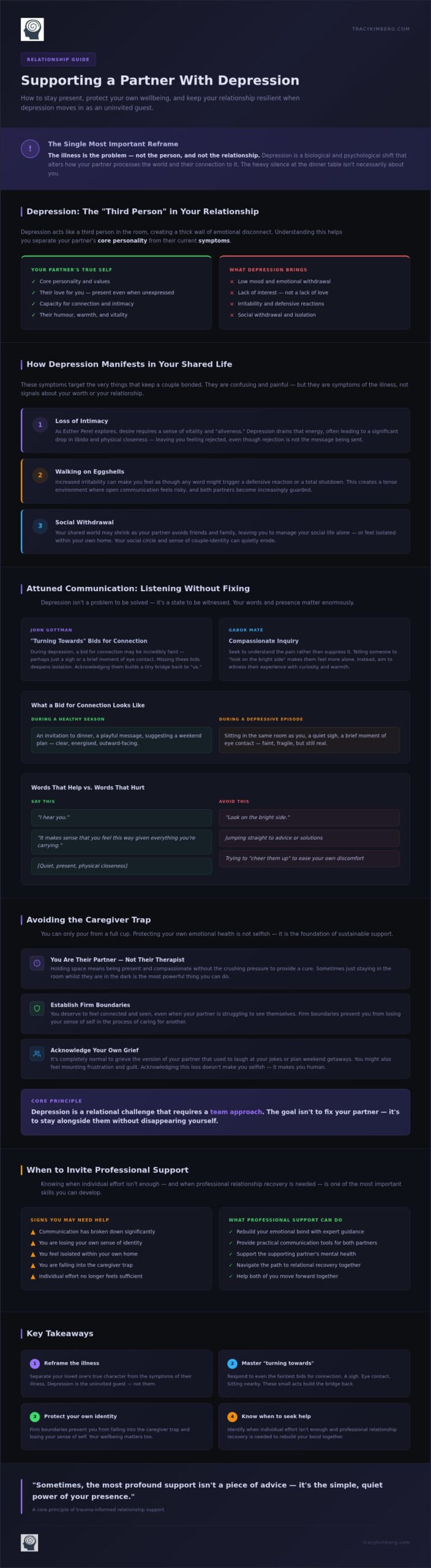
- Reframe depression as an uninvited guest in your relationship, helping you separate your loved one’s true character from the symptoms of their illness.
- Discover how to support a partner with depression by mastering the art of “turning towards” their small bids for connection, even when they feel faint.
- Protect your own emotional health by establishing firm boundaries, ensuring you don’t fall into the caregiver trap or lose your sense of self.
- Learn to identify the specific markers that indicate when individual effort isn’t enough and professional relationship recovery is needed to rebuild your bond.
Understanding the Shadow: How Depression Affects Relationship Dynamics
Depression isn’t just a clinical label found in a textbook. In the context of a committed partnership, it’s more like an uninvited guest that has moved into your spare room and started dictating the house rules. Understanding depression and its effects on mood and behavior is vital because it helps you realise that the heavy silence at the dinner table isn’t necessarily about you. It’s about a biological and psychological shift that alters how your partner processes the world and their connection to it.
It’s completely normal to feel as though you’ve “lost” your companion. You might be grieving the version of them that used to laugh at your jokes or plan weekend getaways. Acknowledging this loss doesn’t make you selfish; it makes you human. While your partner struggles with the biological weight of low mood, you’re navigating the relational fallout of their withdrawal. Learning how to support a partner with depression begins with recognising that the illness is the problem, not the person or the relationship itself.
The “Third Person” in Your Marriage
Depression often acts as a “third person” in the room, creating a thick wall of emotional disconnect. You might find yourself talking to a version of your partner that feels distant or even ghost-like. It’s crucial to recognise the difference between your partner’s core personality and the symptoms they’re currently exhibiting. Their lack of interest isn’t a lack of love, even if it feels that way in the quiet moments. Depression is a relational challenge that requires a team approach.
Common Relational Symptoms of Depression
When depression enters the home, it often targets the very things that keep a couple bonded. These symptoms can be confusing and painful if you don’t see them for what they are. Here are a few ways the illness manifests in your shared life:
- Loss of intimacy: As Esther Perel often explores, desire requires a sense of vitality and “aliveness.” Depression drains that energy, often leading to a significant drop in libido and physical closeness that can leave you feeling rejected.
- The “walking on eggshells” phenomenon: Increased irritability can make you feel as though any word might trigger a defensive reaction or a total shutdown. This creates a tense environment where open communication feels risky.
- Social withdrawal: Your shared world might shrink as your partner avoids friends and family, leaving you to manage your social life alone or feel isolated within your own home.
The goal isn’t to fix them. Instead, it’s about “holding space.” This means being present and compassionate without the crushing pressure to provide a cure. You aren’t their therapist; you’re their partner, and sometimes just staying in the room whilst they are in the dark is the most powerful thing you can do.
The Art of Attuned Communication: Listening Without Fixing
When you’re figuring out how to support a partner with depression, your first instinct is often to offer solutions. You want to fix the leak, mend the break, and bring back the light. But depression isn’t a problem to be solved; it’s a state to be witnessed. John Gottman’s research highlights the importance of “Turning Towards” bids for connection. In a relationship shadowed by depression, these bids might be incredibly faint, perhaps just a sigh or a brief moment of eye contact. Missing them can deepen the isolation, whilst acknowledging them creates a tiny bridge back to “us”.
Validation as a Healing Tool
We often try to “cheer up” our loved ones because their pain makes us uncomfortable. However, telling someone to “look on the bright side” often backfires, making them feel misunderstood and even more alone. Gabor Maté’s approach of compassionate inquiry suggests that we should seek to understand the pain rather than suppress it. Phrases like “I hear you,” or “It makes sense that you feel this way given everything you’re carrying,” foster a sense of safety. Sometimes, the most profound support isn’t a piece of advice, but the simple, quiet power of your presence.
Identifying Bids for Connection
In a healthy season, a bid for connection might be an invitation to dinner. During a depressive episode, a bid might simply be sitting in the same room as you. Recognising these small gestures is essential for staying tethered. Even if they have very little to give, your positive response tells them they are still seen. While the “erotic” side of your partnership might be on hold, as Esther Perel often observes, you can still maintain emotional intimacy through these micro-connections. Understanding depression symptoms and treatment options helps you adjust your expectations without losing hope for the future.
You will inevitably face the “I don’t know” response. It’s frustrating, but it’s often a literal reflection of their mental fog. Instead of pushing for answers, try a “Softened Start-up” when you need to discuss your own feelings. Start with “I feel” rather than “You always,” which prevents the conversation from turning into a conflict. If the emotional disconnect feels too wide to bridge alone, relationship counselling can provide a safe space to practice these new ways of relating and communicating that protect the bond you’ve built.
Avoiding the Caregiver Trap: Maintaining Your Identity and Boundaries
One of the most delicate shifts in a relationship occurs when one partner becomes a “patient” and the other becomes a “carer”. When you are focused on how to support a partner with depression, it’s easy to let your own identity slip through your fingers. You might find yourself managing their schedule, monitoring their moods, and slowly abandoning your own needs. This is the caregiver trap. It leads to a state of codependency where your happiness is entirely tethered to their recovery, a burden that neither of you can carry for long.
Gabor Maté often highlights the profound cost of suppressing our own authenticity for the sake of attachment. If you constantly ignore your own emotional requirements to keep the peace or provide support, you risk physical and mental exhaustion. Truly understanding how to support a partner with depression involves knowing you were never meant to be their therapist. Attempting to fill that role actually disrupts the egalitarian nature of a healthy partnership, making true intimacy even harder to reach.
Setting Healthy Boundaries with Love
Boundaries are not acts of rejection; they are the framework that allows love to survive a crisis. You must define what you can and cannot do. For instance, you can offer a listening ear for an hour, but you cannot be responsible for their medication or their safety 24 hours a day. Communicating these limits clearly and warmly protects the relationship from resentment. It is essential to involve a wider support network of friends, family, or professionals to ensure you aren’t the sole pillar holding everything up.
The Importance of Self-Preservation
Your personal wellbeing is the very foundation upon which the relationship’s recovery is built. You must continue to organise your life to include pockets of joy and normalcy, even whilst your partner is in the midst of a struggle. This might mean going to your favourite yoga class or seeing friends without feeling a shred of guilt. Self-care is a relational duty, not a selfish act. By keeping your own emotional tank full, you maintain the strength required to offer genuine compassion rather than forced obligation. You can find excellent resources on how to help someone with depression that emphasise this balance between care and self-preservation.
Practical Steps to Support a Partner Daily
Living with a partner in the depths of a depressive episode requires a shift in how you view the “everyday”. Tasks that once felt effortless, like loading the dishwasher or choosing what to eat, can become mountainous obstacles for someone struggling. When considering how to support a partner with depression, your role is to help lower the altitude of these mountains. Establish a low-pressure daily routine that celebrates small wins. If they managed to shower or sit in the garden for ten minutes, acknowledge it quietly. These aren’t just chores; they are micro-victories against the weight of the illness.
Encouraging Professional Support
Suggesting therapy is a delicate dance. If it feels like an accusation, they will likely retreat. Instead, frame professional help as a gift to the relationship, a way to build a map through a landscape you are both lost in. You might say, “I want us to have more tools to handle this together.” Researching options as a team can lower the barrier to entry, making the process feel less like a solo mission. For those with severely low energy, online therapy offers a way to connect with an expert from the safety and comfort of home, removing the exhausting logistics of travel.
Creating a Low-Stress Environment
Depression thrives in stagnation. You can gently nudge the environment toward healing by focusing on light, nutrition, and movement without making it a demand. Open the curtains. Suggest a five-minute walk together. Crucially, try to reduce “decision fatigue”. Instead of asking “What do you want for dinner?”, try “I’m making pasta tonight, would you like to sit with me whilst I cook?”. These shared rituals, like a morning cup of tea, act as emotional anchors. They maintain a sense of normality and continuity when everything else feels like it is drifting.
Whilst you focus on the daily rhythm, you must also have a silent safety plan in place. Recognise the signs of a crisis, such as a sudden change in behaviour or talk of hopelessness, and know who to call. Managing the household whilst your partner is incapacitated is a heavy lift. It’s okay to let some balls drop. Focus on what is essential and outsource or delay the rest. If you feel the gap between you is growing too wide, exploring a structured 12-Week Relationship Recovery Process can help you both rebuild the bridge that depression has tried to burn down.
When to Seek Professional Guidance: The Path to Relational Recovery
There comes a point where even the most dedicated efforts to learn how to support a partner with depression reach a natural limit. You might find that whilst your partner is engaging in their own individual therapy, the “us” part of the equation is still languishing in the shadows. This is usually the marker that individual support isn’t enough. When the silence between you feels heavy, or when every attempt at connection ends in a misunderstanding, it is a sign that the relationship itself needs a dedicated space to breathe and heal.
Seeking professional guidance is never an admission of failure; it is a fierce act of commitment. It says that the bond you share is worth more than the illness trying to pull you apart. A structured approach, like the 12-Week Relationship Recovery Process, provides a roadmap out of the survival mode you’ve been living in. This programme moves the focus from managing a daily crisis to rebuilding a partnership based on mutual respect and renewed intimacy.
Moving from Survival to Growth
One of the hardest parts of how to support a partner with depression is dealing with the resentment that quietly builds when you’ve been the “strong one” for too long. In a safe, therapeutic environment, you can finally process these feelings without guilt. We use research-based methods, including the Gottman Method, to help you relearn the art of “turning towards” each other. As the depressive cloud begins to lift, the focus shifts to relearning how to play, how to find joy in each other’s company, and how to prevent future emotional disconnect from taking root.
Your Next Steps Towards Healing
You don’t have to navigate this complex emotional landscape alone. Relationship coaching offers a neutral, non-judgemental space where both of you can feel heard and supported. It’s a place where the partner with depression can feel understood, and the supporting partner can feel seen in their struggle. This collaborative approach is what transforms a period of suffering into a catalyst for long-term relational strength.
If you’re ready to move beyond just “getting through the day” and want to start rebuilding your emotional bridge, the first step is simple. Book a consultation with Tracy Kimberg to begin your recovery journey. A discovery call can help you determine if this structured path is the right fit for your unique situation, giving you both the hope and the practical tools needed for a lasting recovery.
Reclaiming Your Relationship from the Shadow
Navigating the heavy fog of mental illness doesn’t have to mean losing the person you love or the life you’ve built together. By reframing depression as an uninvited guest rather than a character flaw, you can begin to separate your partner from their symptoms. You’ve learned that how to support a partner with depression involves a delicate balance of attuned communication and fierce self-preservation. Success isn’t found in “fixing” them, but in maintaining your own identity whilst turning towards their small, quiet bids for connection.
When the emotional disconnect feels too vast to bridge on your own, a structured, research-based approach can provide the map you need. Tracy Kimberg offers a compassionate, non-judgemental space to help you move from survival to growth. Using insights from Gottman and Perel, her 12-Week Relationship Recovery Process is designed to foster lasting change and deep emotional reconnection. Book your 12-Week Relationship Recovery consultation with Tracy Kimberg to begin this proactive adventure toward healing. There is a path back to intimacy and joy; you simply need the right tools to find it together.
Frequently Asked Questions
How do I know if my partner is depressed or just unhappy with our relationship?
Depression is typically pervasive, affecting sleep, appetite, and interest in hobbies, whereas relationship unhappiness tends to be specific to your interactions. If they are struggling to find joy in anything, it is likely clinical. When you are learning how to support a partner with depression, observing these global patterns helps you realise that their withdrawal isn’t a personal rejection of you, but a symptom of a much larger internal struggle.
Can I suggest therapy to my partner without them getting defensive?
Frame the suggestion as a collaborative effort to protect your bond rather than a fix for their individual “brokenness.” Use a softened start-up by saying, “I miss our connection and I want us to have expert help to find our way back to each other.” This shifts the focus from their diagnosis to the health of the relationship. Researching options together can also lower the barrier and make the process feel less daunting.
What should I do if my partner refuses to seek professional help?
You cannot force a partner into healing, but you can choose to prioritise your own mental health and set clear boundaries. If they refuse help, it is vital that you seek support for yourself through individual therapy or coaching. This prevents the “caregiver trap” and ensures you have the emotional resources to stay resilient. Sometimes, seeing the positive changes in you can gently encourage them to reconsider their own path to recovery.
Is it normal to feel angry or resentful towards a depressed partner?
It is entirely normal to feel a complex mix of anger, resentment, and guilt when your needs are consistently sidelined by a partner’s illness. These feelings are often a signal that your own boundaries have been crossed or your emotional tank is empty. Acknowledging this frustration is a healthy step toward self-preservation. In a safe, non-judgemental environment, you can process these emotions without shame, ensuring they don’t turn into toxic bitterness.
How can I maintain our physical intimacy when my partner has no libido?
Shift your focus from goal-oriented sexual performance to micro-connections and physical touch that carries no expectation. Depression often drains the vitality needed for desire, but small gestures like holding hands, long hugs, or sitting close on the sofa can maintain a sense of safety and “us.” By removing the pressure for sex, you create a space where intimacy can eventually breathe again once the heaviest part of the depressive cloud begins to lift.
What are the warning signs that my partner’s depression is becoming a crisis?
Look for a marked increase in hopelessness, talk of being a burden, or a sudden, uncharacteristic calm after a long period of distress. Other warning signs include total social withdrawal and significant changes in sleeping or eating patterns. If you notice these shifts, it is time to activate a safety plan. Understanding how to support a partner with depression means knowing when the situation has moved beyond your domestic role and requires immediate intervention.
How do I explain my partner’s condition to our children or family?
Use age-appropriate, honest language that frames depression as a physical illness of the mind, much like a severe flu or a broken leg. Ensure children understand that they are not the cause of the parent’s sadness and that it is not their job to fix it. This systemic approach prevents the family from absorbing the “shadow” of the illness and helps maintain a sense of security and normalcy for everyone involved.
Can relationship coaching help if only one of us is struggling with mental health?
Yes, relationship coaching is incredibly effective because mental health challenges never exist in a vacuum; they impact the entire relational system. Even if only one person carries the diagnosis, both partners experience the emotional disconnect and the shift in dynamics. A structured 12-Week Relationship Recovery Process can help you both navigate the fallout together, rebuilding the bridge of connection and ensuring the relationship thrives despite the challenges of an individual’s mental health journey.

Article by
Tracy Kimberg
Tracy Kimberg is a Relationship Expert, Couples Therapist and Coach with a dedicated focus on helping couples and individuals rebuild connection, trust and emotional safety in their relationships. Drawing on the research of John and Julie Gottman, the relational insights of Esther Perel, and years of hands-on therapeutic experience, Tracy offers a warm, non-judgemental and deeply compassionate approach to modern relationships.
Based in Dorset, Tracy works with couples navigating communication breakdowns, betrayal, intimacy challenges, separation, family dynamics and life transitions. Known for creating a safe and grounded therapeutic space, she combines practical tools with emotional depth to help clients move beyond survival patterns and towards meaningful, lasting change.
With a reputation for empathy, professionalism and dedication to her clients’ growth, Tracy is passionate about helping people feel seen, understood and empowered — both within their relationships and within themselves.
Disclaimer
Disclaimer:
The information shared in this article is intended for educational and informational purposes only and should not be considered a substitute for professional therapeutic, psychological, medical or legal advice. Every individual and relationship is unique, and the perspectives offered are based on general therapeutic principles, research and professional experience.
Reading this article does not establish a therapist-client relationship with Tracy Kimberg. If you are experiencing significant emotional distress, relationship crisis, trauma, or mental health concerns, it is important to seek support from a qualified professional appropriate to your individual circumstances.
All content remains the intellectual property of Tracy Kimberg and may not be reproduced or distributed without permission.