

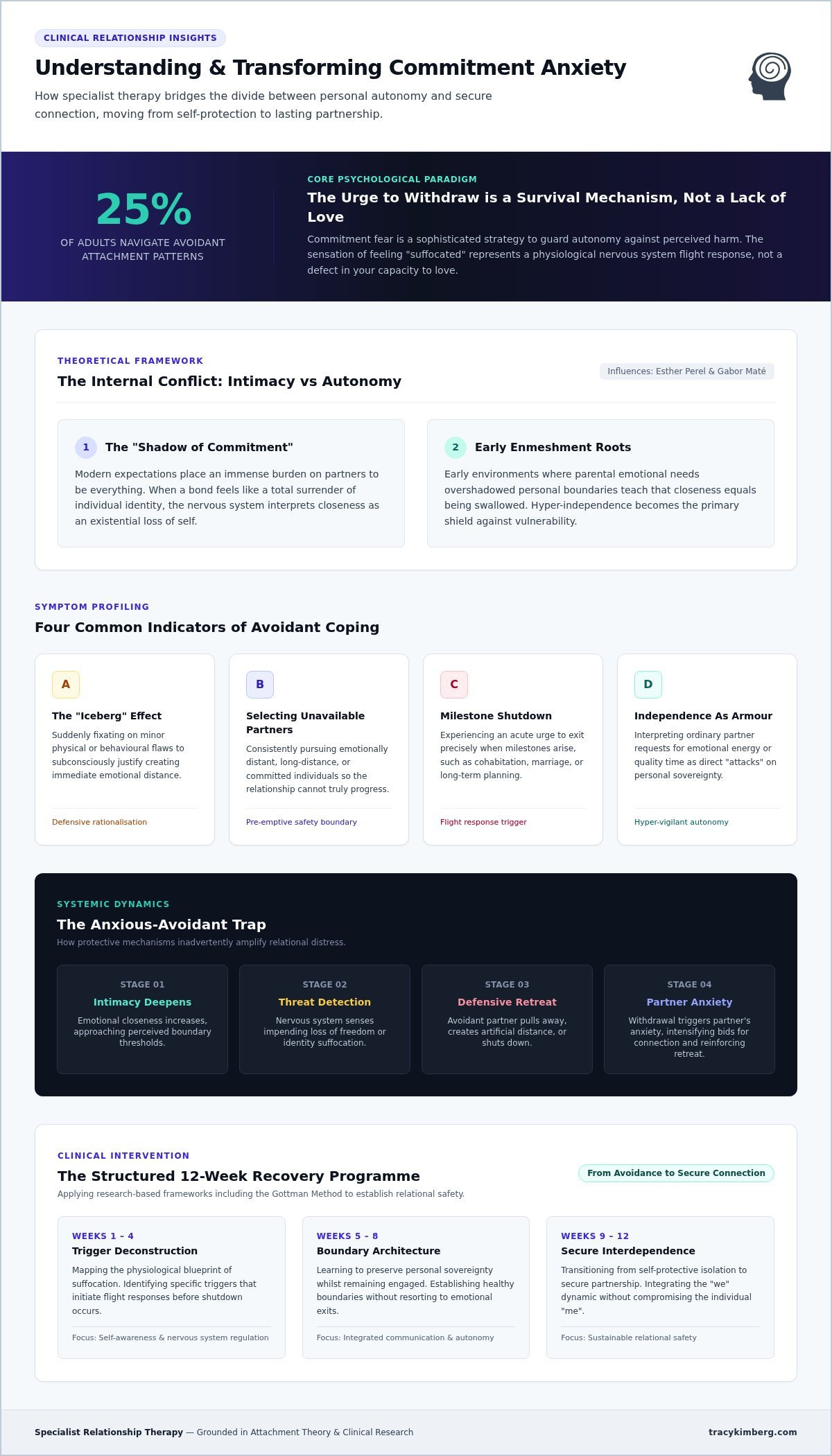
What if your urge to run away from a great relationship isn’t a lack of love, but a survival instinct trying to protect your freedom? It’s a confusing place to be. You desire intimacy, yet you feel an overwhelming sense of suffocation when a partner gets too close. If you’ve spent years sabotaging connections just as they become meaningful, you aren’t alone. Research suggests that around 25% of adults navigate avoidant attachment patterns, often feeling a deep sense of loneliness despite their fierce desire for independence. Seeking therapy for fear of commitment is often the first step in understanding that your need for autonomy doesn’t have to come at the cost of your relationship.
I understand the heavy guilt that comes from hurting good people simply because you feel you need to breathe. It’s possible to change this cycle. In this guide, you’ll discover how specialist therapy can transform commitment anxiety into a secure, fulfilling partnership without you losing your identity. We will explore the roots of your anxiety, discuss how to set boundaries whilst staying connected, and look at how a structured 12-week programme can help you move from self-protection to genuine connection. By finding a therapist who understands these complex patterns, you can finally build a life of relational safety.
Key Takeaways
- Understand why your urge to withdraw is often a protective survival mechanism rather than a lack of love for your partner.
- Discover how specialist therapy for fear of commitment helps you identify the specific emotional triggers that lead to feelings of suffocation.
- Learn how to apply research-based frameworks like the Gottman Method to build a secure partnership whilst preserving your independence.
- Explore the benefits of a structured 12-week relationship recovery programme designed to move you from avoidance to secure connection.
- Recognise the subtle differences between a chronic pattern of commitment anxiety and simply not having met the right person yet.
What is Fear of Commitment and Why Does it Persist?
Many people spend years believing they simply haven’t met the right person yet. They move from one partner to another, hoping the next one won’t trigger that familiar urge to run. However, when you notice a recurring pattern of pulling away just as things get serious, it’s often a sign of a deeper protective response. This fear of commitment in relationships isn’t a medical condition to be “cured” like a common cold. Instead, it’s a sophisticated strategy your mind uses to guard your autonomy and protect you from perceived harm.
The sensation of feeling “suffocated” by a partner’s needs is a legitimate nervous system response. When closeness is perceived as a threat to your freedom, your body enters a flight mode. You might feel physically trapped or anxious, even if you logically know your partner is kind and supportive. Seeking therapy for fear of commitment helps you understand that this fear often masks a profound desire for connection that you’ve simply learned to keep at arm’s length for your own safety.
The Conflict Between Freedom and Intimacy
The renowned therapist Esther Perel often discusses the “shadow of commitment.” She suggests that in our modern search for a soulmate, we place an immense burden on our partners to be everything for us. This expectation can make the idea of a long-term bond feel like a loss of self. Commitment fear is a strategy for self-preservation developed in early life. It’s a way of ensuring that you never have to experience the pain of being controlled or abandoned again. By framing it this way, we can begin to see your avoidance not as a flaw, but as a misguided attempt to stay safe whilst maintaining your independence.
Common Signs You Might Benefit from Therapy
Recognising these patterns requires honest self-reflection. Many people experience the “Iceberg” effect, where they fixate on a partner’s minor flaws to justify an exit. If you find yourself suddenly repulsed by the way someone speaks or dresses just as the relationship deepens, your brain is likely looking for a reason to create distance. Other common indicators include:
- Choosing “unavailable” partners: You might consistently date people who are married, live far away, or are emotionally distant, ensuring the relationship can never truly progress.
- The milestone shut down: Feeling an intense urge to end things specifically when talk turns to moving in together, marriage, or long-term planning.
- Prioritising independence over connection: Viewing any request for your time or emotional energy as an “attack” on your personal freedom rather than a bid for closeness.
If these behaviours feel familiar, therapy for fear of commitment can provide the tools to navigate these internal conflicts without losing the sense of self you’ve worked so hard to protect. It’s about learning that you can be part of a “we” without losing the “me”.
The Psychological Roots: Why Closeness Feels Dangerous
Attachment theory provides the primary framework for understanding why some of us view intimacy as a threat. Instead of seeing commitment as a source of support, those with an avoidant-dismissive attachment style often view it as a cage. This isn’t a conscious choice; it’s a physiological blueprint designed to keep you safe. When you’ve learned that your survival depends on self-reliance, the idea of depending on another person feels like a profound risk to your autonomy.
Gabor Maté often highlights how our early environment dictates adult behaviour. If your childhood involved enmeshment, where a parent’s emotional needs overshadowed your own, you likely learned that closeness equals a loss of self. You might feel a primal need to keep distance to ensure you aren’t swallowed by another person’s expectations. While some might seek clinical treatment for gamophobia to address the physical symptoms of this anxiety, understanding the root cause is the most compassionate way to heal.
The Role of Attachment Styles
Inconsistent or intrusive parenting often creates a persistent danger signal around intimacy. If you were forced to be hyper-independent as a child, relying on others now feels like a dangerous vulnerability. This often leads to the Anxious-Avoidant Trap, where your withdrawal triggers a partner’s anxiety, which in turn makes you want to retreat further. Recognising your specific blueprint for relationship safety is a core part of specialist relationship support. It allows you to see the cycle whilst it’s happening, rather than just reacting to the urge to run.
Trauma-Informed Perspectives
In many ways, commitment fear is a “flight” response. If you witnessed high-conflict or emotionally “dead” marriages as a child, your brain categorised long-term partnerships as places of pain or stagnation. You learned that staying means suffering. This trauma-informed perspective shifts the narrative from “I’m bad at relationships” to “My system is trying to protect me from what it saw before.”
Specialist therapy for fear of commitment helps you de-couple these past memories from your current reality. You can learn that your current partner isn’t your parent, and your current relationship isn’t your childhood home. By processing these old echoes, you can begin to see commitment as a choice you make daily, rather than a sentence you have to serve. It’s about building enough internal safety that the presence of another person no longer feels like an intrusion.
Therapeutic Approaches: Comparing Pathways to Connection
Finding the right path forward can feel overwhelming, especially when you’re already feeling hesitant about the process itself. Specialist therapy for fear of commitment offers a structured way to navigate these complex emotions without the pressure of an immediate, lifelong decision. Unlike casual advice found on social forums, professional frameworks provide a research-based roadmap for change. It’s about creating a safe, non-judgemental environment where you can explore your relational patterns at a pace that feels manageable for you.
The Gottman Method and Commitment
One of the most effective tools for addressing commitment anxiety is the Gottman Method. This approach focuses on building “The Sound Relationship House” by strengthening the foundation of friendship and mutual respect. For someone experiencing a chronic fear of commitment, the clinical focus is often on achieving physiological calm. When your heart rate spikes because a partner asks about the future, your “flight” response takes over. We use techniques like “Small Things Often” to build connection in tiny, manageable doses that don’t trigger your internal alarm system. We also identify the “Four Horsemen”—behaviours like stonewalling or defensiveness—that often serve as exits when things feel too intense, helping you replace them with healthier communication habits.
Individual vs. Relationship Coaching
Deciding whether to attend sessions alone or with a partner depends on your current needs. Individual therapy allows you to build a secure base within yourself first. It’s a space to explore your history and attachment blueprint without worrying about a partner’s immediate reaction. Conversely, Relationship Counselling and Coaching for Couples can be incredibly powerful if you’re currently in a partnership. It helps your partner understand that your need for space isn’t a rejection of them, but a requirement for your own emotional safety. This shared understanding can lower the overall tension in the relationship significantly.
Many clients find that open-ended talk therapy feels too vague or potentially endless, which can actually increase the feeling of being “trapped.” This is why I prioritise the 12-Week Relationship Recovery Process. It’s a structured, time-limited programme that provides clear milestones for progress. Instead of just talking about problems, we focus on active, evolving experiences that help you re-organise your attachment patterns in real-time. This manageable approach ensures you feel in control of the journey, rather than being swept away by it.
What to Expect in Therapy for Fear of Commitment
Taking the first step into a therapeutic space can feel daunting, especially when your instinct is to maintain distance. Your initial session isn’t about being pressured into making a lifelong promise. Instead, it’s focused on building a rapport of safety and trust. We begin by creating an environment where you feel heard rather than judged. This foundation allows us to explore your history at a pace that feels manageable, ensuring you never feel “trapped” within the therapeutic process itself.
A significant part of our work involves identifying the specific “triggers” that cause your urge to withdraw. You might notice that certain milestones, like meeting a partner’s family or discussing a joint holiday, spark a sudden need to retreat. We also focus heavily on “boundary work.” Many people who avoid commitment do so because they don’t realise that saying “No” is actually allowed within an intimate partnership. By learning to set healthy boundaries, you discover that you can stay connected without being swallowed by the other person’s needs. Therapy provides a supportive holding space where both your deep-seated fear of losing yourself and your genuine desire for connection can exist together without conflict.
The Stages of Therapeutic Progress
The journey through therapy for fear of commitment typically moves through three distinct phases of growth:
- Stage 1: Awareness of the Push-Pull Cycle. You’ll learn to spot the moments when you’re creating distance before you actually act on the impulse.
- Stage 2: Regulation of the Nervous System. We use techniques to calm the physical “suffocation” sensation, allowing you to stay present during moments of closeness.
- Stage 3: Testing New Behaviours. This involves small, controlled experiments in vulnerability, where you share your needs with your partner and experience their support.
As you move through these stages, you’ll notice a profound shift in your internal dialogue. The question moves from “How do I get out?” to a more empowered “How do I stay and grow?”.
Practical Tools You Will Learn
Beyond emotional insight, you’ll gain a toolkit of practical strategies to use in your daily life. We develop communication scripts that help you express your need for autonomy without hurting your partner. For instance, instead of shutting down, you might learn to say, “I’m feeling a bit overwhelmed and need some time to myself to recharge.” We also practice grounding exercises designed to settle your nervous system when that familiar anxiety strikes. These tools ensure you remain the driver of your relational experience. If you’re ready to start this process, you can book a session for individual or couples therapy to begin your journey toward secure connection.
Starting Your Journey with Tracy Kimberg
Choosing to address your relational patterns is a brave decision. When you work with me, you aren’t just another patient in a clinical system; you’re entering a collaborative partnership. I specialise in relationship recovery and individual therapy, acting as a wise guide for those who feel they might lose themselves in a partnership. My approach to therapy for fear of commitment is fundamentally empathetic and professional, striking a balance between psychological expertise and a warm, accessible environment. I believe that healing is a proactive adventure, a positive step toward a life that feels both free and connected.
The 12-Week Relationship Recovery Advantage
One of the biggest hurdles for those with commitment anxiety is the fear of an open-ended, indefinite process. To address this, I offer the 12-Week Relationship Recovery Process. This structured programme provides clarity and measurable progress through three distinct phases. We begin with “Phase 01: Deep Sweep Inside Out” to identify your emotional anchors and triggers. We then move into “Phase 02: Map to Me” to establish your personal values and communication needs. Finally, “Phase 03: Me You Us” helps you rebuild trust and intimacy whilst maintaining sustainable boundaries.
This framework is built on research-based methods, including the Gottman Method and the insights of Esther Perel. It allows us to address issues like infidelity, chronic disconnect, and deep-seated anxiety within one cohesive journey. Because the programme is time-limited and goal-oriented, it provides the safety of a clear roadmap. This ensures you always know where you are and where you’re going next, reducing the fear of being trapped in a static treatment.
Taking the First Step
Whether you prefer the convenience of Online Therapy or the personal connection of Face-to-Face Therapy, I provide a safe, non-judgemental space for both teenagers and adults. My practice is designed to demystify the therapeutic process, making it feel manageable and even empowering. You don’t have to navigate these complex interpersonal challenges alone. We can work together to turn your commitment anxiety into a source of relational strength and secure connection.
I invite you to reach out and explore how we can re-organise your attachment patterns for long-term emotional health. Your journey toward a more fulfilling partnership starts with a simple conversation. Begin your journey toward secure connection today.
Embracing a Future of Secure Connection
Your desire for intimacy doesn’t have to be at odds with your need for independence. We’ve explored how understanding your attachment blueprint and nervous system responses can shift your perspective from fear to empowerment. Closeness doesn’t mean losing your identity. It’s about building a relationship where your boundaries are respected and your autonomy is preserved whilst you stay connected.
Choosing therapy for fear of commitment is a proactive step toward a more fulfilling life. By utilising a research-led approach inspired by Gottman and Perel, we can work together to re-organise the patterns that keep you stuck in a cycle of withdrawal. Whether you choose safe, non-judgemental online sessions or face-to-face therapy, the 12-Week Relationship Recovery Process provides the manageable, structured support you need to see real, lasting change.
You deserve a partnership that feels like a safe harbour rather than a cage. If you’re ready to move beyond the urge to run and start building a secure future, I’m here to guide you through this positive adventure. Book a consultation to explore your path to relationship recovery
Frequently Asked Questions
Is fear of commitment a mental health disorder?
No, fear of commitment isn’t a standalone mental health disorder in the DSM-5-TR or ICD-11. Instead, it’s often understood as a protective mechanism rooted in attachment insecurity. Whilst severe cases might be clinically categorised as a specific phobia, most people experience it as a relational challenge. Specialist therapy for fear of commitment focuses on understanding these survival instincts rather than treating a “disease”, helping you feel safe whilst moving toward intimacy.
Can therapy actually change my attachment style from avoidant to secure?
Yes, it’s entirely possible to shift from an avoidant to a secure attachment style, a process often called “earned security”. Through consistent work, you learn to identify your withdrawal triggers and replace them with healthier responses. This doesn’t mean changing your personality; it’s about re-organising your internal blueprint so that closeness no longer feels like a threat to your personal freedom and independence.
How long does therapy for commitment issues typically take?
The duration varies depending on your personal history, but many clients prefer a structured approach over open-ended talk therapy. My 12-Week Relationship Recovery Process is designed specifically to provide measurable progress within a clear timeframe. This manageable structure is particularly helpful for those who fear being “trapped” in a clinical setting, offering a proactive adventure with clear milestones for building relational safety and trust.
Should I go to therapy alone or with my partner for commitment fear?
Both paths offer significant benefits. Individual therapy allows you to explore your family-of-origin and personal triggers in a private, non-judgemental space. However, attending relationship coaching as a couple can help your partner understand your need for autonomy. This shared insight often reduces the “push-pull” dynamic, as your partner learns to give you the breathers you need without feeling rejected or abandoned.
What if my partner is the one with the fear of commitment?
If your partner is struggling, attending couples coaching together can be transformational. It provides a neutral space where they can express their fears of suffocation without causing conflict. By using research-based methods like the Gottman Method, we can build a “Sound Relationship House” that respects their need for distance whilst ensuring your needs for connection are met. This collaborative approach helps de-escalate the anxiety for both of you.
Is it possible to be happy in a relationship if I value my independence?
Yes, and in fact, a secure relationship should enhance your sense of independence. Secure attachment provides a “safe base” from which you can explore your own interests and goals. Therapy helps you move away from the false belief that intimacy requires total self-sacrifice. You’ll learn practical communication tools to protect your autonomy whilst staying deeply connected to your partner in a healthy, fulfilling way.
How do I know if I am just with the wrong person or if it is a deeper fear?
Distinguishing between the “wrong person” and a deeper pattern requires honest reflection. If you consistently find yourself sabotaging relationships just as they reach a milestone, or if you fixate on minor flaws to justify leaving, it’s often a sign of commitment anxiety. Therapy provides the clarity needed to see whether you’re genuinely incompatible or if your nervous system is simply sounding a false alarm to protect your freedom.
What happens if I ignore my fear of commitment?
Ignoring these patterns often leads to a repetitive cycle of short-lived relationships and a persistent sense of loneliness. Over time, the guilt of hurting others and the frustration of your own “shutdown” response can damage your self-esteem. Addressing these fears proactively through a specialist programme allows you to break the cycle. It transforms your relational experience from a source of stress into a manageable and rewarding part of your life.

Article by
Tracy Kimberg
Tracy Kimberg is a Relationship Expert, Couples Therapist and Coach with a dedicated focus on helping couples and individuals rebuild connection, trust and emotional safety in their relationships. Drawing on the research of John and Julie Gottman, the relational insights of Esther Perel, and years of hands-on therapeutic experience, Tracy offers a warm, non-judgemental and deeply compassionate approach to modern relationships.
Based in Dorset, Tracy works with couples navigating communication breakdowns, betrayal, intimacy challenges, separation, family dynamics and life transitions. Known for creating a safe and grounded therapeutic space, she combines practical tools with emotional depth to help clients move beyond survival patterns and towards meaningful, lasting change.
With a reputation for empathy, professionalism and dedication to her clients’ growth, Tracy is passionate about helping people feel seen, understood and empowered — both within their relationships and within themselves.
Disclaimer
Disclaimer:
The information shared in this article is intended for educational and informational purposes only and should not be considered a substitute for professional therapeutic, psychological, medical or legal advice. Every individual and relationship is unique, and the perspectives offered are based on general therapeutic principles, research and professional experience.
Reading this article does not establish a therapist-client relationship with Tracy Kimberg. If you are experiencing significant emotional distress, relationship crisis, trauma, or mental health concerns, it is important to seek support from a qualified professional appropriate to your individual circumstances.
All content remains the intellectual property of Tracy Kimberg and may not be reproduced or distributed without permission.