

Love can become tangled with responsibility until one person’s needs and sense of self begin to disappear. Codependency describes a relationship pattern in which someone’s wellbeing or identity becomes closely tied to caring for, pleasing or managing another person. Counselling for codependency in the UK can help you explore this pattern, build healthier boundaries and strengthen your sense of self.
If you find yourself putting someone else first, even when it leaves you anxious, exhausted or unsure who you are, it can be hard to know where care ends and self-neglect begins. These patterns aren’t a reason to blame yourself; they may have developed as ways of coping and relating.
This guide explains how codependency can affect wellbeing and relationships, how early experiences may shape it, and what therapy and support options could help. You’ll also learn how counselling can support clearer communication, more balanced relationships and space for both people’s needs.
Key Takeaways
- Codependency can blur the line between caring for someone and losing sight of your own needs, identity and wellbeing.
- Therapy can help you explore relationship patterns and consider approaches such as CBT, psychodynamic therapy or DBT.
- Clear boundaries and respectful communication can make it easier to express your needs and build more balanced relationships.
- Support groups and relationship counselling offer different ways to understand patterns and practise healthier connections.
- Early experiences may shape how you relate to others, but recognising those influences can open up new ways of responding.
Anxiety, depression, burnout, and low self-esteem
Codependency can affect emotional and mental wellbeing when someone’s identity becomes closely tied to another person. Recognising this pattern can help make sense of distress and identify what needs attention.
Emotional Effects of Codependency
Codependency describes a relationship dynamic in which one person’s sense of self becomes closely intertwined with another’s in an unhealthy way. This can contribute to anxiety, depression and burnout, especially when someone feels responsible for managing another person’s emotions or actions. For example, constantly anticipating a partner’s reaction may leave little energy for rest, work or personal interests. The difficulty is not caring itself, but losing space for your own needs.
Notice whether your wellbeing shifts sharply with another person’s mood or approval. Keeping a journal can help: record what happened, how you felt, how you responded and what you needed. Over time, these notes may reveal triggers such as conflict, silence or a request for help. Mind UK suggests mindfulness, regular exercise and enjoyable hobbies as self-care routines that can support wellbeing.
Validation and Self-Worth
Relying on another person for validation means judging your worth mainly through their approval, attention or satisfaction. If a partner’s praise feels like proof that you matter, disagreement may feel like rejection rather than a difference of opinion. This can make your self-esteem dependent on keeping the relationship calm, even when your own preferences or limits are overlooked.
Consider a specific example: you agree to plans you dislike because you fear disappointing someone. Afterwards, note what you wanted, what you chose and what you feared might happen if you said no. This reflection can help separate your values from another person’s expectations. The Co-Dependents Anonymous checklist groups codependency characteristics into four categories. Use it as a prompt for self-reflection, not as a diagnosis.
Building Self-Esteem and Asserting Needs
Building self-esteem means recognising that your feelings, preferences and needs deserve attention, even when someone close to you disagrees. Start with a specific choice, such as saying how you would like to spend an evening. Practising small decisions can strengthen your sense of identity beyond your role as a partner, friend or caregiver.
Try turning an unspoken need into a clear statement: “I need time to rest tonight” or “I’d like us to decide together.” Then notice your response and the other person’s response without treating their approval as a measure of your worth. Codependency characteristics can vary in intensity. A qualified professional can assess your concerns; a checklist alone cannot diagnose codependency.
What therapy types help with codependency problems?
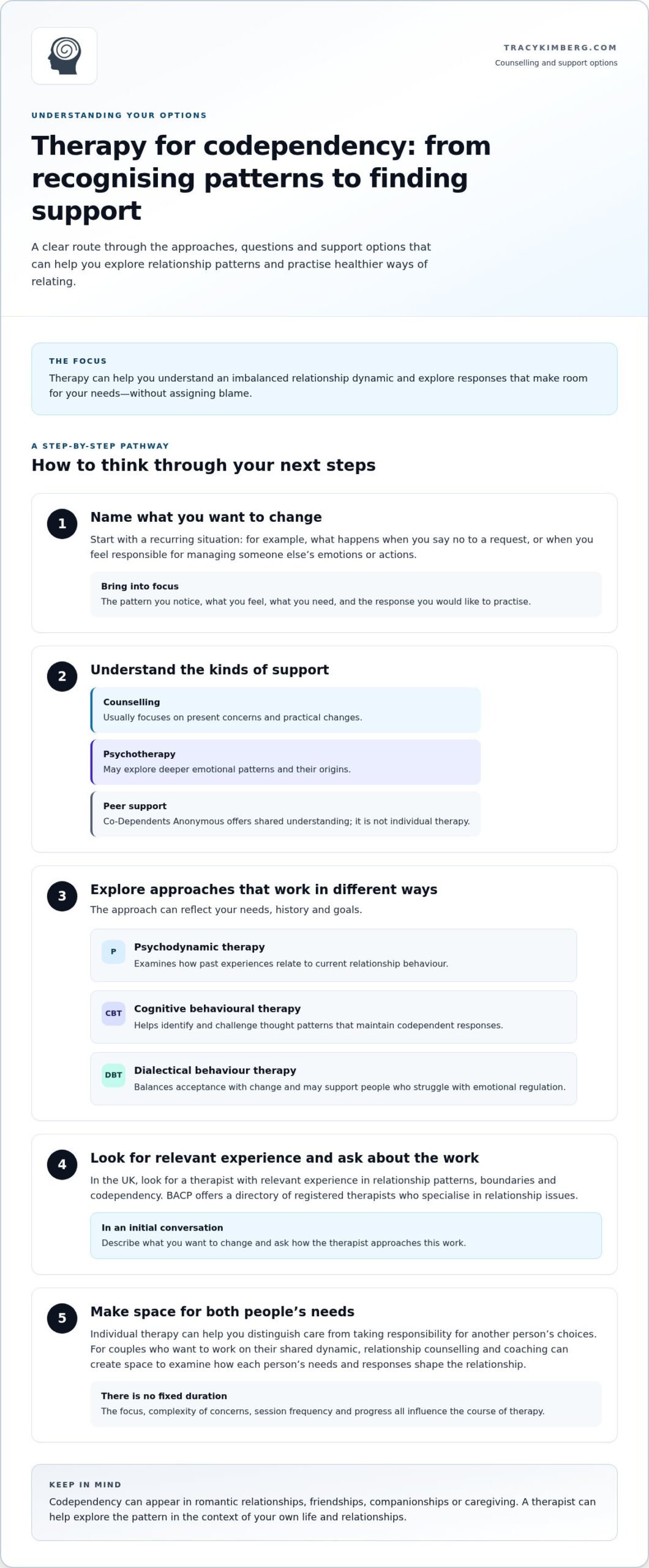
Therapy can help you understand an imbalanced relationship dynamic and practise healthier ways of relating. The right approach focuses on your needs, history and goals, rather than assigning blame.
Counselling usually focuses on present concerns and practical changes, whilst psychotherapy may explore deeper emotional patterns and their origins. Co-Dependents Anonymous is a peer-support option where people can find shared understanding; it isn’t individual therapy.
When looking for a therapist in the UK, seek relevant experience with relationship patterns, boundaries and codependency. BACP offers a directory of registered therapists who specialise in relationship issues. In an initial conversation, describe what you want to change and ask how the therapist approaches this work.
In counselling, you may explore recurring situations, identify beliefs that shape your actions and practise different responses. For example, you might look at what happens when you say no to a request. There’s no fixed duration: the focus, complexity of concerns, session frequency and progress all influence the course of therapy.
Codependency is an unhealthy relationship dynamic in which one person’s sense of self becomes closely tied to another person. It can appear in romantic relationships, friendships, companionships or caregiving. Anxious attachment may be associated with seeking closeness and fearing abandonment, so a delayed reply or disagreement can feel especially threatening.
Family experiences can influence how we understand closeness and care. If love or acceptance felt conditional in childhood, a person may learn to associate love with self-sacrifice. They might become highly attuned to others’ moods, take responsibility for keeping the peace or find it difficult to ask directly for support. These responses can make sense as adaptations, yet become limiting in adult relationships.
Different therapeutic approaches offer different ways to explore these patterns. Psychodynamic therapy can examine how past experiences relate to current relationship behaviour. Cognitive behavioural therapy (CBT) can help identify and challenge thought patterns that maintain codependent responses. Dialectical behaviour therapy (DBT) balances acceptance with change and may support people who struggle with emotional regulation.
Therapy can also help distinguish care from taking over responsibility for another person’s choices. Where a family dynamic involves harmful behaviour, sessions may explore how caretaking affects it and how to protect personal boundaries. For couples who want to work on their shared dynamic, relationship counselling and coaching for couples can create space to examine how each person’s needs and responses shape the relationship.
Setting boundaries and communicating needs
Boundaries clarify what you can offer and what you need in a relationship. A practical starting point is noticing where you agree automatically, then naming the limit you want to set.
Autonomy and Personal Boundaries
Autonomy means retaining choice over your time, feelings and actions while staying connected to someone else. Personal boundaries make that choice visible, such as asking for time alone after work or keeping a commitment with a friend. Without them, attachment can become tangled with responsibility for another person’s comfort. Naming your limit helps you stay in the relationship without abandoning yourself.
Difficulty setting boundaries can show up in everyday moments: answering messages during a meeting, lending money you need, or changing plans to avoid someone’s disappointment. Notice the moment before you say yes. Ask yourself, “Do I want to do this, or am I afraid of their reaction?” That pause gives you room to choose instead of responding from fear.
A boundary describes your own action, not a rule that controls another person. For instance, “I’ll continue this conversation when we’re both calm” states what you will do. “You must never get angry” tries to dictate another person’s feelings. This distinction supports autonomy and makes a limit clearer during difficult conversations.
Setting Healthy Boundaries
Healthy boundaries communicate a clear limit while respecting both people. Use a direct statement such as, “I can listen tonight, but I can’t solve this for you.” This names what you can offer without dismissing the other person’s feelings. Clear language can reduce confusion and help both partners understand what is being asked.
When a request feels difficult, try this approach: identify the specific behaviour, describe its effect, then state your need. For example, “When plans change without warning, I feel unsettled. Please tell me as soon as you know.” Keep the focus on one event. A specific request gives the other person something practical to respond to.
Assertive communication is neither silence nor attack. Speak in first-person terms, listen to the reply and check that you have understood. You might say, “I hear that you’re disappointed; I still need this evening to myself.” Active listening acknowledges their experience without requiring you to withdraw your boundary.
Therapy can help you practise these conversations and explore why saying no feels unsafe. Bring a recent example, such as agreeing to a family visit despite feeling exhausted, and rehearse a different response. The aim is to make choices that reflect your needs, rather than acting automatically out of fear or guilt.
Notice what happens after you communicate a limit. A respectful exchange allows both people to express their feelings and discuss options; repeated pressure or manipulation is a pattern worth addressing. Keeping a brief record of the request, your response and the other person’s reaction can help you see whether your boundaries are being heard.
Support groups and relationship counselling
Support groups and relationship counselling offer different kinds of help: peer understanding, or space to work on patterns with a therapist. Both can support movement towards relationships where each person’s needs and responsibilities matter.
Building Healthier Relationship Patterns
Healthier relationship patterns involve mutual respect, shared decisions and room for each person’s individual goals. For example, partners can agree on household responsibilities together instead of leaving one person to carry them by default. Maintaining friendships and hobbies alongside shared activities also helps each person keep a life beyond the relationship.
Notice how decisions are made: can both people express a preference, and does each person’s view affect the outcome? A pattern in which one partner always apologises, arranges plans or gives up friendships may signal an imbalance. Counselling can help partners understand these repeated interactions and practise more collaborative responses.
Support groups can offer community and understanding through shared experiences. Group therapy may also form part of treatment, alongside individual work or education. Hearing how others approach similar challenges can prompt reflection on your own actions, whilst a therapist can help connect those reflections to your particular relationship.
Codependency-Related Specialities
Support for codependency may involve individual psychotherapy, group therapy or relationship counselling, depending on what you want to address. Individual sessions can focus on personal beliefs and responses; couples work can examine how both partners contribute to recurring patterns. Support groups provide a peer setting, rather than a substitute for tailored therapeutic work.
Some codependent behaviours involve excessive caretaking or enabling destructive actions out of duty. For example, repeatedly taking over a partner’s responsibilities can prevent them from facing the consequences. Therapy can explore what drives that response and how to distinguish compassion from taking responsibility for another adult’s choices.
Choosing a UK Counsellor or Psychotherapist
When choosing a UK counsellor or psychotherapist, look for relevant experience with relationship issues and ask how sessions address codependent patterns. BACP offers a directory of registered therapists who specialise in relationship issues. Consider whether the professional’s approach suits your concerns, such as setting individual boundaries or working on a shared couple dynamic.
Private counselling fees depend on the case and are provided after a quote request; factors include session format, frequency and the support needed. You can also ask how progress is reviewed and whether the work focuses on individual or relationship goals. Clear answers help you understand the process before deciding whether it fits.
Relationship counselling may be useful when both partners want to examine their dynamic and share responsibility for change. If one person isn’t ready to attend, individual therapy or a support group can still offer space to understand your own patterns and choices.
Childhood origins of codependent behaviour
Codependent behaviours can develop as responses to difficult early experiences, including neglected emotional needs or taking on a caregiving role. Exploring those origins can help make sense of patterns that continue into adult relationships.
Learned Codependent Behaviours
When a child has to monitor a parent’s moods or manage household responsibilities, caring for others can become a way to feel safe. This response may have helped them cope at the time, but can later become a constant habit of putting other people first. For example, an adult may feel responsible for calming a partner after every disagreement, even when both people could take part in resolving the conflict.
Family patterns can also be learned by observation. A child who sees one parent repeatedly avoid conflict by giving in may come to treat self-sacrifice as part of love. Codependency is often learned and passed from one generation to the next, but recognising a pattern doesn’t mean blaming your family. It gives you a starting point for noticing which behaviours still serve you and which cause stress.
To explore a recurring response, write down what happened, what you felt responsible for and what you did next. For instance, did you cancel your plans because a relative seemed upset? Comparing that action with what you actually wanted can help identify the beliefs behind it. Therapy may explore childhood experiences alongside current behaviour, connecting earlier adaptations with present-day relationship choices.
Enabling Destructive Behaviours
Enabling means taking actions that protect another person from the consequences of harmful behaviour, often out of duty or obligation. A family member might repeatedly cover someone’s missed responsibilities, make excuses for destructive choices or provide support that allows the pattern to continue. The intention may be care, yet the impact can include more stress and neglect of your own needs.
Consider the difference between support and taking over. Listening to a relative discuss a problem is supportive; repeatedly resolving the same problem for them may keep you in a constant caretaker role. Ask what belongs to you and what belongs to the other person. This can help you choose a response without dismissing your concern for their wellbeing.
Working through these behaviours involves examining what you fear might happen if you stop stepping in. A therapist can help connect those fears with family history and consider alternative actions. If early caregiving roles or family patterns are affecting your relationships now, take a step towards understanding those patterns.
Tracy Kimberg: Relationship Counselling and Coaching for Couples
Tracy Kimberg offers Relationship Counselling and Coaching for Couples to help partners explore recurring patterns, understand each other’s needs and work towards a more balanced relationship. It may be a useful next step when conversations keep returning to the same conflict or one partner feels responsible for holding everything together.
For couples seeking a structured way to work on relationship difficulties, the 12-Week Relationship Recovery Process provides a defined programme. Therapy for Adults is another option when you want to explore your own experiences and responses individually. The focus can be on understanding what happens between you and finding different ways to relate, without reducing complex patterns to blame.
If you’d like to explore support, you’re welcome to visit tracykimberg.com.
Take a thoughtful next step
Changing a familiar relationship pattern can begin by noticing what you want to do differently, then choosing support that fits. If you’re considering counselling for codependency in the UK, you don’t need to have everything resolved before you begin. A first conversation can help you describe what feels difficult and what you hope might change.
Tracy Kimberg offers Relationship Counselling and Coaching for Couples, the 12-Week Relationship Recovery Process, and Therapy for Teenagers. These options provide different ways to explore relationship challenges, whether you’re seeking support together or for a teenager in your family.
Contact Tracy Kimberg about counselling to explore a possible next step. You can move towards relationships with more room for your needs, choices and connection.
Frequently Asked Questions
What is codependency?
Codependency is a relationship pattern in which caring for another person becomes closely tied to your identity or emotional security. For example, you might feel unable to make a decision until your partner approves, or repeatedly manage problems they could address themselves. The term describes a pattern, not a fixed identity. Understanding how it appears in your relationships can help you decide what support may be useful.
Does codependency only involve romantic partners?
No. Codependent patterns can also appear in friendships, family relationships, companionships and caregiving situations. You might feel responsible for a sibling’s choices or find it hard to disagree with a close friend. The particular relationship matters less than the recurring pattern: whether care, responsibility and personal choice are shared, or one person’s needs regularly eclipse the other’s.
How do I get started?
Start by choosing one recent situation that left you unsettled, such as agreeing to a request you wanted to refuse. Write down what happened, what you felt, what you did and what you would have preferred. You can use these notes to explain your concerns when contacting a therapist. You don’t need a diagnosis or a perfect account; a specific example gives the first conversation a practical place to begin.
Is therapy available online?
Yes. Tracy Kimberg offers online therapy, with one-to-one online sessions for couples and teenagers. Online sessions let you speak from a familiar, private setting, which may feel more comfortable than travelling to an appointment. In therapy, you can raise codependency concerns by describing how a particular relationship affects your choices, emotional wellbeing or daily life.
What is classed as a dysfunctional family and how does it lead to codependency?
A dysfunctional family is a family relationship system where recurring patterns make it difficult for members to feel heard, safe or supported. For example, a child may take on adult responsibilities, avoid expressing needs or try to prevent conflict from escalating. These responses can become familiar ways of relating later in life. The label alone doesn’t explain an individual’s experience; the specific roles and interactions matter.
Where else can I get help for codependency?
Peer support groups and group therapy can offer connection with people reflecting on similar relationship struggles. Co-Dependents Anonymous also provides a checklist to help you consider whether certain characteristics feel familiar. Treat it as a reflection tool, not a diagnosis. If anxiety, low mood or relationship stress is affecting everyday life, you can also speak with a qualified mental health professional about what support may suit your needs.
What is codependency and how is it recognised?
Codependency is recognised through recurring relationship behaviours, not one isolated act of kindness. For example, notice whether you routinely cancel your plans, hide the effects of someone else’s actions or feel unable to express a different view. Consider how often this happens and how it affects your wellbeing and relationships. A qualified professional can help explore the pattern; a checklist cannot establish a diagnosis.
What types of counselling help with codependency in the UK?
Approaches that may help include cognitive behavioural therapy, psychodynamic therapy and dialectical behaviour therapy. CBT can examine thoughts that shape relationship responses; psychodynamic work may explore how past experiences connect with current patterns; DBT can support emotional regulation. The focus can vary, from understanding a repeated reaction to practising a different response in a real relationship situation. A therapist can discuss which approach fits your concerns and goals.

Article by
Tracy Kimberg
Tracy Kimberg is a Relationship Expert, Couples Therapist and Coach with a dedicated focus on helping couples and individuals rebuild connection, trust and emotional safety in their relationships. Drawing on the research of John and Julie Gottman, the relational insights of Esther Perel, and years of hands-on therapeutic experience, Tracy offers a warm, non-judgemental and deeply compassionate approach to modern relationships.
Based in Dorset, Tracy works with couples navigating communication breakdowns, betrayal, intimacy challenges, separation, family dynamics and life transitions. Known for creating a safe and grounded therapeutic space, she combines practical tools with emotional depth to help clients move beyond survival patterns and towards meaningful, lasting change.
With a reputation for empathy, professionalism and dedication to her clients’ growth, Tracy is passionate about helping people feel seen, understood and empowered — both within their relationships and within themselves.
Disclaimer
Disclaimer:
The information shared in this article is intended for educational and informational purposes only and should not be considered a substitute for professional therapeutic, psychological, medical or legal advice. Every individual and relationship is unique, and the perspectives offered are based on general therapeutic principles, research and professional experience.
Reading this article does not establish a therapist-client relationship with Tracy Kimberg. If you are experiencing significant emotional distress, relationship crisis, trauma, or mental health concerns, it is important to seek support from a qualified professional appropriate to your individual circumstances.
All content remains the intellectual property of Tracy Kimberg and may not be reproduced or distributed without permission.