

Rebuilding a relationship after a miscarriage starts with making room for both partners’ grief, even when it looks different. There’s no set timetable for healing, and the American Pregnancy Association advises against rushing it. Gentle, honest conversations can help you understand what each of you needs without turning different ways of coping into blame.
You may want to talk while your partner needs quiet, or one of you may feel ready to try again before the other does. Neither response means you care less. Pregnancy loss can affect attachment, intimacy and your sense of safety together, so feeling out of step can be painful and confusing.
This article explores how grief and differences in bonding can create distance, and how listening, small gestures of care and shared ways to remember your baby may help you reconnect. You’ll also learn how to approach trying again and when individual or couples support may help you move forward together, at a pace that respects both of you.
Key Takeaways
- Make space for different emotions after pregnancy loss; grieving differently doesn’t mean either partner cares less.
- Share what you need, listen to understand, and take a pause if a conversation feels too difficult.
- Seek support together or individually, especially when grief makes it hard to connect or discuss trying again.
- Find a shared way to remember your baby while respecting that each partner’s attachment may have developed differently.
- Rebuild closeness through small acts of care, and let decisions about intimacy and another pregnancy unfold at a pace that feels right for both of you.
1. What are emotions I might feel after a miscarriage?
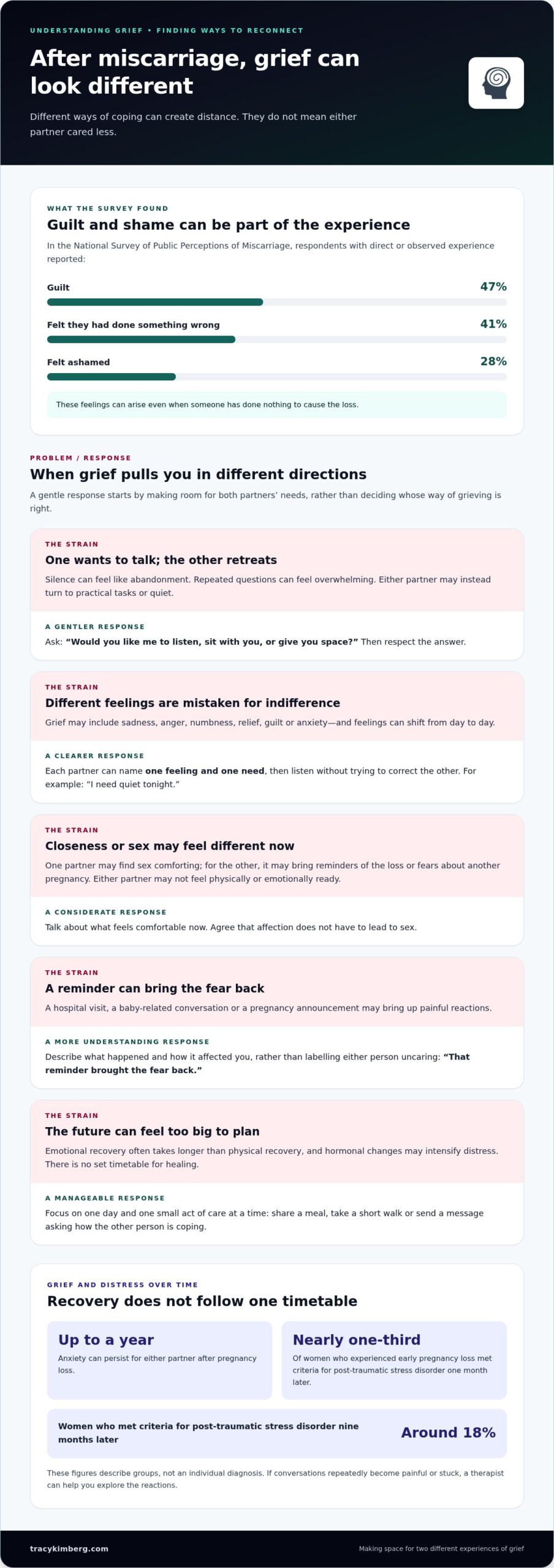
Different grieving styles, guilt, withdrawal and uncertainty about intimacy can all strain a relationship. Take one specific step: each partner names one feeling and one need, then listens without trying to correct the other. For example, “I need quiet tonight” explains a need without leaving a partner to guess whether they’re being rejected.
Grief can include sadness, anger, numbness, relief, guilt or anxiety, sometimes shifting from day to day. In a National Survey of Public Perceptions of Miscarriage, 47% of respondents with direct or observed experience reported guilt; 41% felt they had done something wrong, and 28% felt ashamed. Those feelings can arise even when someone hasn’t done anything to cause the loss.
Emotional recovery often takes longer than physical recovery, and hormonal changes may intensify distress. Anxiety can persist for up to a year after pregnancy loss for either partner. Nearly one-third of women who experienced early pregnancy loss met criteria for post-traumatic stress disorder one month later; around 18% did so nine months later. These figures describe groups, not an individual diagnosis.
Strain can grow when one partner talks about the loss and the other retreats into practical tasks or silence. Both may be coping in their own way, yet silence can feel like abandonment and repeated questions can feel overwhelming. Try a short check-in: ask, “Would you like me to listen, sit with you, or give you space?” Then respect the answer.
The loss may also leave emotional wounds that affect how safe closeness feels. A partner might replay a hospital visit, avoid baby-related conversations or feel alarmed by pregnancy announcements. Rather than labelling either person uncaring, describe what happened and how it affected you: “That reminder brought the fear back.” A therapist can help you explore these reactions if conversations repeatedly become painful or stuck.
You may also feel differently about sex. After a miscarriage, either partner may not feel physically or emotionally ready; vaginal dryness or problems with erection or ejaculation may also occur. Sex might comfort one partner while reminding the other of the loss or raising fears about another pregnancy. Agree that affection doesn’t have to lead to sex, and talk about what feels comfortable now.
Focus on one manageable goal at a time. The American Pregnancy Association recommends getting through each day rather than planning the whole week. You might agree to share a meal, take a short walk or send a message asking how the other person is coping. Small, clear gestures let you offer support without demanding that grief follow the same timetable.
2. Support when trying again after a previous miscarriage
Trying for another pregnancy can bring hope and fear at once. One partner may feel ready to plan, while the other worries about another loss. Before making decisions, each of you could write down what feels hopeful, what feels difficult and what remains unanswered. Compare notes without treating either list as a promise or refusal. This makes room for sadness about the pregnancy that ended alongside thoughts about a possible future.
Talk together about what support would make the next stage more manageable. You could agree how to handle pregnancy announcements, appointments, anniversaries or moments when anxiety rises. Ask, “What would help you feel less alone today?” rather than assuming you know. You might talk after an appointment, take a quiet walk together or ask a trusted person to be available afterwards. A simple plan gives both partners something concrete to lean on.
You don’t have to make an immediate, definite decision about another pregnancy. Some people may be advised to wait before trying to conceive again, and the decision can depend on physical recovery, emotional readiness and each partner’s wishes. When you feel ready to explore medical considerations, consulting dedicated women’s health and fertility specialists such as Sincere Healthcare Group can offer clarity on physical readiness and conception options. A person may be fertile in the first month after a miscarriage. If you have sex and don’t want another pregnancy yet, use contraception. Keeping these practical details in mind can help separate intimacy from the decision to try again.
Support outside the relationship can ease pressure on you as a couple. A friend might listen without offering solutions; a relative might help with a practical task. Choose someone who respects your privacy and won’t push either partner to feel hopeful or “move on”. If one person wants to talk and the other needs quiet, you can each seek a different kind of support. Time with a trusted friend or a restorative activity can help someone grieve without making their partner responsible for meeting every need.
The American Pregnancy Association advises seeking counselling to support both partners after pregnancy loss. Professional support can be individual or shared, depending on whether someone needs space to process privately or wants help discussing the loss together. If fear about trying again repeatedly closes down conversation, Relationship Counselling and Coaching for Couples can offer a space to explore those concerns and hear each other more clearly. Support isn’t a verdict on the relationship; it’s a way to approach a complicated decision with care.
3. How can incongruent grief divide a couple following pregnancy loss?
After pregnancy loss, partners may grieve at different speeds or express grief differently. One might feel an urgent need to talk, while the other focuses on work, household tasks or practical decisions. That contrast can become painful if one person reads silence as indifference, or questions as pressure. Different responses don’t prove that either partner cared less. They reflect different ways of living with the loss.
Gender expectations can shape what feels acceptable to show. Someone taught to “stay strong” might hide tears and turn towards problem-solving; their partner might feel alone with the emotional impact. A systematic review published in 2020 found that women generally experienced more distress and more intense grief after pregnancy loss than male partners. That finding describes a general pattern, not a rule for every couple or a measure of who loved the baby more.
Try separating the feeling from the interpretation. Each partner can complete two sentences: “I feel…” and “I need…”. For example: “I feel shut out when we don’t talk; I need you to tell me when you’re ready.” The other person can reflect back what they heard before responding. This simple practice can replace blame with a clearer request and help both of you understand what the other is carrying.
Grief can also be triggered unexpectedly. An appointment reminder, a pregnancy announcement or a date connected with the loss might feel manageable one day and overwhelming the next. Agree on a simple signal, such as “I need a pause,” and decide whether to step outside, sit together or talk later. If a conversation becomes too difficult, taking a break can prevent hurtful words. Agree when you’ll return to it, so the pause doesn’t feel like abandonment.
Acceptance doesn’t mean forgetting the baby or feeling ready to move on. The American Pregnancy Association says there is no set time for healing after miscarriage, and grief shouldn’t be rushed. You can honour different needs while creating something shared, such as choosing a keepsake or setting aside a quiet moment to remember. The ritual matters less than agreeing that the loss has a place in both your stories.
Repeated conflict can hide a more tender question: “Can you stay close to me, even when we grieve differently?” Answer it by listening, not competing over whose pain is greater. If you can’t talk about the loss without shutting down or arguing, couples therapy may help you hear each other and find a way forward together. Grief may remain personal, but understanding can become shared.
4. Differences in attachment to an unborn baby
Attachment can begin at different moments for each parent. One might feel connected after seeing a positive pregnancy test; another may need time, conversation or a physical sign. Partners often attach to the baby around 20 weeks, when the baby begins to move. This is a common point of connection, not a deadline. If one partner’s feelings seem less visible, it doesn’t prove they feel less loss.
Pregnancy can make the baby feel present in different ways. The pregnant parent may notice bodily changes, appointments and daily reminders. Their partner might connect through practical preparations, choosing a name or imagining family life. These experiences can create different memories and meanings. Try naming what each of you remembers: “I felt close during the scan” or “I started imagining us as parents when we chose the cot.”
After a loss, these differences can shape how each of you experiences grief. Someone who bonded early may feel the baby was already part of family life. Someone whose attachment grew gradually may struggle to find words, while still feeling sadness or shock. Don’t use visible emotion as a measure of love. Instead, ask what the pregnancy meant to each of you and listen without correcting the other person’s account.
A shared way to remember the baby can give both partners space to honour their own feelings. You might write a letter, keep a meaningful object, plant something together or mark a date privately. Choose something that feels manageable to both of you. One partner may want to speak the baby’s name, while the other prefers a quiet ritual. Agreeing to differ can still make the act shared.
For a collective remembrance, you can take part in the Wave of Light during Baby Loss Awareness Week. Lighting a candle together can create a moment to pause, remember and acknowledge the loss. If that event doesn’t feel right, choose another ritual that reflects your relationship. The aim isn’t to perform grief in a particular way, but to make room for the baby’s place in your shared story.
Keep the conversation open as feelings change. One partner might want to revisit a keepsake months later, while the other needs more distance. Ask, “Would remembering together feel comforting today?” Give each person permission to answer honestly. You can also remember separately, then share a detail when you’re ready. These small choices honour your differences without asking either partner to hide what the baby meant to them.
5. Moving forward together after miscarriage or stillbirth
A shared future doesn’t require you to leave the past behind. It can hold the baby you lost and the life you’re still shaping together. Rebuilding a relationship after a miscarriage may mean asking what you want your partnership to stand for now, beyond decisions about pregnancy. Each of you could name a value you want to protect, such as tenderness, honesty or making room for joy.
Turn those values into a shared direction. If you both value connection, choose a new experience for your life now, such as learning a recipe together or planning a day out. This isn’t a replacement for the baby or a way to erase grief. It’s a reminder that your relationship can keep growing around what matters to you both.
You might also revisit the future you imagined before the loss. Some hopes may still feel right; others may have changed. Each partner can privately note what they want to carry forward and what they want to reconsider, then discuss one point at a time. This makes room for change without forcing a final answer about the shape of your family.
Future plans can include everyday milestones as well as major choices. You might decide what you want the next season to look like, or how to mark an occasion that once carried different expectations. Give yourselves permission to make plans that feel meaningful now, rather than treating them as proof that grief has ended. Rebuilding a relationship after a miscarriage can mean discovering what you want to create together, at a pace that feels authentic.
As your shared direction becomes clearer, you may want a dedicated space to explore what has changed between you and what you want to nurture next. Relationship Counselling and Coaching for Couples can help you reflect on those relationship questions and consider a way forward that feels true to both of you.
Tracy Kimberg: Relationship Counselling and Coaching for Couples
Tracy Kimberg’s Relationship Counselling and Coaching for Couples can help when grief makes it hard to communicate, feel close or discuss what comes next. Sessions offer space to understand how each partner is affected and explore ways to move forward together, without expecting you to grieve in the same way.
If you want more structured support, Tracy also offers a 12-Week Relationship Recovery Process. Consider reaching out when conversations repeatedly become difficult, or when you’d like help finding a way to reconnect after pregnancy loss. Support can help you approach the relationship with care, one step at a time.
Contact Tracy Kimberg to explore support for your relationship.
Choose one gentle next step together
The next step doesn’t have to resolve every question about grief, intimacy or the future. It can be a shared intention: make room for an honest conversation, seek support, or approach one another with curiosity rather than assumptions. Rebuilding a relationship after a miscarriage isn’t about returning to exactly how things were. It can mean building a new understanding of what each of you needs now.
You might begin by asking, “What would help us feel more connected this week?” Listen to the answer without turning it into a promise or a test. If you’d value support in finding your way through this together, contact Tracy Kimberg to explore your next step.
There’s no single right pace. With care, patience and a willingness to keep meeting each other, you can move towards a relationship that holds both the love you share and the loss you’ve experienced.
Frequently Asked Questions
How can incongruent grief divide a couple following pregnancy loss?
Different grief responses can create a cycle of pursuing and withdrawing. One partner seeks conversation to feel connected; the other retreats to manage overwhelm, leaving both feeling misunderstood. Name the pattern together rather than assigning blame: “We seem to get stuck when I ask and you go quiet.” Then agree how to return to the conversation in a way that feels manageable for both of you.
What are emotions I might feel after a miscarriage?
You might feel sadness, anger, numbness, guilt, relief or anxiety, and those feelings may shift. A familiar moment, such as seeing a pram or hearing a pregnancy announcement, can bring an unexpected reaction. Notice what happened just before the feeling arose and what you need now, such as company or quiet. Naming the emotion can help you explain it without having to justify it.
How can couples communicate after a miscarriage?
Choose a calm moment and take turns speaking without interruption. One partner can describe a feeling and what brought it up, while the other reflects back what they heard. For example: “I felt alone at the appointment,” followed by “You wanted me beside you.” Ask whether the reflection feels accurate before offering explanations. This keeps the conversation focused on understanding, not proving who remembers events correctly.
How do partners grieve differently after pregnancy loss?
One partner may want to talk, while the other processes privately or through practical tasks. Responses can also change over time: someone who seemed composed at first may feel the loss more strongly later. Rather than judging grief by tears or words, ask what support would help today. One partner might prefer company during an appointment, while the other finds comfort in writing privately before talking.
How can couples rebuild emotional intimacy after a miscarriage?
Start with safe, low-pressure connection, such as sitting together over breakfast or sharing a familiar activity. Ask before initiating touch, and make clear that affection doesn’t create an expectation of sex. You can also set aside time to talk about something beyond the loss, such as a film or a meal you both enjoy. These ordinary moments can help the relationship feel like more than grief.
What counselling or support groups help couples after miscarriage?
Couples counselling can help you talk through the loss together, while individual therapy offers private space to explore personal feelings. Some people also value a peer support group focused on pregnancy loss, where they can hear from others with related experiences. Friends or relatives may provide practical or emotional support, too. Choose the support that feels easiest to approach, and be specific about what would help.
When should couples seek professional help after a miscarriage?
Consider professional support if distress is making everyday life harder, conversations repeatedly turn into conflict, or either partner feels unable to share what they’re experiencing. Support may also help if anxiety or low mood continues to weigh on your relationship. You don’t need to agree on every detail of the loss before seeking help; one partner can begin by explaining what feels difficult and what they hope might change.
How can partners support each other while trying to conceive again?
Talk about what each of you wants to know and share during the process. You could agree whether to discuss appointments together, how to handle difficult days, and what kind of comfort feels welcome when emotions rise. Make room for mixed feelings rather than treating hope and fear as opposites. A brief check-in after a challenging moment can help you adjust your support to what your partner needs then.

Article by
Tracy Kimberg
Tracy Kimberg is a Relationship Expert, Couples Therapist and Coach with a dedicated focus on helping couples and individuals rebuild connection, trust and emotional safety in their relationships. Drawing on the research of John and Julie Gottman, the relational insights of Esther Perel, and years of hands-on therapeutic experience, Tracy offers a warm, non-judgemental and deeply compassionate approach to modern relationships.
Based in Dorset, Tracy works with couples navigating communication breakdowns, betrayal, intimacy challenges, separation, family dynamics and life transitions. Known for creating a safe and grounded therapeutic space, she combines practical tools with emotional depth to help clients move beyond survival patterns and towards meaningful, lasting change.
With a reputation for empathy, professionalism and dedication to her clients’ growth, Tracy is passionate about helping people feel seen, understood and empowered — both within their relationships and within themselves.
Disclaimer
Disclaimer:
The information shared in this article is intended for educational and informational purposes only and should not be considered a substitute for professional therapeutic, psychological, medical or legal advice. Every individual and relationship is unique, and the perspectives offered are based on general therapeutic principles, research and professional experience.
Reading this article does not establish a therapist-client relationship with Tracy Kimberg. If you are experiencing significant emotional distress, relationship crisis, trauma, or mental health concerns, it is important to seek support from a qualified professional appropriate to your individual circumstances.
All content remains the intellectual property of Tracy Kimberg and may not be reproduced or distributed without permission.