

More revision isn’t always the best way to ease exam stress. Supporting a teenager with exam stress means helping them plan manageable study sessions, listening without judgement and protecting time for rest; most teenagers need 8 to 10 hours of sleep a night.
It can be hard to tell whether your teenager’s worries are a passing response to exams or a sign they’re struggling. Revision stress can affect more than study time: it may shape conversations at home and leave everyone feeling under pressure.
This guide explains how to create a practical revision plan, recognise signs of exam-related stress and offer support that keeps your relationship at the centre. You’ll also learn how exam pressure can affect family life and how to make room for connection when conversations seem to revolve around grades.
Key Takeaways
- Make rest, regular meals, hydration and enjoyable movement part of exam preparation; most teenagers need 8 to 10 hours of sleep a night.
- Help your teen shape revision into focused sessions with breaks, rather than leaving everything until the last minute.
- Notice changes such as withdrawal, disrupted sleep or persistent physical complaints, and respond with curiosity rather than criticism.
- Break overwhelming study tasks into smaller steps so your teenager can see a manageable way forward.
- Keep family time open to conversation beyond exams, helping your teen feel valued for who they are, not just their results.
Sleep, nutrition, hydration, and physical activity
Sleep is part of revision, not time taken away from it. Most teenagers need 8 to 10 hours a night, so help your teen protect a regular bedtime. Avoid revision and screens for an hour before bed, then use a quieter wind-down routine. A book, a shower or calm music can help mark the shift from study to rest.
Notice changes in sleep, appetite, energy or mood when exam pressure continues for days or weeks. These changes can make study and family conversations harder. Ask what would help tonight, rather than turning bedtime into another discussion about unfinished work. A consistent routine gives your teenager a predictable end to the day, even when revision feels unfinished.
Regular meals and water can help maintain energy during exam preparation. Encourage your teenager to eat balanced meals at regular times, with protein, fruit and vegetables. Eggs, yoghurt, beans, fish, fruit or chopped vegetables can be practical options between study sessions. A balanced diet can support wellbeing, but it needn’t become another standard your teenager feels they must meet perfectly.
Keep water available where your teen studies, and make drinking part of ordinary breaks. Regular hydration, alongside balanced meals, can help stabilise energy levels. Physical activity offers a change of focus: walking, cycling, swimming, football or dancing can help ease tension. Aim to encourage daily movement; even a 10-minute walk outside counts, and 20 minutes of exercise each day can support mood and sleep patterns.
Revision, sleep, friendships and movement all need space in the week. Dr Anna Colton recommends dividing the day into three segments, with no more than two devoted to revision. This leaves room for meals, exercise and social time. Colton also recommends taking at least one day off each week. A proper meal break, even a short one, gives your teenager a pause from studying.
Ask your teenager which routine feels realistic, then agree on one small adjustment. They might take a walk after school, eat dinner away from their desk or stop revising before bed. Breaks for enjoyable activities can support emotional wellbeing and make revision feel less consuming. The aim is balance, not a timetable that leaves no room for themselves.
Schools may support students with arrangements such as extra time, rest breaks or smaller exam groups. They may also offer a quiet space, counselling or mentoring, and agree on regular updates with parents about how the student is managing.
2. Revision planning and study techniques
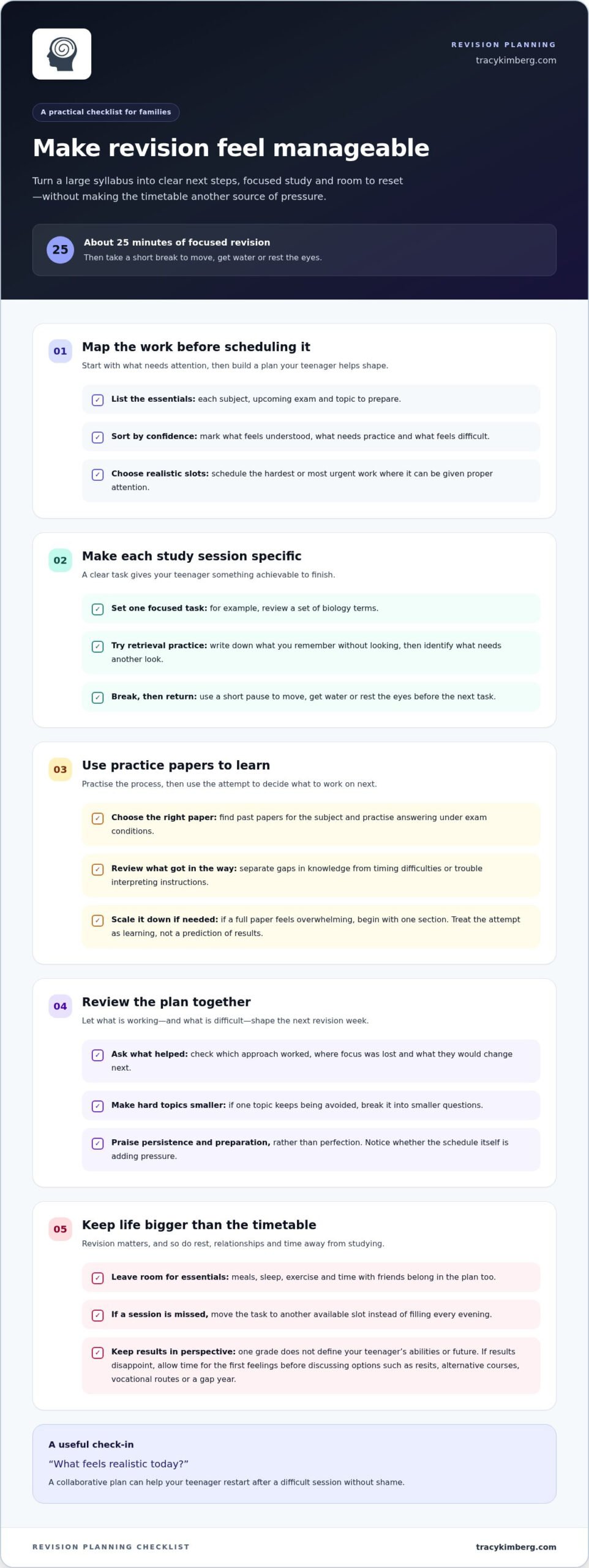
A written plan turns a large syllabus into visible, manageable tasks. List each subject, upcoming exam and topic your teenager needs to prepare. Ask them to mark what they understand, what needs practice and what feels difficult. Then schedule the hardest or most urgent work in realistic study slots. A timetable works best when your teenager helps shape it, rather than receiving it as another demand.
Keep revision sessions focused and achievable. A session of about 25 minutes gives a clear stretch of work, followed by a short break to move, get water or rest their eyes. For example, your teen might review one set of biology terms, then write down what they remember without looking. These small retrieval tasks give them something concrete to complete and reveal which ideas need another look.
Past papers can make exam preparation feel more familiar. Help your teenager find papers for the right subject and practise answering questions under exam conditions. Afterwards, review the questions together and distinguish gaps in knowledge from difficulties with timing or interpreting instructions. If a full paper feels overwhelming, start with one section. The aim is to learn from the attempt, not treat every practice score as a prediction.
Don’t let the timetable become a measure of your teenager’s worth. Make room for meals, sleep, exercise and time with friends, as well as revision. If they miss a session, help them move the task to another available slot instead of filling every evening. Ask, “What feels realistic today?” This can ease pressure and help a young person who is struggling to start again without shame.
Plan for results as well as exams. Before results day, remind your teenager that one grade doesn’t define their abilities or future. If results disappoint, allow time for the first emotional response before discussing next steps. Once feelings have settled, explore options such as resits, alternative courses, vocational routes or a gap year. A calm conversation makes room for choices without pretending disappointment doesn’t matter.
After each practice paper or revision week, review the plan together. Ask which approach helped, where they lost focus and what they’d change next. For example, if your teenager keeps avoiding one topic, they may need help breaking it into smaller questions. Praise persistence and preparation, not perfection. This keeps revision responsive to what your child is learning and helps you notice if the schedule itself is adding pressure.
3. Recognising exam-related stress and anxiety
Some nervousness before an exam is a natural response and can help a teenager prepare. The key question is whether anxiety starts to disrupt everyday life, relationships or learning. Teenagers show stress differently: one may become tearful or restless, while another withdraws. Look for changes from their usual behaviour, rather than comparing them with friends or siblings.
Look for patterns at school and home. A teenager who stops enjoying hobbies, avoids friends or becomes unusually quiet may be struggling. Headaches, stomach aches, appetite changes and trouble sleeping can also accompany excessive stress. A sudden drop in school performance or doing very little under pressure calls for curiosity, not an accusation of laziness. Ask what feels hardest before assuming they aren’t trying.
Try a grounding exercise before revision or an exam. Invite your teenager to name five things they see, four they feel, three they hear, two they smell and one they taste. They can also take three slow belly breaths, making each exhale longer. These steps bring attention back to the present. They don’t have to remove every worry to help your teenager begin coping.
How can teenagers manage exam anxiety with breathing or mindfulness techniques? Practise three slow belly breaths or the 5-4-3-2-1 grounding scan before study or an exam. Rehearsing the steps at a calm moment can make them easier to recall when anxiety rises.
Seek additional help when anxiety or low mood is severe, persists or interferes with daily life. Persistent sadness, ongoing anxiety or thoughts of self-harm call for immediate support. A GP can guide families towards further evaluation, counselling or other mental health resources. If your teenager says they may harm themselves, stay with them and seek urgent help rather than managing the risk alone.
Are there free U.S. resources or crisis support options for teens with severe anxiety? A school counsellor or mental health team can discuss support available at school, including counselling. If a teenager is in immediate danger, contact local emergency services; a GP can help families find further mental health support.
Try a gentle opening, such as, “I’ve noticed you seem more worried this week. What’s been hardest?” Listen without judgement, then remind your teenager that asking for help is a way of coping, not a failure. If talking feels difficult, offer another way to communicate, such as writing down their worries. Their response can help you work out whether practical support, contact with school or professional care is the next step.
4. How can I tell if my teen is stressed?
A teenager who keeps delaying may feel overwhelmed rather than unwilling to work. Instead of asking why they haven’t started, try, “Which part feels hardest right now?” Listen before offering solutions. If they can’t identify a first step, sit together and choose one small task, such as opening the workbook or picking a question. Their response can show whether they need practical help, space or a quieter approach.
Turn a broad instruction such as “revise history” into actions your teenager can see and complete. For example, they could choose one topic, list key events, then explain those events aloud without notes. Keep the task specific and agree on what “done” looks like before they begin. If the first action still feels too big, break it down further, perhaps by selecting one page or one question to start.
A suitable study space should feel calm and practical, not perfect. A quiet area with natural light can support concentration. Clear away unrelated books, keep the necessary materials within reach and leave a notebook nearby for distracting thoughts or questions. If the kitchen table is the only option, agree when it’s for studying and when it returns to family use. Let your teenager help choose what works for them.
Some young people struggle to focus in silence; others find household noise distracting. Ask your teen to test one adjustment at a time, such as moving away from the television or studying in a quieter room. A simple checklist can prevent repeated trips for pens, notes or chargers. If siblings share the space, agree a clear signal for focused study, such as headphones or a note on the door.
Make the routine predictable without turning it into surveillance. Agree on a start cue, such as making a drink, and an end cue, such as putting books away. Parents can check in at an agreed time instead of asking about progress every few minutes. If a study session becomes frustrating, a short break can help your teenager reset before returning to one defined task. Consistent boundaries make study and rest easier to anticipate.
Motivation often grows when young people have some ownership. Offer two helpful choices, such as which subject to start with or whether to work at the desk or table. Notice effort specifically: “You got started even though that topic felt difficult.” This recognises persistence without making grades the measure of success. If your teenager says they’re struggling, treat that as useful information and work out the next step together.
5. Effects of exam stress on family life
During exams, family life can begin to revolve around revision. A question about homework may sound like criticism to a teenager who already feels overwhelmed, and a reminder can spark an argument. Parents may also disagree about how much to encourage studying or when to step back. Talk privately with your partner before responding, so your teenager doesn’t feel caught between competing expectations. Then ask, “Would you like help, or would you rather talk later?”
Notice when ordinary routines start to change. Meals may become tense, your teenager might stay in their room, or every conversation may turn to grades. Parents can feel worried and out of step with each other, especially if one wants to ask more questions while the other wants to give space. Agree on a practical boundary, such as one planned check-in about schoolwork, then revisit it together if it isn’t working. This helps stop the issue from taking over all your time as a family.
Make family time explicitly non-academic. Dr Anna Colton recommends using meals or downtime to talk about whatever your teenager wants, not only exams or revision. Set aside 10 minutes of non-academic time together each day. Ask about a friend, a programme they’re watching or what they’d like to do after exams. These ordinary moments help your teen feel valued beyond school performance and give parents a chance to reconnect as partners, too.
Parents can reduce the emotional weight attached to results by agreeing on the message they want to give. Tell your teenager plainly that your love and their worth don’t depend on a grade, including a grade 4 or 9. Praise persistence, such as returning to a difficult topic, rather than only high marks. Partners don’t have to respond identically, but discussing differences away from the teen can prevent results becoming a source of blame between adults.
Social media can intensify comparisons when teenagers see classmates sharing successes but not setbacks. If your teenager seems more distressed after scrolling, ask what they’re noticing and feeling before suggesting a change. You might agree to put phones aside at dinner or mute exam-related posts for a while. As parents, try to make that decision together. A shared boundary is less likely to become another argument about who is being too strict.
After an exam, try a two-part conversation: first ask what went well, then help your teenager turn attention towards the next paper. Avoid replaying answers that can no longer be changed. If disappointment persists as sadness, anxiety or withdrawal, involve the school, a GP or mental-health support. If stress is affecting connection at home or between partners, therapy for teenagers can offer a space to explore difficult feelings and family patterns.
Tracy Kimberg: Relationship Counselling and Coaching for Couples
Tracy Kimberg offers Teen Therapy, providing a space for teenagers to explore exam anxiety and pressures affecting everyday life. It may help when worry persists, disrupts wellbeing or makes communication at home difficult. Therapy for Adults is also available to support parents with their own responses and family relationships during a stressful period.
Exam pressure can affect the whole household, but you don’t have to navigate those conversations alone. If stress is creating distance or repeated conflict, Relationship Counselling and Coaching for Couples may help partners understand how they can support each other and their teenager. The right next step depends on who needs support and what feels most difficult at home.
If you’d like to explore support, visit Tracy Kimberg’s website.
Keep the connection growing beyond exam day
Once exams are over, give your family room to reflect on what the pressure brought up. Your teenager may want to celebrate, rest or talk through a difficult moment. Let them choose where to begin. A simple conversation about what helped them feel understood can shape how you face the next demanding period together.
Supporting a teenager with exam stress also means making room to repair your relationship. If revision led to sharp words or distance, acknowledge your part without turning the conversation into another lesson. You might say, “I know we both felt under pressure. How can we handle that differently next time?” This keeps the relationship open, even when you don’t have every answer.
If exam worries continue to strain family relationships, support can help you explore what’s happening and find a way forward. Contact Tracy Kimberg for support. Small steps towards understanding can help your family move through this experience with greater trust and connection.
Frequently Asked Questions
Struggling with exam stress?
Start by identifying what feels most difficult: getting started, remembering material, fear of a particular subject or pressure about results. Choose one supportive action together, such as asking a teacher to clarify an assignment or agreeing on a quieter evening. If anxiety or low mood is severe, persists or affects everyday life, speak with your GP. You don’t have to solve everything in one conversation.
How can I tell if my teen is stressed?
Compare their current behaviour with what’s usual for them. A teenager who normally chats over dinner might become unusually quiet, or someone who enjoys football may lose interest. Ask about the change without assuming exams are the only cause. If anxiety, sadness or withdrawal continues and affects everyday life, involve a GP or school support staff. A brief note of changes can help you explain your concerns.
How can parents help?
Supporting a teenager with exam stress can start with a calm check-in and practical choices. Try asking, “Would you like me to listen, help you plan, or give you some space?” Then follow their answer where possible. You could also help with a specific barrier, such as finding a quiet place to work or arranging a conversation with a teacher. Focus on what your teenager says they need.
What are common signs of exam stress in teenagers?
Exam stress may show as irritability, tearfulness, restlessness, trouble sleeping, appetite changes or physical complaints such as headaches and stomach aches. Some teenagers seek constant company; others pull away from family and friends. A single difficult evening doesn’t tell the whole story. Look for a pattern or a marked change, such as a young person repeatedly avoiding activities they usually enjoy or struggling to manage ordinary routines.
How can parents talk to a teenager about exam stress?
Choose a low-pressure moment, perhaps while walking together or travelling in the car, rather than starting during an argument about revision. Share what you’ve noticed, then invite their perspective: “You seem quieter after school. What’s been on your mind?” Listen without correcting their feelings or immediately offering solutions. If they’re not ready to talk, say you’re available later and keep the invitation open without repeatedly pressing them.
What practical study strategies help teenagers prepare for exams without burnout?
Agree on a clear stopping point for each study task, such as completing a set of questions or reviewing one topic. Encourage your teenager to alternate subjects so one difficult area doesn’t dominate the whole evening. A practice question can reveal what they understand better than rereading notes alone. Review the plan together after a few days, then adjust it if it’s crowding out meals, rest or normal family routines.
How much sleep should teenagers get during exam periods?
Most teenagers need 8 to 10 hours of sleep a night. Help yours make a bedtime routine that fits their school mornings, and avoid turning the final hour into a last-minute revision session. If they’re lying awake worrying, suggest writing down tomorrow’s first study task before winding down. Persistent sleep difficulties, especially alongside ongoing anxiety or low mood, are worth discussing with a GP.
What should teenagers eat and drink to support concentration during exams?
Offer regular meals and easy options your teenager can manage between school and revision, such as yoghurt, fruit, eggs or a sandwich. Keep water within reach, and avoid making food another source of pressure or criticism. For a busy exam morning, prepare breakfast ingredients the night before, then eat before leaving. Notice whether skipped meals or not drinking enough coincide with tiredness or difficulty concentrating.

Article by
Tracy Kimberg
Tracy Kimberg is a Relationship Expert, Couples Therapist and Coach with a dedicated focus on helping couples and individuals rebuild connection, trust and emotional safety in their relationships. Drawing on the research of John and Julie Gottman, the relational insights of Esther Perel, and years of hands-on therapeutic experience, Tracy offers a warm, non-judgemental and deeply compassionate approach to modern relationships.
Based in Dorset, Tracy works with couples navigating communication breakdowns, betrayal, intimacy challenges, separation, family dynamics and life transitions. Known for creating a safe and grounded therapeutic space, she combines practical tools with emotional depth to help clients move beyond survival patterns and towards meaningful, lasting change.
With a reputation for empathy, professionalism and dedication to her clients’ growth, Tracy is passionate about helping people feel seen, understood and empowered — both within their relationships and within themselves.
Disclaimer
Disclaimer:
The information shared in this article is intended for educational and informational purposes only and should not be considered a substitute for professional therapeutic, psychological, medical or legal advice. Every individual and relationship is unique, and the perspectives offered are based on general therapeutic principles, research and professional experience.
Reading this article does not establish a therapist-client relationship with Tracy Kimberg. If you are experiencing significant emotional distress, relationship crisis, trauma, or mental health concerns, it is important to seek support from a qualified professional appropriate to your individual circumstances.
All content remains the intellectual property of Tracy Kimberg and may not be reproduced or distributed without permission.