

A letter to my husband about our marriage problems can express what hurts, what you regret, and what you hope your relationship could become. Focus on your feelings and needs rather than blaming yourself or attacking him. The aim isn’t to solve everything on the page, but to make an honest conversation possible.
If you’ve tried to explain what’s wrong but still feel dismissed, writing your thoughts down may help you find clearer words. Describe the patterns that hurt, how they affect you, and what you’d like to change, without minimising your experience or turning the letter into an accusation.
This guide will help you shape an honest, caring letter, with ideas to adapt rather than copy word for word. You’ll also explore how to raise recurring problems, consider therapy or separation, and set boundaries with care. You can start with one clear sentence about what you need your husband to understand.
Key Takeaways
- Use a specific example to explain when you feel unheard, then say what you need in that moment.
- Consider whether a guided conversation could help you both understand the pattern and decide what comes next.
- Look beneath repeated arguments to identify the unmet needs or emotional distance that may be keeping them alive.
- Set a clear, caring boundary by stating what you will do to protect your wellbeing, rather than trying to control your husband.
Feeling unheard or dismissed by a spouse
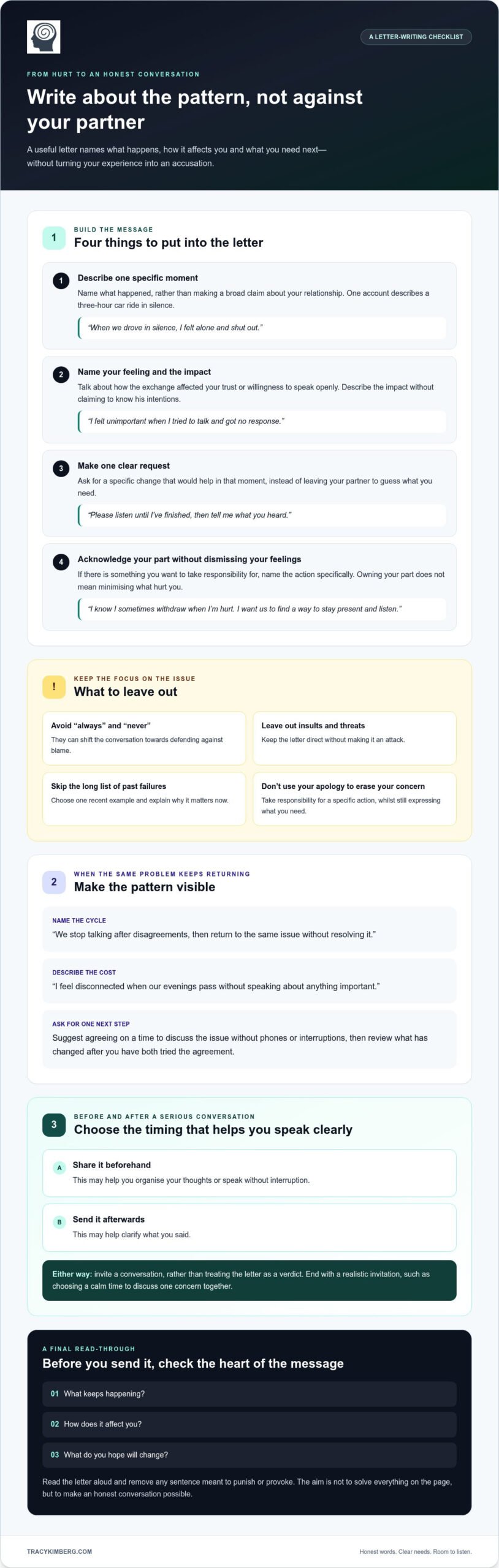
Feeling unheard can make an ordinary exchange feel like proof that your feelings have no place. One account describes a three-hour car ride during the final months of a marriage, with the husband refusing to speak. In your letter, describe the moment and how it affected you: “When we drove in silence, I felt alone and shut out.” A specific example helps your husband understand what you mean by feeling dismissed.
Focus on your experience rather than judging his intentions. “You never care about me” can lead to an argument over whether that’s true. “I felt unimportant when I tried to talk and got no response” explains the impact without claiming to know what he was thinking. You can also say what you need: “Please listen until I’ve finished, then tell me what you heard.”
Should you give your husband a letter before or after a serious conversation? Either can work. Share it beforehand if writing helps you organise your thoughts or speak without interruption; send it afterwards if you want to clarify what you said. Either way, invite a conversation instead of treating the letter as a verdict.
- Describe one moment: Name what happened, such as being interrupted while discussing a difficult decision.
- Share your feeling: Say “I felt dismissed” instead of labelling your husband uncaring.
- Explain the impact: Describe how that exchange affected your trust or willingness to speak openly.
- Make a clear request: Ask for one change, such as setting aside phones while you talk.
A letter to my husband about our marriage problems can acknowledge your part without minimising your feelings. For example: “I know I sometimes withdraw when I’m hurt. I want us to find a way to stay present and listen.” Use a sample for inspiration, then adapt it to your relationship. End with a realistic invitation, such as choosing a calm time to discuss one concern together.
Marriage therapy and separation
A letter can open a difficult conversation, but it can’t make both partners ready to take part. Writing can help organise your thoughts, make it easier to express them under stress, and invite a calmer discussion. It may help resolve conflict when it leads to listening, accountability and follow-through, rather than replacing a conversation.
Examples of letters to a husband about marriage problems might describe feeling distant, ask to attend therapy together, or explain that you’re considering separation. For instance: “I want us to understand why we keep having the same painful arguments. Would you consider meeting a relationship therapist with me?” Keep your request clear, while leaving room for his response.
Therapy can add structure when conversations repeatedly become defensive or end without change. One commenter described making three attempts at marital therapy, a reminder that attending sessions doesn’t by itself show whether both partners are willing to engage. You might use a letter to explain what you hope to work on, such as rebuilding trust, understanding a breach of trust, or deciding whether to continue together.
If separation is on your mind, name it honestly without presenting it as a threat. You could write, “I’m unsure whether we can repair this relationship, and I want us to discuss what separation would mean.” One commenter described separating after 38 years of marriage; another had separated six weeks before commenting. These individual experiences show how different the context and timing can be. Focus instead on the questions you need to discuss, including emotional readiness, practical arrangements and what support each of you needs.
A conscious approach to divorce and separation can help you consider a more deliberate transition when staying together no longer feels workable. Explore a conscious approach to separation as you think through what a respectful next conversation might involve. A letter can begin that conversation, but the next step is deciding what you need to hear, understand or change.
Repeated relationship problems and emotional exhaustion
Repeated conflict can drain hope, especially when apologies are followed by the same behaviour. One commenter described writing four desperate letters to her husband over the previous decade. If your own words feel increasingly urgent, pause before sending another message. Instead, identify the recurring pattern: perhaps you raise household responsibilities, he becomes defensive, and the discussion ends without an agreed change.
Use a calm, direct tone that makes room for both honesty and connection. For example: “I feel worn down when we agree to share the chores, but I still manage them alone. I want us to decide who will do what.” This describes the issue and its impact without judging his character.
Avoid “always” and “never”, insults, threats, and long lists of past failures. These can shift attention from the problem to defending against blame. Choose one recent example, explain why it matters now, and make one request. If you need to take responsibility, name a specific action, such as interrupting, without using it to dismiss your concern.
- Name the cycle: “We stop talking after disagreements, then return to the same issue without resolving it.”
- Describe the cost: “I feel disconnected when our evenings pass without speaking about anything important.”
- Make one request: Ask to agree on a time to discuss the issue without phones or interruptions.
- Offer a next step: Suggest reviewing what has changed after you have both tried the agreement.
Before sending, read the letter aloud and remove any sentence meant to punish or provoke. Keep the main message clear: what keeps happening, how it affects you, and what you hope will change. If the same disagreement returns, note what happens after you make your request. That can help you distinguish a difficult conversation from a pattern that continues despite clear discussion.
When repeated efforts leave you depleted, consider what boundary could protect your wellbeing and whether a trusted professional could help you think through your next steps.
Setting boundaries and taking responsibility
A boundary describes what you’ll do to protect your wellbeing, not how you’ll control your husband. One writer described leaving for five days to attend to her needs. In your letter, explain the boundary, why it matters, and what action you’ll take. For example: “If our discussion turns into shouting, I’ll pause and return when we’re calmer.”
How can you express feelings and needs without blaming your husband? Connect a specific situation to your feeling and request: “I feel overwhelmed when I manage our plans alone. I need us to share the decisions.” This keeps the focus on your experience rather than assigning him a motive.
To ask your husband to work on the marriage, explain what effort you’re hoping for and invite a clear response. You might write, “I want us to rebuild closeness. Will you set aside time with me to talk about how we can begin?” A direct request makes willingness easier to discuss than a general plea to “try harder”.
- Choose one boundary: State what you’ll do if a conversation becomes hurtful, such as pausing it.
- Make room for yourself: One writer asked for at least three days alone every three months to think, write or travel.
- Protect shared connection: The same writer requested at least two nights with her husband every three months for shared activities and intimacy.
- Own your part: If you raise your voice, acknowledge it and describe how you’ll handle the next disagreement differently.
Boundaries work best when they’re specific, realistic and followed consistently. One commenter said she asked her husband to be quiet three times before arguments escalated. Rather than waiting for tension to peak, agree on a pause phrase and what happens next, such as returning to the conversation after you’ve both settled. Keep the request focused on safety and respect, not punishment.
If you’d like support turning difficult patterns into clear requests and boundaries, take a step towards relationship support.
Tracy Kimberg: Relationship Counselling and Coaching for Couples
Tracy Kimberg’s Relationship Counselling and Coaching for Couples provides a supportive space to explore recurring conflict, emotional distance and difficult decisions. It may be a helpful next step when writing has clarified your feelings, but conversations still return to the same painful pattern. Together, you can explore what each of you brings to the relationship and consider practical ways forward.
For couples seeking a structured process, Tracy also offers the 12-Week Relationship Recovery Process. If you’re unsure whether to repair the relationship or move towards separation, support can help you reflect on your needs and choices with care. Counselling isn’t a substitute for your own decision, but it can help you approach that decision more thoughtfully.
Contact Tracy Kimberg to discuss taking a next step.
Choose a next step that feels true to you
A letter to my husband about our marriage problems can mark a moment of honesty, not a demand that everything change overnight. What matters next is whether both of you are willing to engage with what you’ve raised, and choosing support that suits the situation. You may want space to understand your feelings before deciding what to ask for. Or you may be ready to work on the relationship together.
Tracy Kimberg offers Relationship Counselling and Coaching for Couples, a 12-Week Relationship Recovery Process, and Therapy for Teenagers. These options speak to different needs, from working through shared difficulties to getting support for a young person. You can begin by describing what feels hardest right now, even if you’re still unsure what you want to happen next.
Contact Tracy Kimberg for support and take the next step at a pace that feels manageable. Your feelings deserve care, and a more honest conversation can begin with you.
Frequently Asked Questions
How to write a letter to your husband about marriage problems?
If you’re preparing a letter to your husband about your marriage problems, focus on one concern and explain how it affects you. For example: “I feel lonely when we spend evenings on our phones, and I’d like us to set aside time to talk.” Describe your experience without assigning blame, then suggest a manageable next step. If it feels hard to begin together, couples counselling can offer support.
What topics should a marriage problems letter address?
Describe the specific situation troubling you, the feelings it brings up, and what you hope could change. You might write about recurring arguments over household responsibilities, explain that you feel overwhelmed, and ask to agree on a fairer arrangement. Include your own part in the pattern where appropriate, and name something you value about your relationship. End by inviting a discussion rather than demanding an immediate answer.

Article by
Tracy Kimberg
Tracy Kimberg is a Relationship Expert, Couples Therapist and Coach with a dedicated focus on helping couples and individuals rebuild connection, trust and emotional safety in their relationships. Drawing on the research of John and Julie Gottman, the relational insights of Esther Perel, and years of hands-on therapeutic experience, Tracy offers a warm, non-judgemental and deeply compassionate approach to modern relationships.
Based in Dorset, Tracy works with couples navigating communication breakdowns, betrayal, intimacy challenges, separation, family dynamics and life transitions. Known for creating a safe and grounded therapeutic space, she combines practical tools with emotional depth to help clients move beyond survival patterns and towards meaningful, lasting change.
With a reputation for empathy, professionalism and dedication to her clients’ growth, Tracy is passionate about helping people feel seen, understood and empowered — both within their relationships and within themselves.
Disclaimer
Disclaimer:
The information shared in this article is intended for educational and informational purposes only and should not be considered a substitute for professional therapeutic, psychological, medical or legal advice. Every individual and relationship is unique, and the perspectives offered are based on general therapeutic principles, research and professional experience.
Reading this article does not establish a therapist-client relationship with Tracy Kimberg. If you are experiencing significant emotional distress, relationship crisis, trauma, or mental health concerns, it is important to seek support from a qualified professional appropriate to your individual circumstances.
All content remains the intellectual property of Tracy Kimberg and may not be reproduced or distributed without permission.