

You’re sitting across from the person you love most, yet the silence between you feels like a physical barrier, heavy and cold. Perhaps every conversation, no matter how small, feels like a minefield where one wrong word triggers an explosion. It’s exhausting to feel unheard or to find yourself walking on eggshells just to keep the peace. Many couples only start looking for how to fix communication in a relationship once the sense of loneliness has become a daily companion, but this distance doesn’t have to be your permanent reality.
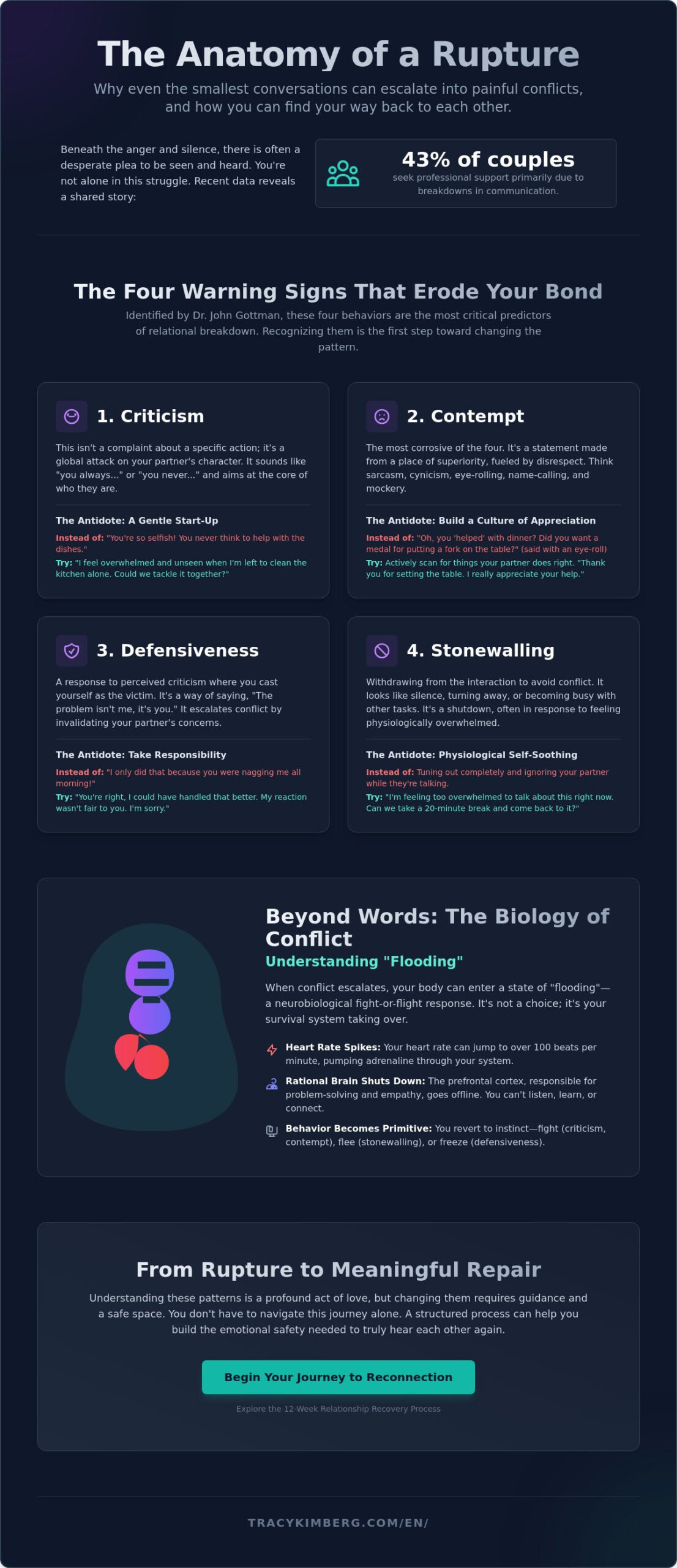
We understand that beneath the surface of every “pointless” argument lies a deeper cry for connection and emotional safety. Recent 2026 data indicates that 43% of couples seek professional support because they find it difficult to communicate. It’s a common struggle, but once you realise the hidden patterns of your behaviour, the path back to each other becomes clear. We’ll show you how to move beyond surface-level bickering and use research-backed psychological insights to build a lasting bond. This article explores why these breakdowns happen and provides a roadmap for learning to argue well, helping you both feel like a team again.
Key Takeaways
- Understand why true communication is an emotional bridge for attunement rather than a simple exchange of information or data.
- Recognise the biological signs of “flooding” and the “Four Horsemen” of conflict that often predict a breakdown in your connection.
- Discover how to fix communication in a relationship by moving beyond robotic scripts towards a framework of radical attunement and empathy.
- Learn a proactive two-step approach to regulate your nervous system and identify the deeper emotional needs beneath surface-level arguments.
- Identify when your partnership needs expert intervention and how a structured 12-Week Relationship Recovery Process can guide you back to emotional safety.
What Does it Actually Mean to ‘Fix’ Communication in a Relationship?
To many, the idea of fixing a broken dialogue sounds like repairing a faulty appliance; you find the broken part, replace it, and the machine hums again. But human connection doesn’t work that way. When we explore how to fix communication in a relationship, we aren’t just looking for better words. We’re looking for a bridge to emotional attunement. True communication is less about a data transfer and more about creating a shared emotional space. It’s the difference between merely talking and actually being heard in a way that resonates with your partner’s nervous system.
The study of Interpersonal communication suggests that our exchanges are deeply layered with social and psychological context. In a therapeutic setting, we see that silence often isn’t a lack of effort. Instead, it’s frequently a form of protection. When safety vanishes, we retreat into quiet to avoid further hurt. Rebuilding this requires a foundation of mutual respect where both people feel secure enough to be vulnerable. Without that safety, even the most polished “I” statements will fall flat.
The Difference Between Surface Talking and Deep Listening
Partnerships often fall into the trap of logistical love. You discuss who is buying the groceries or when the car needs its MOT, but you stop sharing your inner world. These surface-level chats eventually replace emotional intimacy. Experts like John Gottman describe small gestures, like a sigh or a touch, as “bids for connection”. If these are consistently ignored, the distance grows. Learning how to fix communication in a relationship starts with an internal shift; you must decide to turn towards your partner rather than away, even in the smallest moments.
Recognising the Signs of a Relational Breakdown
You might notice your conversations have become closed loops of blame. One person points a finger, the other defends, and the cycle repeats without resolution. This emotional withdrawal erodes the “we-ness” of the couple. It doesn’t just stay in your head, either. Unresolved conflict often manifests as physical tension, chronic fatigue, or a constant feeling of being on edge. Your body keeps the score of the disconnection long before your mind puts it into words. Recognising these signs is the first step toward moving from a state of survival back into a state of connection.
The Anatomy of a Rupture: Why Conversations Turn into Conflicts
To understand how to fix communication in a relationship, we must first look at what happens when the dialogue breaks. Dr John Gottman identified four specific behaviours, known as the “Four Horsemen”, that act as primary predictors of relational breakdown: criticism, contempt, defensiveness, and stonewalling. When these guests arrive, they don’t just disrupt the conversation; they dismantle the emotional safety required for intimacy. These patterns aren’t usually born out of malice, but from a desperate, albeit misguided, attempt to be heard.
The physiological reality of conflict is often overlooked. When a conversation heats up, you might experience “flooding”. This is a state of neurobiological fight-or-flight where your heart rate spikes and your nervous system becomes overwhelmed. In this state, the creative, problem-solving parts of your brain effectively shut down. You aren’t being difficult; your body is simply trying to survive a perceived threat. Understanding Solving Relationship Communication Problems starts with recognising this physical overwhelm. If you often find yourselves stuck in these high-intensity loops, our Relationship Counselling and Coaching can provide the tools to de-escalate before the rupture occurs.
Our attachment styles and past traumas also play a quiet but powerful role in every disagreement. If you grew up in an environment where your needs were met with silence, you might lean towards stonewalling as a protective shield. Conversely, if you feared abandonment, you might use criticism to demand attention. These internal blueprints colour our interpretation of our partner’s words, turning a simple request into a devastating indictment of our character.
Criticism vs. Complaint: Learning the Nuance
Criticism is an attack on your partner’s character or personality, whilst a complaint focuses on a specific behaviour or situation. When you use absolute terms like “always” or “never”, you create a psychological weight that almost guarantees a defensive response. A softened start-up is the practice of stating your feelings and a specific positive need without casting blame or judgment.
The Silent Killer: Contempt and Its Impact
Contempt is the most destructive of the Horsemen because it flows from a position of moral superiority. It often manifests as sarcasm, eye-rolling, or name-calling. Beyond the emotional hurt, research suggests that the target of contempt suffers a weakened immune system, showing how deeply our relational health impacts our physical well-being. Moving away from contempt requires a conscious shift towards shared vulnerability, trading the “high ground” for the common ground of your shared humanity.
Active Listening vs. Radical Attunement: A New Framework
Many couples believe that learning how to fix communication in a relationship simply requires better scripts. You might have tried the classic “I” statements, only to find they feel robotic or even patronising. Whilst these tools have their place, they often fail because they lack the soul of connection. We need to move beyond mere active listening and into the realm of radical attunement. This is the process of truly “tuning in” to your partner’s frequency, much like adjusting a radio dial until the static disappears and the music becomes clear.
Attunement involves a deep awareness of your partner’s inner world. It requires turning toward their emotional needs, having tolerance for their perspective, and practising non-defensive listening. When you approach your partner with genuine empathy, you create a healthy communication style that honours the “space between” you. This space is the living energy of your relationship. If it’s filled with tension, no amount of “correct” wording will bridge the gap. We must protect this shared energy as if it were a third entity in the room.
We should also consider the role of erotic intelligence in our dialogue. Communication isn’t only about resolving chores or managing schedules; it’s about maintaining the vitality and mystery that drew you together. A vibrant communication channel requires both the safety of connection and the space for individual desire to breathe. When we stop being curious about each other, the conversation withers.
The Art of Turning Toward
Every day, your partner makes “bids” for your attention. It might be a comment about a news story, a sigh, or a gentle touch on the shoulder. These are invitations to connect. When you turn toward these bids, you deposit into your emotional bank account. If you habitually turn away or against them during vulnerable moments, you bankrupt the relationship’s trust. Recognising these unique, often subtle languages of connection is a vital step in learning how to fix communication in a relationship.
Listening to Understand, Not to Respond
Most of us listen whilst waiting for our turn to speak. We are building a legal case in our heads rather than hearing our partner’s pain. The Speaker-Listener technique provides a structured way to ensure both parties feel heard. You don’t have to agree with your partner’s reality to validate it. Simply saying, “I can see why that made you feel lonely,” can de-escalate a heated exchange more effectively than any logical argument. Sometimes, the most powerful thing you can say is nothing at all, allowing silence to act as a container for your partner’s feelings.
Practical Steps to Repair and Reconnect
Knowing how to fix communication in a relationship isn’t just about what you say during a conflict; it’s about what you do after the storm has passed. Repair is the most essential skill in any long-term partnership. It is the act of reaching out to bridge the gap after a rupture has occurred. Research suggests that the success of a relationship isn’t determined by the absence of fighting, but by the speed and effectiveness of the repair. Here is a replicable process to help you move from disconnection back to safety.
- Recognise the flood: If you feel your heart racing or your jaw tightening, you are likely “flooded”. Call a proactive time-out. Agree to step away for at least twenty minutes to let your nervous system regulate before trying to talk again.
- Identify the need: Once calm, ask yourself what you actually need. Behind every angry outburst is usually a vulnerable desire, such as a need for appreciation or reassurance.
- Initiate a repair attempt: Use humour, a gentle touch, or a shared phrase to signal that you want to reconnect. It’s an olive branch offered in the midst of tension.
- The State of the Union: Schedule a weekly meeting to discuss what went well and what needs attention. This prevents small grievances from festering into major resentments.
- Daily rituals: Practise attunement through small, daily moments of connection, like a six-second kiss or a morning check-in.
The Power of the Repair Attempt
A repair attempt can be as simple as making a silly face or saying, “I’m sorry, I took that the wrong way.” These moments are vital because they de-escalate the “fight-or-flight” response mentioned earlier. However, repair is a two-way street. You must be willing to receive your partner’s attempt even whilst you are still feeling a bit bruised. If you find yourselves stuck in a cycle where repair feels impossible, our 12 week relationship recovery process offers a structured path to breaking those old patterns and restoring your bond.
Impact on the Family: Communicating for Your Children
Your relationship serves as the primary classroom for your children’s emotional education. By mastering these steps, you are improving parent-child relationship dynamics through direct modelling. Children are incredibly sensitive to the “emotional weather” of the home. Chronic, unresolved conflict is often a significant factor for those seeking help for anxious teens. When your children see you argue and then successfully repair, they learn that conflict isn’t something to fear, but a manageable part of human connection. You are teaching them that love is resilient enough to survive a disagreement.
When to Seek Professional Guidance: The 12-Week Path
Whilst the practical steps of repair are powerful, there comes a point where the weight of past hurts or the complexity of current patterns requires a more robust container. You might feel as though you’re speaking different languages, or perhaps the silence between you has become a permanent resident in your home. Recognising this isn’t a defeat; it’s a moment of profound honesty. When you seek professional guidance on how to fix communication in a relationship, you’re choosing to step out of the cycle of survival and into a process of intentional, guided healing. It’s about moving from simply getting through the day to truly understanding the landscape of your partner’s heart.
Our 12 week relationship recovery process is designed to provide this essential structure. Unlike the scattered nature of self-help, this programme offers a logical, research-based roadmap for couples who feel stuck. A neutral third party acts as a mirror, reflecting the “dance” of your relationship from the outside. We often cannot see our own blind spots or the subtle ways our behaviour triggers a partner’s defensive response. This clarity allows you to move from reactive pain to a conscious approach where you can decide whether to commit to deep repair or explore the difficult question: can your relationship be saved?
The Role of Relationship Coaching and Counselling
Relationship coaching often feels different from traditional therapy. While we honour the past and the stories that shaped you, our focus remains firmly on future-oriented action and practical skills. In our sessions, you can expect a safe, non-judgemental environment where both voices are heard with equal weight. We work to demystify the “why” of your conflicts and replace them with the “how” of connection. The long-term return on investment for your emotional health is immeasurable. When your primary relationship is secure, your capacity for joy, your professional focus, and your physical vitality all begin to flourish.
Taking the First Step Towards Transformation
Asking for help is an act of courage and a sign of deep commitment to the partnership. It shows that you still value the love that brought you together, even if the path forward feels obscured. It’s vital to find a professional whose approach resonates with your values. Our work is deeply influenced by the research-based methods of John Gottman, the systemic insights of Esther Perel, and the trauma-informed perspectives of Gabor Maté. We invite you to honour the history you’ve built whilst reaching for the professional tools that can keep your connection alive. You don’t have to navigate this landscape alone; we are here to guide you back to each other.
Restoring the Heart of Your Connection
Rebuilding a bond requires more than just changing your vocabulary; it demands a shift toward radical attunement and the courage to repair after a rupture. We’ve explored how understanding your neurobiology and identifying the “Four Horsemen” can prevent conversations from spiralling into conflict. Learning how to fix communication in a relationship is an evolving journey of turning toward one another, even in the smallest moments of the day. It’s about protecting the “space between” and choosing curiosity over criticism.
If you find yourself stuck in a cycle of emotional disconnect or are navigating the complex aftermath of infidelity, you don’t have to find the way back alone. Our research-based approach, inspired by the work of experts like John Gottman and Esther Perel, provides a safe, non-judgemental environment for both online and face-to-face therapy. We invite you to book a discovery call to see if the 12-Week Relationship Recovery Process is right for your partnership. Your relationship is a living story, and with the right tools, the next chapter can be one of deep understanding and renewed intimacy. Healing is possible, and it begins with a single, conscious step toward each other.
Frequently Asked Questions
Can a relationship survive without good communication?
A relationship can technically exist without good communication, but it rarely thrives; instead, it often devolves into a state of “parallel lives” where emotional intimacy is replaced by logistical cohabitation. Resentment builds in the silence when there is no shared emotional language. True vitality requires the ability to navigate conflict and express needs. If you’re living in a state of quiet disconnect, it’s a sign that the relationship’s pulse is weakening and requires intentional resuscitation.
How do I talk to a partner who shuts down or stonewalls?
When a partner stonewalls, they are usually experiencing physiological flooding and have reached their limit of emotional safety. Instead of pushing harder for a response, which often increases their withdrawal, try using a softened start-up. Acknowledge that they seem overwhelmed and suggest a proactive time-out. This creates the safety they need to eventually emerge from their protective shell and engage in a more regulated, meaningful dialogue once their nervous system has calmed.
Is it possible to fix communication if only one person is trying?
It is possible to initiate significant change when only one person is trying, as shifting your own behaviour inevitably alters the relational “dance.” By learning how to fix communication in a relationship through your own responses, you can lower the overall tension in the home and invite a different reaction from your partner. However, long-term restoration usually requires both partners to eventually commit to the process. One person can start the fire of repair, but both must tend it.
What are the most common communication mistakes in long-term marriages?
The most common mistake in long-term marriages is the loss of curiosity; partners begin to assume they already know everything about the person sitting across from them. This leads to logistical love, where conversations revolve solely around household management rather than inner worlds. Another frequent error is allowing the “Four Horsemen,” such as contempt or defensiveness, to become habitual responses. Over time, these small erosions of respect can dismantle even the most stable foundations of a partnership.
How can we stop the same argument from happening over and over again?
You can stop repetitive arguments by identifying the unmet need or the dream that lies beneath the surface-level bickering. Most recurring fights aren’t actually about the dishes or the finances; they are about feeling unappreciated, lonely, or unsafe. By shifting the conversation from the external event to the internal feeling, you break the loop. This requires vulnerability and a willingness to explore the psychological roots of your frustrations rather than just the symptoms.
How do I express my needs without sounding like I am complaining?
To express your needs without sounding like you are complaining, focus on a positive need rather than your partner’s perceived failure. Instead of saying “You never help,” try “I would feel so much more supported if we could organise the kitchen together tonight.” This approach invites your partner into a collaborative solution rather than putting them on the defensive. It’s about stating what you want to move toward, rather than what you want to escape.
Can online relationship coaching really help fix deep-seated communication issues?
Online relationship coaching is highly effective for addressing deep-seated issues, providing a structured and safe environment from the comfort of your own home. Our Online Therapy sessions utilise research-based frameworks to show you how to fix communication in a relationship whilst maintaining the flexibility your schedule requires. For many, the familiar setting of their own living room actually lowers the initial anxiety of the therapeutic process, making it easier to engage in honest, transformative conversations.
How often should we have a ‘check-in’ about our relationship communication?
We recommend a weekly “State of the Union” meeting to check in on your relationship communication and emotional health. This dedicated hour allows you to appreciate what went well during the week whilst addressing small grievances before they fester into larger ruptures. Consistency is key; these regular rituals of connection act as a preventative measure. They ensure that your partnership remains a priority amongst the busyness of daily life and domestic responsibilities.

Article by
Tracy Kimberg
Tracy Kimberg is a Relationship Expert, Couples Therapist and Coach with a dedicated focus on helping couples and individuals rebuild connection, trust and emotional safety in their relationships. Drawing on the research of John and Julie Gottman, the relational insights of Esther Perel, and years of hands-on therapeutic experience, Tracy offers a warm, non-judgemental and deeply compassionate approach to modern relationships.
Based in Dorset, Tracy works with couples navigating communication breakdowns, betrayal, intimacy challenges, separation, family dynamics and life transitions. Known for creating a safe and grounded therapeutic space, she combines practical tools with emotional depth to help clients move beyond survival patterns and towards meaningful, lasting change.
With a reputation for empathy, professionalism and dedication to her clients’ growth, Tracy is passionate about helping people feel seen, understood and empowered — both within their relationships and within themselves.
Disclaimer
Disclaimer:
The information shared in this article is intended for educational and informational purposes only and should not be considered a substitute for professional therapeutic, psychological, medical or legal advice. Every individual and relationship is unique, and the perspectives offered are based on general therapeutic principles, research and professional experience.
Reading this article does not establish a therapist-client relationship with Tracy Kimberg. If you are experiencing significant emotional distress, relationship crisis, trauma, or mental health concerns, it is important to seek support from a qualified professional appropriate to your individual circumstances.
All content remains the intellectual property of Tracy Kimberg and may not be reproduced or distributed without permission.