

What if the “mental films” and the racing heart you’re experiencing aren’t just signs of a broken heart, but a biological response to a shattered reality? When a partner betrays your trust, it doesn’t just wound your ego; it shatters your “assumptive world” and leaves your nervous system in a state of high alert. You might feel trapped in a loop of overthinking, or perhaps you’re physically exhausted by insomnia and a loss of appetite. It’s a heavy, disorienting space where your entire history feels like a fabrication. We recognise that healing after being cheated on is a complex labour of reclaiming your sense of self amongst the wreckage of what used to be.
I want to offer you a psychologically grounded path to regulate your biology and silence the intrusive questions that keep you awake at night. You’ve been through a trauma, and your body is simply trying to keep you safe. By understanding this connection, you can move toward emotional regulation and rebuild your shattered confidence. This guide will help you find the clarity you need to decide your future, helping you determine whether the relationship is truly salvageable or if it’s time to begin a journey toward a conscious separation.
Key Takeaways
- Understand why betrayal feels like a physical injury and learn how to stabilise your nervous system when your world feels unsafe.
- Discover the biological reasons behind your racing thoughts and how to begin healing after being cheated on by calming your brain’s overactive alarm system.
- Explore a fresh perspective on your relationship’s future, whether you choose to build a new foundation together or move toward a conscious separation.
- Learn how to implement radical self-care and firm digital boundaries to protect your emotional energy and reclaim your sense of self.
- See how a structured 12-week relationship recovery process can guide you from the initial chaos of discovery toward lasting clarity and peace.
Understanding Betrayal Trauma: Why Healing After Being Cheated On Feels So Intense
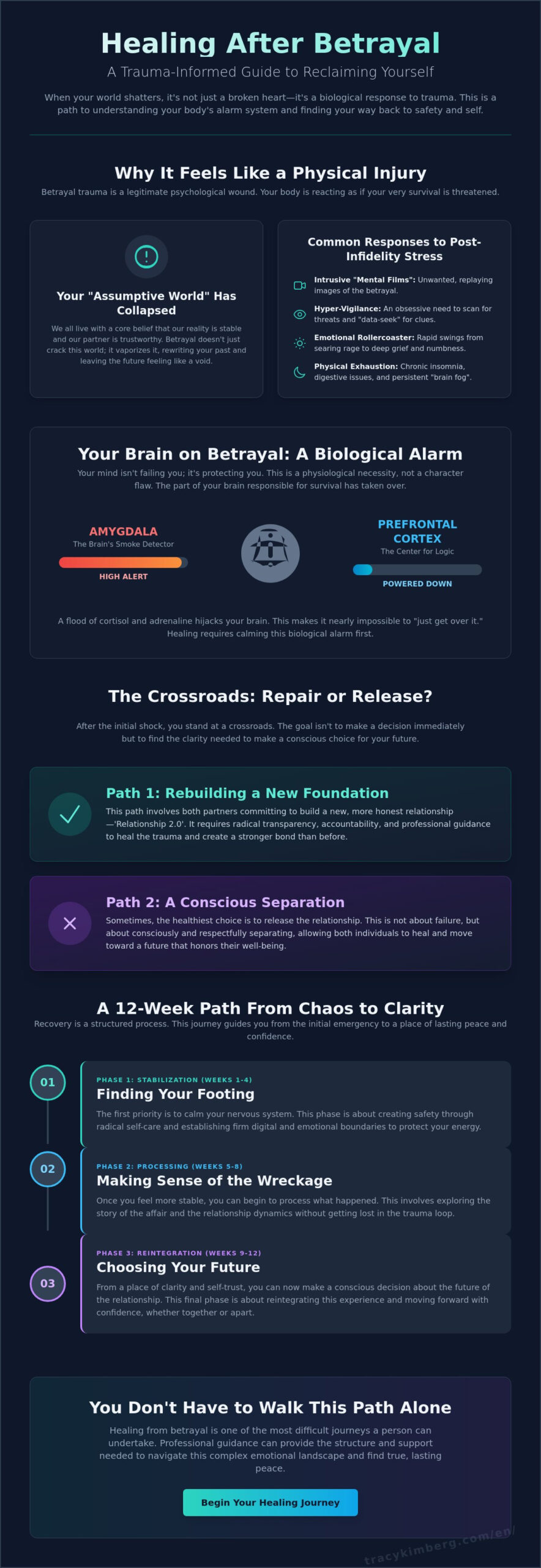
When you discover a partner’s secret life, the world doesn’t just change; it collapses. This isn’t merely a social or emotional disappointment. It is a profound disruption of a secure attachment bond, a concept we call betrayal trauma. For most of us, our primary relationship is the “home base” for our nervous system. When that base is compromised through infidelity, your brain perceives it as a threat to your very survival. This is why healing after being cheated on feels less like getting over a breakup and more like recovering from a physical assault.
Your mind relies on a set of core assumptions to navigate daily life, such as the belief that your world is generally safe and your partner is reliable. Betrayal shatters these assumptions, rewriting the past and making the future look like a void. It’s vital to distinguish between the acute shock of discovery and the long-term infidelity recovery stages that follow. One is an emergency; the other is a slow, methodical process of reconstruction that requires a different kind of emotional labour.
The Symptoms of Post-Infidelity Stress
Your body is now in a state of high alert. Hyper-vigilance, intrusive “mental films” of the betrayal, and emotional numbing are not signs that you’re losing your mind. They are natural responses to trauma. You might find yourself obsessively questioning every detail of the affair. This “data seeking” is your brain’s desperate attempt to find a logic that will prevent future pain. This mental load carries a heavy physical toll, often manifesting as chronic insomnia, digestive issues, and a persistent “brain fog” that makes simple decisions feel impossible.
Validating Your Emotional Rollercoaster
The Neurobiology of Betrayal: Why Your Mind Won’t Stop Racing
If you find yourself awake at 3:00 am, replaying every conversation and scanning for hidden meanings, you aren’t failing at recovery. You’re experiencing a biological alarm. Gabor Maté often speaks of trauma as a loss of connection to oneself; in the wake of betrayal, your brain severs this connection to prioritise survival. Your mind has become a hyper-vigilant detection system. Because it failed to predict the betrayal, it now attempts to predict every possible future threat to ensure you’re never caught off guard again. This is a physiological necessity, not a character flaw.
This state makes healing after being cheated on feel like an uphill battle against your own biology. You can’t “just get over it” because your nervous system is stuck in a trauma loop. In this loop, memories aren’t stored as past events; they’re experienced as present-day dangers. This constant state of high alert alters your perception, making the world feel inherently hostile and your partner’s every move suspicious. Your brain is simply trying to keep you safe in a world that no longer feels predictable.
The Amygdala and the Fight-Flight Response
When betrayal strikes, the amygdala, your brain’s smoke detector, takes full control. It sends a flood of cortisol and adrenaline through your body, effectively shutting down the prefrontal cortex, the area responsible for logic and complex reasoning. This is why you might feel “stuck” in the moment you first found out, unable to move past the initial shock. It also explains why you may struggle with emotional affair vs friendship assessments. When your survival brain is in charge, every ambiguous interaction looks like a threat, and every acquaintance looks like a potential rival.
Soothe Your System: Initial Regulation Techniques
Before you can decide the future of your relationship, you must bring your body back to a state of safety. Research on healing after infidelity suggests that cognitive work is impossible whilst you’re outside your “window of tolerance.” This is the emotional zone where you can process feelings without becoming overwhelmed or shutting down. Simple grounding techniques can help:
- The 5-4-3-2-1 method: Name five things you see, four you can touch, three you hear, two you smell, and one you can taste.
- Rhythmic Breathing: Focus on making your exhales longer than your inhales to signal to your amygdala that the immediate danger has passed.
Establishing this baseline of safety is the first step in our online therapy sessions, ensuring you have the stability to navigate the complex road ahead with a clear mind and a calm heart.
The Crossroads: Deciding Whether to Repair or Release the Relationship
You stand at a crossroads that feels less like a choice and more like a precipice. The pressure to decide whether to stay or go can be suffocating, especially when friends or family offer well-meaning but binary advice. It’s helpful to reframe this moment. Instead of a “right” or “wrong” decision, consider this a choice between two distinct paths of growth. As Esther Perel suggests, your “first marriage” is over. The question now is whether you and your partner wish to co-create a “second marriage” together, or if you will find your individual paths forward through a conscious separation.
The most common question I hear is whether trust can ever truly be rebuilt. The answer is yes, but it is not a return to the old status quo. It is a slow, methodical process of reconstruction. Research shows that with professional intervention, 60 to 75 percent of marriages survive infidelity. This process often follows science-based steps to heal, moving through stages of atonement, attunement, and eventually, a new form of attachment. Healing after being cheated on requires this structured approach to transform the crisis into a catalyst for deeper, more honest intimacy.
Signs That Repair is a Viable Path
Repair is possible when the partner who strayed moves beyond mere guilt, which is a focus on their own discomfort, and into genuine remorse, which is a focus on your pain. Look for “radical honesty” and a willingness to answer questions without becoming defensive. In couples therapy for infidelity, we examine the affair through a systemic lens. We look at the “why” not to excuse the behaviour, but to understand the relationship dynamics that preceded the crisis. If both partners are willing to hold the pain and do the heavy emotional labour, the foundation can be rebuilt.
When Release is the Healthier Choice
There are times when the most courageous act is to let go. If there is a pattern of serial infidelity, a refusal to take accountability, or if the partner continues to gaslight you, the environment is too toxic for healing. Choosing a conscious separation allows you to preserve your dignity whilst acknowledging that the relationship no longer serves your well-being. Many find that individual relationship counselling provides the necessary space to find this clarity. It allows you to process your trauma independently of your partner’s influence, ensuring your final decision is rooted in self-respect rather than fear or obligation.
Practical Steps for Reclaiming Your Sense of Self and Safety
Regaining your agency is the most vital part of recovery. Betrayal is a theft of your reality, leaving you feeling like a passenger in your own life. The journey of healing after being cheated on requires more than just time; it requires intentionality. You must move from a state of reactive trauma to proactive self-reclamation. This begins with radical self-care, which is not a luxury but a fundamental boundary. It means prioritising your sleep, your nutrition, and your peace of mind above the demands of the relationship crisis.
To protect your fragile nervous system, consider implementing the following boundaries:
- Digital Boundaries: Stop the “pain-shopping” of checking your partner’s devices or social media. This only reinforces the trauma loop.
- Reclaim Your Space: Rearrange the furniture, buy new bed linens, or visit your favourite park alone. Neutralise the physical triggers that have become tainted by the betrayal.
- Organise a Support Circle: Identify two or three non-judgemental friends who can hold space for your pain without pressuring you to make immediate decisions.
Silencing the Overthinking and Intrusive Questions
To manage the “mental films,” try a technique called scheduled venting. Set a timer for 15 minutes a day to allow yourself to feel the full weight of the trauma. When the timer stops, you consciously pivot to a grounding activity. It’s also helpful to distinguish between detective questions and investigative questions. Detective questions, such as “Where did you go?” or “Was it better than with me?”, often fuel the trauma. Investigative questions, like “What did this affair allow you to express that was missing in our life?”, help you understand the systemic “why.” You have every right to say to your partner: “I need to understand the meaning of what happened, but the graphic details are harmful to my recovery right now.”
Rebuilding Self-Worth Independent of the Betrayal
If you feel overwhelmed by these steps, our 12-Week Relationship Recovery Process provides the structured roadmap you need to move from the initial chaos toward lasting clarity and peace.
Professional Support: Navigating the 12-Week Relationship Recovery Process
Navigating the aftermath of betrayal alone is like trying to map a new continent whilst in the middle of a storm. Whilst the self-regulation techniques we’ve discussed are essential for immediate relief, the deeper work of healing after being cheated on often requires a more structured, time-bound framework. This is why I offer the 12-week relationship recovery programme. It isn’t just about “talking it out”; it’s a strategic roadmap designed to move you from the initial shock of discovery into a state of empowered clarity.
During a time when your world feels chaotic, a structured approach provides the scaffolding your nervous system craves. Professional coaching bridges the gap between understanding the clinical nature of your trauma and implementing the actionable life changes needed to reclaim your identity. It’s a proactive adventure where we work together to demystify the recovery process, making the path to peace feel manageable rather than overwhelming. Within this safe, non-judgemental space, we can explore your specific dynamics with the precision of an expert and the warmth of a guide.
The Role of Research-Based Methods (Gottman & Perel)
My approach integrates the research of the world’s leading relationship experts to ensure your recovery is grounded in science. We utilise the Gottman “Sound Relationship House” to identify where the structural leaks in your partnership began and how to repair the foundations of trust. Simultaneously, we draw on Esther Perel’s insights into erotic intelligence to understand the complex nature of desire and how it might be rebuilt. By combining these systemic perspectives, I provide a safe environment where you can examine the “why” of the betrayal without losing sight of your own worth.
Taking the First Step Toward Peace
Many people feel anxious about beginning this work, wondering if they’ll be forced into a decision they aren’t ready for. I want to reassure you that our first session is simply about creating a calm space to be heard. We’ll identify your immediate pain points and discuss how a structured programme can offer the relief you’ve been searching for. For those who require privacy and the comfort of their own surroundings, online therapy is a highly effective option that fits into your life without added stress. You don’t have to carry the weight of this betrayal by yourself any longer. Book a discovery call to start your personal healing journey and begin the process of reclaiming your life today.
Reclaiming Your Future with Clarity and Peace
The journey of healing after being cheated on is not a linear path; it’s a profound process of returning to your own centre. We’ve explored how your nervous system reacts to betrayal and why the intrusive thoughts you’re experiencing are biological alarms rather than signs of weakness. By establishing firm boundaries and prioritising radical self-care, you begin to reclaim the agency that was compromised. Whether you choose to rebuild your partnership or move toward a conscious separation, the goal is to ensure your decision is rooted in self-respect rather than fear.
As a specialist in Gottman and Perel research-based methods, I provide a safe, non-judgemental environment for both teenagers and adults to navigate these complex emotional landscapes. You don’t have to carry this weight alone. Our transformational 12-week structured recovery programme offers the roadmap you need to move from the initial chaos toward lasting peace.
Begin your journey to peace with a structured 12-Week Relationship Recovery Process.
You have the inherent capacity to heal. You deserve a future where you feel safe, seen, and completely whole again.
Frequently Asked Questions
How long does it typically take to heal after being cheated on?
Recovery is a deeply personal process that typically takes about two years, although professional intervention can significantly shorten this timeline. This duration reflects the time needed for your nervous system to return to a state of baseline safety after a profound trauma. It’s important to remember that progress isn’t linear; you’ll experience waves of grief and stability. Rushing the process often leads to suppressed trauma, so patience with your internal rhythm is essential.
Is it possible to ever trust my partner again after such a betrayal?
Yes, trust can be rebuilt, but it requires a fundamental shift from “blind trust” to “earned trust.” This involves the partner who strayed demonstrating consistent transparency and radical accountability over a long period. Research suggests that couples who honestly disclose and address the affair in therapy have a 57% chance of staying together. Rebuilding trust is a collaborative effort where safety is prioritised above all else to ensure the foundation is secure.
Why can’t I stop thinking about the details of the affair?
Your brain is obsessively scanning for details because it’s trying to find a logic that will prevent you from being hurt again. This is a survival mechanism triggered by the amygdala, which perceives the betrayal as a direct threat to your safety. Whilst these intrusive thoughts are exhausting, they are a natural part of betrayal trauma. Distinguishing between “detective questions” and “investigative questions” can help transition your mind from repetitive pain toward a deeper systemic understanding.
Should I tell our friends and family that they cheated?
Sharing this information is a personal choice, but it’s often wise to wait until the initial shock has subsided before making a public disclosure. Once you tell others, you cannot “untell” them, and their judgements might complicate your decision if you later choose to reconcile. Focus on sharing with a small support circle of one or two people who can offer non-judgemental empathy without pressuring you to make an immediate choice about the relationship’s future.
What is the difference between an emotional affair and a physical one in terms of healing?
Emotional affairs often take longer to heal because they involve a redirecting of intimacy and the “relational soul” to an outsider. Whilst physical affairs are a violation of sexual boundaries, 64% of couples report that an emotional betrayal is just as harmful, if not worse. Healing after being cheated on in an emotional context requires a deep exploration of the unmet needs and systemic gaps that allowed the outside connection to flourish amongst the wreckage. If you are navigating this specific type of betrayal, our compassionate guide to rebuilding after an emotional affair offers targeted support for restoring trust and intimacy.
Can couples therapy really work if the trust is completely gone?
Couples therapy is most effective when trust is at its lowest, as it provides a structured container to navigate the initial chaos. Professional intervention is a critical factor in recovery; success rates for couples who attend therapy are nearly five times higher than for those who don’t. A therapist acts as a Wise Guide, helping you communicate without the defensiveness that usually prevents progress, allowing you to work toward a collaborative solution together.
How do I know if I am experiencing Post-Infidelity Stress Disorder (PISD)?
You may be experiencing PISD if you suffer from hyper-vigilance, flashbacks, or emotional numbing that interferes with your daily life. Common physical symptoms include insomnia, loss of appetite, and a constant state of “fight or flight.” This is a legitimate psychological injury. Healing after being cheated on involves recognising these symptoms as trauma responses and seeking specialised care to regulate your nervous system and reclaim your sense of self and confidence.
What if my partner refuses to talk about why it happened?
If a partner refuses to engage in honest dialogue, it’s often a sign of deep shame or a lack of accountability. Without their participation in the “atonement” phase, the relationship cannot move toward true repair. In these cases, individual relationship counselling is essential for you to find clarity. It allows you to process your trauma independently and decide if the partnership remains a viable space for your long-term emotional health and well-being.

Article by
Tracy Kimberg
Tracy Kimberg is a Relationship Expert, Couples Therapist and Coach with a dedicated focus on helping couples and individuals rebuild connection, trust and emotional safety in their relationships. Drawing on the research of John and Julie Gottman, the relational insights of Esther Perel, and years of hands-on therapeutic experience, Tracy offers a warm, non-judgemental and deeply compassionate approach to modern relationships.
Based in Dorset, Tracy works with couples navigating communication breakdowns, betrayal, intimacy challenges, separation, family dynamics and life transitions. Known for creating a safe and grounded therapeutic space, she combines practical tools with emotional depth to help clients move beyond survival patterns and towards meaningful, lasting change.
With a reputation for empathy, professionalism and dedication to her clients’ growth, Tracy is passionate about helping people feel seen, understood and empowered — both within their relationships and within themselves.
Disclaimer
Disclaimer:
The information shared in this article is intended for educational and informational purposes only and should not be considered a substitute for professional therapeutic, psychological, medical or legal advice. Every individual and relationship is unique, and the perspectives offered are based on general therapeutic principles, research and professional experience.
Reading this article does not establish a therapist-client relationship with Tracy Kimberg. If you are experiencing significant emotional distress, relationship crisis, trauma, or mental health concerns, it is important to seek support from a qualified professional appropriate to your individual circumstances.
All content remains the intellectual property of Tracy Kimberg and may not be reproduced or distributed without permission.