

Imagine you’ve spent forty minutes navigating heavy traffic, only to arrive at your session feeling more frazzled and disconnected than when you left the house. It’s a common struggle for many UK couples who feel that the logistical stress of travelling to appointments is becoming another hurdle in their relationship. You might find yourself questioning the choice between online vs in-person couples therapy, perhaps fearing that a digital screen will act as a barrier to true intimacy or that a therapist won’t be able to see the “whole picture” from a distance.
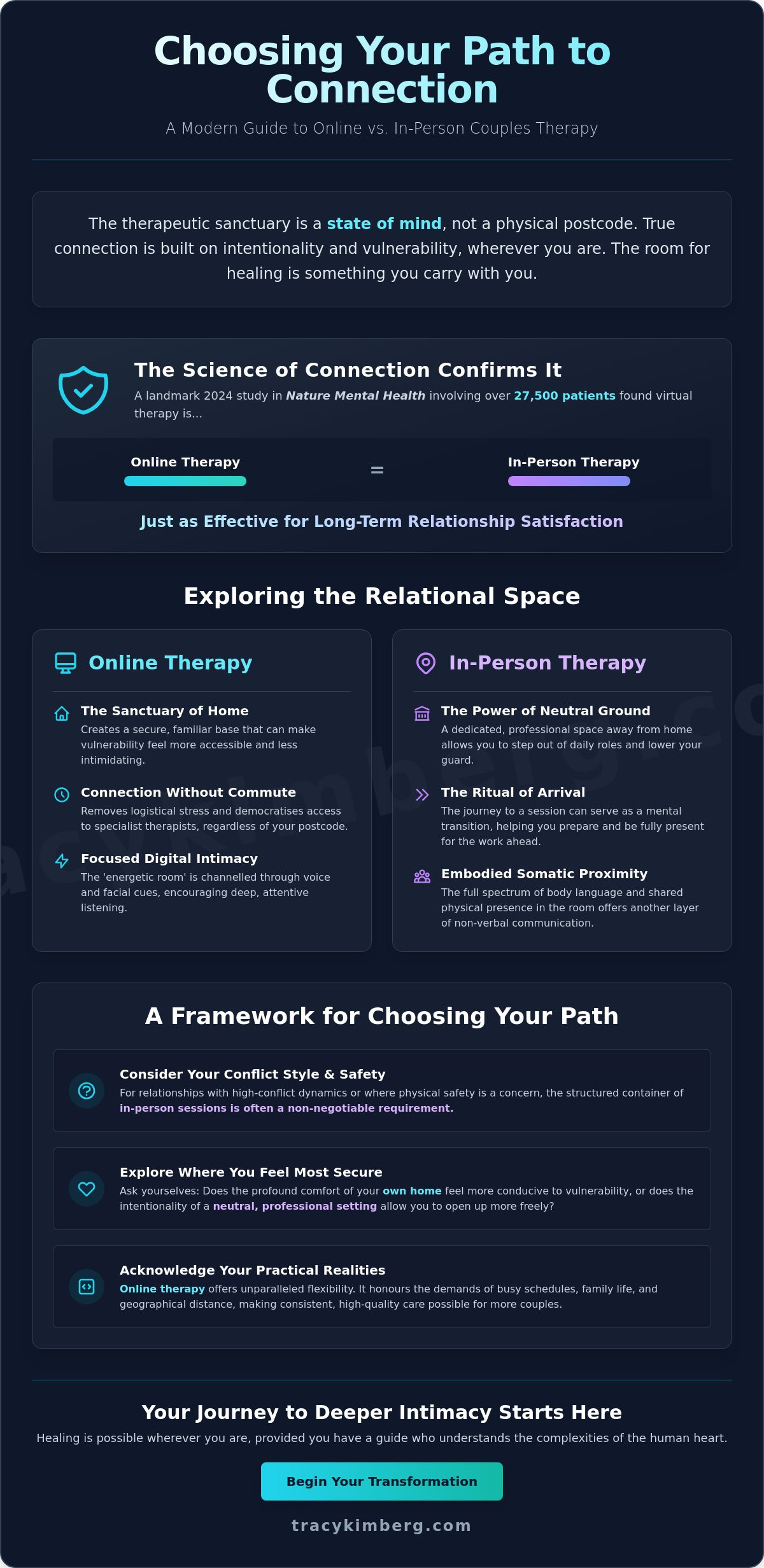
We understand that the “room” in therapy is not just a physical location; it’s a shared psychological sanctuary that you create together through intentionality. Whether you’re sitting on a clinic sofa or in your own living room, the potential for healing remains profound. In fact, a 2024 study published in Nature Mental Health involving over 27,500 patients confirmed that online therapy is just as effective as traditional face-to-face care. This guide will help you explore the practical and emotional differences between these two paths. You’ll gain a clear understanding of which format suits your specific dynamic, along with expert-led advice on how to prepare for your very first session with confidence and calm optimism.
Key Takeaways
- Learn why the therapeutic sanctuary is a state of mind rather than a physical postcode, allowing for deep connection regardless of the medium you choose.
- Discover how clinical research into online vs in-person couples therapy confirms that virtual sessions are just as effective for long-term relationship satisfaction.
- Explore the “Energetic Room” concept to understand how somatic proximity and digital intimacy differ and which suits your unique relationship dynamic.
- Identify when face-to-face sessions are a non-negotiable requirement for safety and how to assess your specific conflict style.
- Understand how a structured 12-week recovery process can bridge the gap between where you are now and the intimacy you desire.
Beyond the Screen: Navigating the Choice Between Online and In-Person Couples Therapy
Choosing the right path for your relationship often feels like standing at a crossroads. You’re likely weighing the practicalities of your daily life against the deep, visceral need for connection. It’s a modern dilemma. We spend our days tethered to devices for work and socialising, so the idea of “opening up” to a laptop screen can feel a bit clinical or even distant. You might worry that a digital interface will act as a barrier, preventing your therapist from seeing the subtle shifts in your body language or the unspoken tension in the room. This anxiety is completely normal. It’s a sign that you value the sanctity of your partnership and want to ensure your healing journey is as authentic as possible.
However, the therapeutic “sanctuary” isn’t defined by a physical postcode or the fabric of a sofa. It’s a psychological space built on trust, intentionality, and vulnerability. The shift toward digital platforms has democratised access to specialist relationship experts across the UK. You’re no longer restricted to the practitioners in your local town or forced to endure a stressful commute to a city centre. As the field of Online counseling has matured, we’ve discovered that the “room” is something we carry with us. Whether you choose online vs in-person couples therapy, the effectiveness lies in your willingness to be seen and heard.
The Evolution of the Relational Space
We’ve moved beyond the traditional image of the therapy couch. Today, the focus is on “connection” rather than “location”. The format of your sessions matters far less than your shared commitment to the process. We often see this when communication breaks down in relationships; the medium of the message can sometimes change the message itself, but the underlying emotional truth remains the same. If you’re both present and engaged, a video call can become just as sacred as a face-to-face meeting. It’s about creating a dedicated time where the outside world falls away, allowing you to focus entirely on the “us” in the room.
A Compassionate Expert Perspective
Drawing on the wisdom of Gabor Maté, we know that our environment profoundly affects our sense of safety. For some, the comfort of their own home provides a secure base that makes vulnerability easier. For others, the neutral ground of a professional office is what allows them to drop their guard. My role is to provide a non-judgemental space that transcends geography. We treat this work as a proactive adventure in healing. By acknowledging your fears about online vs in-person couples therapy, we can move toward a solution that feels right for your unique nervous systems. Healing is possible wherever you are, provided you have a guide who understands the complexities of the human heart.
The Science of Connection: Is Virtual Counselling as Effective as Traditional Sessions?
The hesitation many feel when considering online vs in-person couples therapy often stems from a fear that digital interaction lacks “soul”. We wonder if the profound shifts that happen in a therapist’s office can truly be replicated through a camera lens. However, current research on teletherapy effectiveness suggests that our brains are remarkably adept at forging deep connections across digital divides. A landmark 2024 study published in Nature Mental Health, which analysed data from over 27,500 patients, found that virtual care is just as effective as face-to-face sessions in achieving positive clinical outcomes.
The “Therapeutic Alliance”, that vital bond of trust between you and your therapist, is not contingent on being in the same physical room. It is built on the quality of attention, the empathy in the voice, and the specialist’s ability to hold space for your pain. In many ways, removing the stress of a commute allows couples to enter the session with lower baseline cortisol, making them more receptive to the work itself. When we look at the debate of online vs in-person couples therapy, science increasingly points toward the internal commitment of the couple as the primary predictor of success, rather than the format of the meeting. This focus on the quality of the therapeutic bond is a cornerstone of the care provided at mindfulconversationstherapy.com.
Gottman Method and Digital Interventions
The Gottman Method, renowned for its research-based approach to relationship health, translates beautifully to the digital space. Building “The Sound Relationship House” involves practical tools that you can implement immediately within your own home environment. Practising a “Stress-Reducing Conversation” whilst sitting on your own sofa can actually feel more authentic than doing so in a clinical setting. It reduces what some experts call the “theatricality” of therapy; you aren’t performing for a professional in a clinical office, you are simply learning to relate better in the very space where your life happens.
Trauma-Informed Connectivity
From a trauma-informed perspective, particularly drawing on Gabor Maté’s insights, the priority is always safety and co-regulation. A skilled therapist monitors for “flooding”, that moment of physiological arousal where your heart rate spikes and you can no longer process information. We watch for these subtle shifts in breathing and facial tension through the screen, guiding you back to a state of calm. This process of learning to regulate together, even with a digital screen between us, is a powerful exercise in building a secure base. If you’re ready to explore how these tools can support your unique dynamic, you can begin your relationship recovery journey today with a guide who understands the nuances of both formats.
Analysing the Experience: Logistics, Privacy, and the Energetic Room
When we sit in the same physical space, we share what I call the “Energetic Room”. There is a somatic resonance that happens when two people are three feet apart; you can sense the minute shifts in heart rate or the subtle cooling of the atmosphere when a partner withdraws. Yet, in the ongoing debate of online vs in-person couples therapy, we must also consider the power of digital intimacy. As Esther Perel often observes, sometimes a bit of distance, even the thickness of a screen, can provide the safety needed for emotional honesty to emerge. It can lower the stakes just enough for a partner to finally say the thing they’ve been holding back for years.
The Case for In-Person Therapy
There is a sacred ritual in “going to therapy”. The journey there serves as a period of mental preparation; it’s a way to transition out of the roles of parent or employee and into the role of partner. In a physical office, I can see your whole self. I notice the way you tap your foot when anxious or how you unconsciously reach for your partner’s hand. This full-body visibility provides a richer tapestry of non-verbal cues. Additionally, the office acts as “neutral ground”. It’s a container where you can unpack heavy emotions and then leave them there, rather than bringing the “ghosts” of the session back into your kitchen or bedroom.
The Case for Online Therapy
Online sessions offer a unique kind of vulnerability. Many couples find it easier to access deep emotions when they are sitting in their favourite armchair, surrounded by the familiar scents and textures of their own home. It’s a more integrated approach to healing. This format is also exceptionally efficient for modern schedules. It allows you to fit transformational work between school runs and board meetings without the added stress of travel. Virtual access also makes it simpler to coordinate individual relationship counselling alongside your joint sessions. This ensures that both the partnership and the individual are supported throughout the recovery process.
How to Decide: A Framework for Choosing Your Path to Relationship Recovery
Deciding between online vs in-person couples therapy isn’t a one-size-fits-all solution. It requires an honest look at how you and your partner interact when things get difficult. If your conflict style is high-volatility, characterised by rapid escalation and “flooding”, the physical presence of a therapist can act as a vital regulator. In these moments, having a professional in the room to physically intervene or shift the energy is invaluable. Conversely, couples experiencing a “quiet drift” often find that the focused, face-to-face nature of a video call helps them re-engage without the distractions of a new environment. The screen acts as a lens, forcing a level of visual connection that might have been missing for years.
We must also address the “Safety First” rule. In situations involving high-risk trauma or concerns about physical safety, in-person sessions are non-negotiable. The clinical office provides a controlled, secure environment that a home setting cannot always guarantee. For others, the challenge is more practical. In many UK homes, finding 90 minutes of absolute privacy whilst others are in the house is a tall order. If you can’t speak freely for fear of being overheard by children or housemates, the healing process will inevitably stall. You need to be able to create a “sacred space” wherever you are, free from the pings of notifications or the knock of a door.
A Diagnostic Checklist for Couples
Before booking your first session, it’s helpful to pause and reflect on your shared goals. Ask yourselves if you are truly ready to save your relationship. Commitment is the foundation, regardless of the medium. Consider these logistical points together:
- Do we have a reliable internet connection and a device we both feel comfortable using?
- Can we ensure a private, secure space for 60 to 90 minutes at home without interruption?
- Is there a significant “tech-avoidance” in one partner that might create a power imbalance during the session?
The Hybrid Approach
The choice between online vs in-person couples therapy doesn’t have to be binary. Many couples thrive using a hybrid model. You might choose to begin with an in-person intensive to establish a deep, somatic connection and then transition to online sessions for the remainder of your 12-week relationship recovery process. This flexibility allows the work to remain consistent even when work schedules or family commitments become demanding. It’s about finding a therapist who is fluent in both the digital and physical languages of love. If you’re ready to take that first step toward clarity, book your initial consultation and let’s find the path that leads you back to each other.
Transformational Healing with Tracy Kimberg: Your Journey Starts Here
Healing is a deeply personal exploration, and my role is to act as your Wise Guide through this landscape. Whether we meet in a physical office or across a digital interface, my priority is to create a safe, non-judgemental environment where you both feel truly seen. We’ve explored the nuances of online vs in-person couples therapy, but the most important factor remains the therapeutic alliance we build together. My approach intentionally blends clinical accuracy—drawing on research-based methods—with a deeply human execution that honours your unique story and nervous system. It’s about moving beyond the weight of the problems and focusing on the vibrant possibility of your future together.
I understand that the decision to start therapy often comes at a time of significant vulnerability. You might be feeling exhausted by the same recurring arguments or the silence that has grown between you. My goal is to demystify the process, making it feel powerful yet manageable. By framing our work as a proactive adventure, we shift the energy from “fixing what is broken” to “nurturing what can grow”. Whether you choose the neutral ground of a London centre or the comfort of your own home, the quality of care remains steadfast and focused on your long-term emotional health.
The Signature 12-Week Programme
Many couples come to me feeling more like “roommates” than intimate partners. The 12-Week Relationship Recovery Process is a structured path designed to bridge that gap, helping you rediscover the connection that initially brought you together. This curriculum is available in any format, ensuring that your location never hinders your progress. To supplement our bespoke sessions, I provide online masterclasses that offer practical tools you can implement in your daily life. This is particularly vital when navigating complex challenges like couples therapy for infidelity. We use specific digital safeguards and secure platforms to ensure that the delicate work of rebuilding trust happens in a completely private and protected environment.
Your Invitation to Connect
You don’t have to navigate these complex emotional waters alone. Choosing between online vs in-person couples therapy is simply the first step in a much larger journey toward relational health. I’m here to support your specific needs, providing the expert guidance and compassionate presence required for real transformation. I invite you to take that first step today. We can discuss your specific dynamic and logistical needs during a discovery call to find the format that feels most supportive for your partnership. Healing is possible, and it starts with a single conversation. Book your initial consultation with Tracy Kimberg today.
Embracing the Path to Lasting Connection
Choosing between online vs in-person couples therapy is not about finding the “better” format; it’s about finding the one that allows you and your partner to feel most secure and heard. We’ve seen that the clinical effectiveness of both paths is remarkably similar, with the “therapeutic room” being a state of mind you create together. Whether you need the neutral ground of a physical office or the familiar comfort of your own living room, healing is within reach. The most vital ingredient is your shared commitment to the process.
My work integrates the research-based wisdom of experts like Gottman and Perel into a specialised 12-Week Relationship Recovery Process. This structured journey provides a safe, non-judgemental environment where you can move from a place of conflict to one of deep, renewed intimacy. It’s a proactive adventure that respects your unique needs and busy UK schedule, ensuring that the work of repair feels manageable and hopeful. If you’re ready to stop the cycle of disconnection and start building a more resilient partnership, I’m here to guide you. Begin your journey to a deeper connection—book a consultation today. You deserve a relationship that feels like a sanctuary, regardless of the medium you use to build it.
Frequently Asked Questions
Is online couples therapy as effective as in-person for rebuilding trust after infidelity?
Yes, online sessions are just as effective for rebuilding trust. Clinical outcomes for infidelity recovery depend more on the couple’s commitment and the therapist’s expertise than the physical location. Digital platforms often provide a safe, contained space where partners can express vulnerability without the added stress of a public commute. This allows you to focus entirely on the delicate work of repair and transparency within your own home sanctuary.
How do we ensure privacy during online therapy if we have children at home?
Ensuring privacy whilst children are at home requires a blend of planning and technology. We often suggest using white noise machines outside the door or wearing high-quality headphones to ensure your partner’s voice and the therapist’s insights remain private. Scheduling sessions during school hours or after bedtime can also create the necessary “sacred space”. It’s about being intentional with your environment to protect the intimacy of the work we are doing together.
What happens if our internet connection fails during a vulnerable moment in a session?
If your internet connection fails, we simply pause and follow a pre-arranged backup plan, such as switching to a phone call or a secondary link. Technical glitches are a part of modern life and don’t diminish the emotional progress you’ve made. We approach these moments with calm optimism, treating them as small interruptions rather than barriers to your healing. Your safety and the continuity of our conversation are always my top priorities.
Can a therapist really see our body language and micro-expressions through a camera?
A specialist therapist is trained to observe subtle cues like facial tension, shifts in breathing, and changes in vocal tone through a camera lens. Whilst we don’t see your full body, these micro-expressions often reveal the most profound emotional truths. In the debate of online vs in-person couples therapy, many practitioners find that the close-up view of a video call actually enhances their ability to monitor these delicate relational signals and provide timely interventions.
Do we both need to be in the same room for online couples therapy sessions?
Sitting together in the same room is generally the most effective way to engage in online sessions. This proximity allows for co-regulation and somatic connection, which are vital for relationship health. However, if work travel or other logistical challenges keep you apart, we can certainly conduct sessions with each partner in a different location. The goal is to maintain the momentum of your recovery process, regardless of the physical distance between you.
Which format is better for couples experiencing high-intensity conflict or frequent arguments?
In-person sessions are often more supportive for couples dealing with high-intensity conflict or frequent, volatile arguments. Having a therapist physically present allows for more direct regulation of the “energetic room” and can help prevent emotional flooding. If your dynamic feels particularly explosive, the neutral ground of a professional office provides a secure container where you can explore difficult topics without the risk of the conflict spilling over into your shared home environment.
Is there a price difference between online and in-person sessions with Tracy Kimberg?
We focus on providing the same high level of clinical expertise and transformational support regardless of the format you choose. When comparing online vs in-person couples therapy, the value lies in the structured 12-week recovery process and the research-based tools we implement. You’ll receive the same dedicated guidance and specialised care whether we meet face-to-face in a clinic or connect through a secure digital platform.
How do we prepare our home environment for a successful virtual therapy session?
Preparing your home for a successful session involves creating a comfortable, distraction-free zone. Choose a room with soft lighting where you can sit side-by-side without being interrupted by pets, phones, or housemates. Having a glass of water and some tissues nearby is a simple but important ritual. By treating your home space with the same respect you would a professional office, you set the stage for a proactive and positive adventure in healing.

Article by
Tracy Kimberg
Tracy Kimberg is a Relationship Expert, Couples Therapist and Coach with a dedicated focus on helping couples and individuals rebuild connection, trust and emotional safety in their relationships. Drawing on the research of John and Julie Gottman, the relational insights of Esther Perel, and years of hands-on therapeutic experience, Tracy offers a warm, non-judgemental and deeply compassionate approach to modern relationships.
Based in Dorset, Tracy works with couples navigating communication breakdowns, betrayal, intimacy challenges, separation, family dynamics and life transitions. Known for creating a safe and grounded therapeutic space, she combines practical tools with emotional depth to help clients move beyond survival patterns and towards meaningful, lasting change.
With a reputation for empathy, professionalism and dedication to her clients’ growth, Tracy is passionate about helping people feel seen, understood and empowered — both within their relationships and within themselves.
Disclaimer
Disclaimer:
The information shared in this article is intended for educational and informational purposes only and should not be considered a substitute for professional therapeutic, psychological, medical or legal advice. Every individual and relationship is unique, and the perspectives offered are based on general therapeutic principles, research and professional experience.
Reading this article does not establish a therapist-client relationship with Tracy Kimberg. If you are experiencing significant emotional distress, relationship crisis, trauma, or mental health concerns, it is important to seek support from a qualified professional appropriate to your individual circumstances.
All content remains the intellectual property of Tracy Kimberg and may not be reproduced or distributed without permission.