

You’re lying in the dark, inches away from the person you love, yet the space between you feels like a vast, silent ocean. It’s a crushing loneliness that many couples experience but few talk about openly. If you’ve found yourself searching for help for a sexless marriage UK, you certainly aren’t alone; research suggests that over a quarter of people in relationships are navigating this same quiet disconnect. It isn’t just about the physical act; it’s the erosion of self-esteem and the constant tension of walking on eggshells that weighs so heavily on your heart.
We recognise that this shift from lovers to roommates doesn’t happen overnight, and it’s rarely just a matter of mismatched libidos. This article explores the deep-seated psychological roots of why intimacy fades whilst offering a structured, compassionate path to reclaim your connection. You’ll discover how to move past the resentment and begin a journey of healing that feels both manageable and hopeful. We will look at research-based strategies to bridge the gap, helping you transform your partnership from a source of anxiety back into a sanctuary of warmth and desire.
Key Takeaways
- Understand why the very security that builds a stable marriage can sometimes dampen erotic spark, and how to balance deep comfort with the mystery required for desire.
- Discover practical help for a sexless marriage UK by learning to “turn towards” your partner’s emotional needs, a foundational step in rebuilding the bedroom.
- Identify the “transactional trap” of chores and expectations, replacing it with an understanding of responsive desire and the specific emotional contexts that invite intimacy.
- Learn a “sex-free” intimacy exercise designed to lower performance anxiety and help you rediscover the joy of physical touch without pressure.
- Explore how a structured 12-Week Relationship Recovery Process provides a clear, time-bound alternative to open-ended therapy for couples ready to transition from roommates back to lovers.
Understanding Sexless Marriage in the UK: You Are Not Alone
The transition from passionate lovers to polite roommates rarely happens with a bang. It’s a slow, quiet drift. You might find yourselves functioning as a high-performing domestic team; you manage the school runs, organise the weekly shop, and keep the household running like clockwork. Yet, when the lights go out, the silence is deafening. This “roommate phase” often leaves one or both partners feeling “married but alone,” a unique type of grief that stems from the loss of physical closeness and the vulnerability it represents. It’s a heavy burden to carry, but acknowledging the distance is the first step toward closing it.
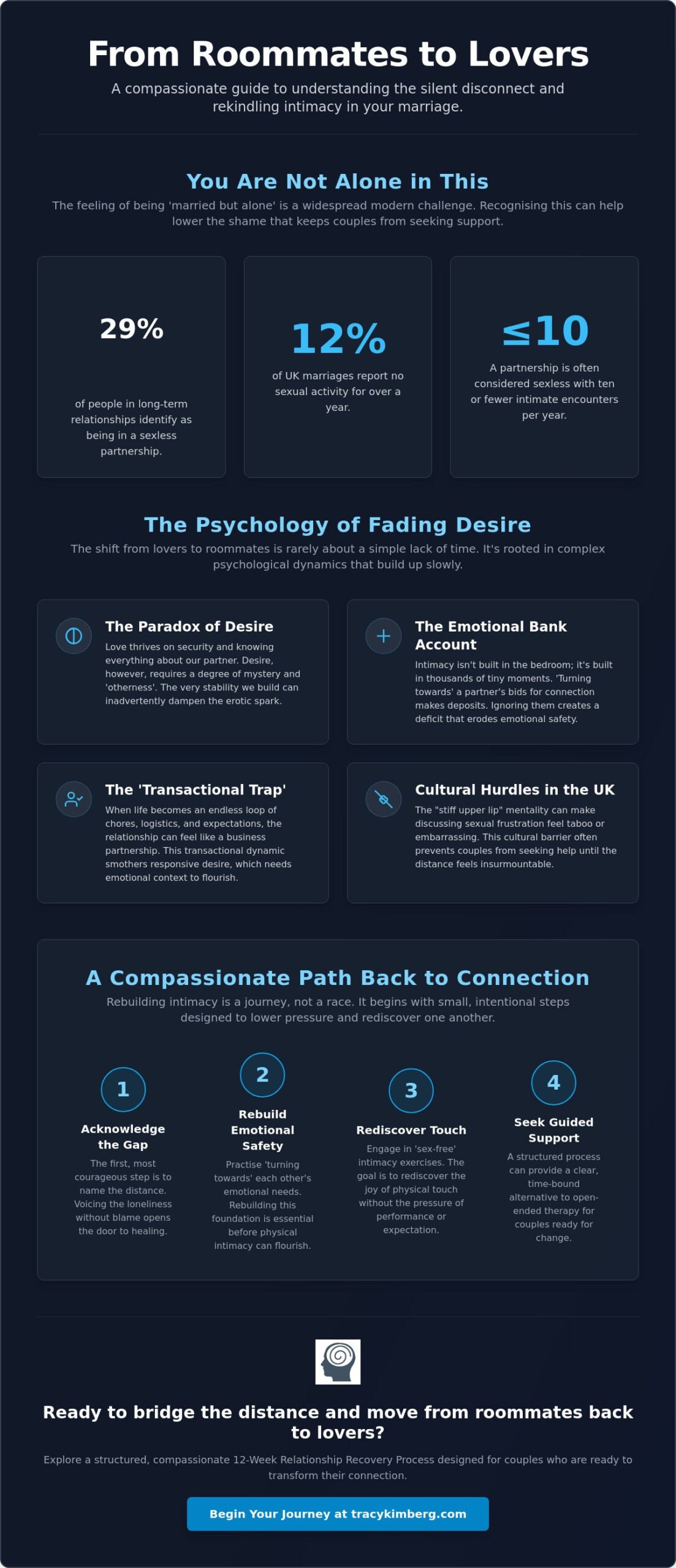
Regarding the definition of this experience, many researchers use a numerical benchmark. Understanding Sexless Marriage often involves looking at couples who have sex ten times or fewer in a year. However, the emotional gap matters far more than the numerical frequency. If the lack of intimacy is causing you distress or making you feel undesirable, it’s a significant issue regardless of what the calendar says. Seeking help for a sexless marriage UK is a proactive step toward reclaiming the warmth and connection that originally brought you together.
You aren’t alone in this struggle. UK-based research has indicated that approximately 12% of marriages involve no sexual activity for over a year. Wider national surveys amongst British couples suggest that nearly 29% of people in long-term relationships identify as being in a sexless partnership. These figures highlight that whilst it feels like a private failure, it’s a widespread modern challenge amongst couples navigating the unique stresses of life in 2026. Recognising that your experience is shared by many can help lower the shame that often prevents couples from seeking support.
Is a Sexless Marriage Sustainable?
Living in a state of long-term celibacy can take a significant toll on your mental health. It often erodes self-esteem, leading to a cycle of rejection and withdrawal where one partner feels inadequate and the other feels pressured. Over time, the lack of intimacy can breed a deep, simmering resentment that poisons other areas of the relationship, from how you parent to how you communicate about finances. The “tipping point” usually occurs when you stop trying to connect altogether, choosing the safety of silence over the risk of another rejected advance. This is when the relationship enters a danger zone where the bond itself begins to fracture.
The UK Context: Why We Struggle to Talk About It
In the UK, we often grapple with a cultural “stiff upper lip” mentality that makes discussing sexual frustration feel taboo or embarrassing. Whilst the NHS provides essential care, its support for relational and sexual health is often limited by long waiting lists and a focus on purely clinical or physiological issues. This is why many couples find that private relationship coaching offers a more discreet, specialised, and tailored environment. It provides a safe space to dismantle these cultural barriers and find genuine help for a sexless marriage UK without the clinical coldness of traditional medical settings, allowing for a more human and holistic approach to healing.
Physical health is often intertwined with emotional resilience; for those needing support with physical recovery or pain management, RED Physiotherapy offers expert rehabilitation services to help restore your body’s strength and vitality.
The Psychology of the ‘Roommate Phase’: Why Intimacy Fades
Many couples assume that a lack of sex is simply a symptom of a busy life or physical exhaustion. Whilst these factors play a role, the psychological architecture of a “roommate phase” is far more complex. As Esther Perel famously suggests, love enjoys knowing everything about a partner, but desire requires mystery and “otherness.” When we become too secure and too predictable, we inadvertently smother the erotic spark. Seeking help for a sexless marriage UK often starts with acknowledging this paradox: the very stability we work so hard to build can become the cage that traps our desire.
John Gottman’s research into the “Sound Relationship House” emphasises that intimacy isn’t built in the bedroom; it’s built in the kitchen and the hallway. Every time you “turn towards” a partner’s small bid for attention, you’re making a deposit in the emotional bank account. Conversely, ignoring these bids creates a deficit. When there is a lack of emotional safety, the body often reacts by shutting down. You might find yourself researching the physiological causes of low libido, only to find that the root cause is actually a “pursuer-distancer” dynamic. One partner pushes for closeness, causing the other to retreat, which in turn fuels more pushing and more retreating.
Gabor Maté reminds us that stress and past trauma also dictate our capacity for pleasure. If your nervous system is stuck in “fight or flight” due to work pressure or unresolved conflict, your body will prioritise survival over sex. This is why “just doing it” rarely works. If you feel like you are overcoming contempt in a relationship, you know that physical touch feels impossible when the air is thick with criticism or stonewalling.
The Conflict Between Safety and Adventure
Predictability is the bedrock of a stable home, but it is the poison of the bedroom. To maintain a spark, we must learn the “erotic intelligence” of reintroducing mystery. This means seeing your partner not just as a co-parent or housemate, but as an individual with a life and thoughts separate from your own. Finding professional help for a sexless marriage UK can assist you in rediscovering this necessary distance, allowing desire the space it needs to breathe again.
Emotional Safety as a Prerequisite for Physicality
True physicality requires vulnerability. If Gottman’s “Four Horsemen”, contempt, criticism, defensiveness, and stonewalling, are present, that vulnerability feels dangerous. Before we can address the physical disconnect, we must first repair the emotional foundation. If you feel stuck in this cycle, exploring Relationship Counselling and Coaching for Couples can provide the tools to navigate these complex emotional landscapes safely and reclaim the connection you both deserve.
Moving Beyond the Blame Game: Chores, Kids, and the Myth of Spontaneous Desire
When intimacy stalls, couples often fall into a transactional trap. You might think, “If I do more of the washing up or take the kids out for the afternoon, my partner will finally want to be intimate with me.” This type of bargaining rarely works because it turns sex into a reward for good behaviour rather than an expression of connection. It strips away the playfulness and replaces it with a sense of obligation. If you are looking for help for a sexless marriage UK, the first step is to stop treating your bedroom like a ledger of accounts.
For many, especially UK mums, the primary libido-killer isn’t a lack of love; it’s the “invisible load.” This is the relentless mental exhaustion of organising school schedules, managing the household, and anticipating everyone’s needs. When your brain is constantly “on,” it’s nearly impossible to switch into an erotic headspace. This often leads to the most common objection: “My partner just isn’t interested anymore.” In reality, they are often just overstimulated and under-supported in ways that dimmed lights and rose petals cannot fix.
Breaking the Pursuit-Withdrawal Cycle
This dynamic is a painful dance where one partner pursues and the other retreats. The “pursuer” feels a deep sense of rejection and tries harder to secure intimacy, which the “distancer” experiences as intense pressure. This pressure causes the distancer to shut down further to protect their autonomy. To break this cycle, you must neutralise the tension. This involves removing the immediate demand for sex, which allows the “distancer” to feel safe enough to move back towards you without the fear of being “trapped” into an encounter they aren’t ready for.
Understanding Responsive Desire
We are often raised on the myth of spontaneous desire; the idea that we should just “feel like it” out of the blue. However, many people, particularly in long-term relationships, experience responsive desire. This means the desire doesn’t show up until after the physical or emotional connection has already started. You can Rediscover Your Desire by focusing on the context that allows it to bloom. It’s about identifying your “brakes” (stress, body image issues, or resentment) and your “accelerators” (feeling seen, laughter, or gentle non-sexual touch). When you understand that desire is something you cultivate together rather than something that just happens, you find the real help for a sexless marriage UK that leads to lasting change.
How to Fix a Sexless Marriage: A Compassionate Path Forward
Reclaiming intimacy isn’t about a single grand gesture or a sudden burst of passion. It’s about a series of small, intentional shifts in how you see and treat one another. If you’ve been seeking help for a sexless marriage UK, you likely know that the hardest part is simply starting the conversation without it ending in tears or a door slamming. The goal is to move the dialogue away from “what is wrong with us” and toward “how can we feel close again.”
One of the most effective ways to lower the tension is through a “Sex-Free” Intimacy Exercise. This involves spending time together with physical contact, such as holding hands or a gentle massage, with the explicit agreement that it will not lead to sex. By removing the pressure of performance, you allow your nervous systems to relax. This creates a safe space where touch can once again become a source of comfort rather than a source of anxiety or a demand for something more.
Communication Under the Surface
When we argue about the lack of sex, we aren’t usually arguing about the physical act. We are often expressing a deep-seated fear of being unwanted or invisible. Identifying how to fix communication in a relationship involves looking at the subtext of these arguments. Using “I” statements, like “I feel lonely when we don’t touch,” rather than “You never want me,” prevents your partner from becoming defensive and opens the door for genuine empathy.
Small Steps to Physical Reconnection
You don’t need to jump back into the bedroom immediately to find help for a sexless marriage UK. Instead, focus on “micro-moments” of connection throughout your day. John Gottman suggests the power of a “6-second hug,” which is long enough to trigger the release of oxytocin, the bonding hormone. These small acts of non-sexual affection, a kiss hello, a hand on a shoulder whilst making tea, or a lingering look, rebuild the emotional bridge that eventually leads back to physical intimacy.
Sometimes, the drift has been so long and so quiet that you may find yourself wondering, Can your relationship be saved? Acknowledging this question isn’t a sign of failure; it’s an honest assessment of where you are. If you’re ready to stop the drift and begin the journey back to one another, our Relationship Counselling and Coaching for Couples provides a structured, supportive environment to help you rediscover the joy of your partnership.
Seeking Professional Help: The 12-Week Relationship Recovery Process
There often comes a point where books, podcasts, and late-night heart-to-hearts simply aren’t enough to bridge the chasm. When the patterns of withdrawal and rejection have become deeply entrenched, you need more than just advice; you need a map. Seeking professional help for a sexless marriage UK provides that map. It offers a neutral, expert space to dismantle the walls you’ve built to protect yourselves. To ensure you are engaging with specialists who meet the highest professional standards, you can visit Active Health Group to explore their accredited training programmes for health and therapy practitioners. Whilst traditional therapy can sometimes feel like an open-ended journey without a destination, a structured approach provides the clarity and momentum necessary for real change.
My 12-Week Relationship Recovery Process is designed to move you from a state of crisis to a place of renewed connection. It doesn’t just look at the symptoms; it addresses the underlying emotional architecture of your partnership. We draw on the research-based brilliance of the Gottman Method and the erotic insights of Esther Perel to ensure your progress is grounded in both science and soul. This isn’t about “fixing” one person; it’s about healing the space between you.
The 12-Week Relationship Recovery Framework
The journey is organised into three distinct, purposeful phases:
- Phase 1: De-escalation. We identify the specific cycle of disconnect that keeps you stuck. By understanding how you trigger one another, we can stop the “pursuer-distancer” dance and lower the emotional temperature in the home.
- Phase 2: Rebuilding the Foundation. We work on your “Love Maps.” This involves rediscovering who your partner is today, beyond their role as a co-parent or housemate, and fostering a culture of appreciation.
- Phase 3: Reintegrating Intimacy. Once the emotional safety is restored, we focus on physical reconnection. We future-proof the bond by giving you the tools to navigate desire and conflict long after our sessions end.
Why This Approach is Different
I believe that transformation requires both insight and action. Sometimes, the path to a better marriage starts with the individual. Exploring individual relationship counselling can be a powerful way to understand your own attachment style and how it influences your sexual connection. By working on yourself, you bring a more regulated and open version of yourself back to the couple’s work.
This process is available through online therapy or face-to-face sessions in the UK, ensuring you can access help for a sexless marriage UK in a way that fits your life. If you want to see how this structure has transformed other couples, you can read this 12-week relationship recovery case study. It’s time to stop the drift and start the adventure of rediscovering one another. I am here to guide you through this process with compassion, expertise, and a firm belief in your capacity to heal.
Rediscover the Spark and Reclaim Your Partnership
The silence in your bedroom doesn’t have to be the final chapter of your story. We’ve explored how the drift into a “roommate phase” is often a protective response to stress or emotional disconnect rather than a lack of love. By understanding the nuances of responsive desire and prioritising emotional safety, you can begin to dismantle the walls between you. Finding genuine help for a sexless marriage UK is about more than just physical tips; it’s about a deep, psychological realignment that honours both your needs and your shared history.
As a specialist in the Gottman Method and Systemic Therapy, I provide a safe, non-judgemental environment where you can explore these complexities without fear. My 12-Week Relationship Recovery Process offers the structure and clinical expertise needed to move from distance back to desire. You don’t have to navigate this landscape alone. I invite you to Book a Discovery Call to explore the 12-Week Relationship Recovery Process and see how we can transform your connection together. Healing is possible, and your journey back to one another can start today.
Frequently Asked Questions
How is a sexless marriage defined in the UK?
In a clinical and research context, a sexless marriage is typically defined as a partnership where the couple has sex ten times or fewer in a year. However, in the UK, the definition is often more about the emotional impact than the specific number. If the lack of physical intimacy is causing one or both partners to feel a sense of rejection, loneliness, or distress, it’s considered a sexless dynamic regardless of the calendar frequency.
Can a sexless marriage survive without professional help?
It is possible for a sexless marriage to survive, as statistics suggest only about 10% of these relationships end in divorce within a five-year period. However, there is a significant difference between surviving and thriving. Without seeking help for a sexless marriage UK, many couples remain in a state of “stable misery,” where the bond is held together by logistics and routine whilst the emotional heart of the relationship continues to wither.
Is it normal for sex to stop after having children?
It is extremely common for sexual intimacy to decline after children arrive due to the “invisible load” of parenting and sheer physical exhaustion. Whilst this is a normal transition phase, it becomes problematic if the “roommate phase” becomes the permanent status quo. The shift from lovers to co-parents requires intentional effort to ensure the romantic bond isn’t completely eclipsed by the demands of the household.
What if my partner refuses to discuss our sexless marriage?
When a partner refuses to engage, it’s usually because the topic triggers intense shame, guilt, or a fear of being “not enough.” Instead of pushing for a direct conversation about sex, try talking about your desire for more emotional connection or shared fun. If the stalemate persists, a professional relationship coach can help create a safer, non-judgmental environment where these difficult topics can be explored without triggering the usual defensiveness.
Can a sexless marriage be a sign of infidelity?
Whilst a sudden withdrawal can sometimes be a red flag, a lack of intimacy is far more likely to be a sign of internal relationship issues like unresolved resentment, stress, or mismatched desire styles. Infidelity is rarely the primary cause of a sexless marriage; usually, the lack of sex is a symptom of an emotional drift that has been happening for quite some time before any outside parties are involved.
How do I bring up the topic of a sexless marriage without causing an argument?
Timing and phrasing are everything when addressing this delicate subject. Avoid bringing it up in the bedroom or when you are both tired and stressed from work. Instead, choose a neutral time and use “I” statements to express your own feelings, such as “I miss the closeness we used to have,” rather than accusing your partner of a lack of interest. This helps keep the conversation focused on connection rather than blame.
Does individual therapy help with a sexless marriage?
Individual therapy can be a powerful tool as it allows you to explore your own attachment style, body image concerns, or past traumas that might be acting as “brakes” on your desire. By understanding your own psychological landscape, you can show up more authentically in the relationship. Working on yourself often shifts the entire dynamic of the partnership, making it easier to find help for a sexless marriage UK together.
What is the difference between a sexless marriage and a companionate marriage?
The core difference lies in mutual agreement and satisfaction. A companionate marriage is often a conscious, shared choice where both partners are content to prioritise deep friendship and domestic stability over sexual intimacy. A sexless marriage, however, typically involves one or both partners feeling a painful lack of connection, often accompanied by feelings of being undesirable, lonely, or “stuck” in a roommate dynamic they didn’t choose.

Article by
Tracy Kimberg
Tracy Kimberg is a Relationship Expert, Couples Therapist and Coach with a dedicated focus on helping couples and individuals rebuild connection, trust and emotional safety in their relationships. Drawing on the research of John and Julie Gottman, the relational insights of Esther Perel, and years of hands-on therapeutic experience, Tracy offers a warm, non-judgemental and deeply compassionate approach to modern relationships.Based in Dorset, Tracy works with couples navigating communication breakdowns, betrayal, intimacy challenges, separation, family dynamics and life transitions. Known for creating a safe and grounded therapeutic space, she combines practical tools with emotional depth to help clients move beyond survival patterns and towards meaningful, lasting change.With a reputation for empathy, professionalism and dedication to her clients’ growth, Tracy is passionate about helping people feel seen, understood and empowered — both within their relationships and within themselves.
Disclaimer
Disclaimer:The information shared in this article is intended for educational and informational purposes only and should not be considered a substitute for professional therapeutic, psychological, medical or legal advice. Every individual and relationship is unique, and the perspectives offered are based on general therapeutic principles, research and professional experience.Reading this article does not establish a therapist-client relationship with Tracy Kimberg. If you are experiencing significant emotional distress, relationship crisis, trauma, or mental health concerns, it is important to seek support from a qualified professional appropriate to your individual circumstances.All content remains the intellectual property of Tracy Kimberg and may not be reproduced or distributed without permission.